
Reports from the Riksdag 2025/26:RFR8
The Committee on Finance
Riksbank Evaluation,
Morten O. Ravn, Carolyn A. Wilkins
Riksbank Evaluation,
Morten O. Ravn*, Carolyn A. Wilkins†
12 January, 2026
*m.ravn@ucl.ac.uk, University College London
†carolyn.wilkins@princeton.edu, Princeton University
ISSN
ISBN
ISBN
Tryck: Riksdagstryckeriet, Stockholm 2026
2025/26:RFR8
Table of Contents
3
4
5
2025/26:RFR8
Foreword
Within the framework of the Riksdag’s mandate to exercise oversight and scrutiny of the Riksbank, the Committee on Finance regularly commissions external evaluations of the monetary policy. To date, four such evaluations have been completed. The most recent evaluation, covering the period 2015– 2020, was conducted by Patrick Honohan, former Governor of the Central Bank of Ireland, and Professor Karnit Flug, former Governor of the Bank of Israel. Earlier evaluations of Swedish monetary policy for various periods commissioned by the Committee on Finance have been carried out by the former Governor of the Bank of England, Mervyn King, as well as by Professors Marvin Goodfriend, Frederic Mishkin, Francesco Giavazzi, Charles Goodhart and
In June 2024, the Committee on Finance decided to appoint Carolyn Wilkins and Morten Ravn to conduct an external evaluation of Swedish monetary policy over the period
The focus of the assignment was to assess whether the monetary policy stance during the period under review was appropriately calibrated in relation to the Riksbank’s mandate and examine the implications for macroeconomic outcomes and financial conditions in Sweden. In addition, the evaluators were to examine and analyse, inter alia, the Riksbank’s communication regarding monetary policy decisions during the period, the significance of the exchange rate for the implementation of monetary policy and the effects associated with a
The evaluators commenced their work at the end of 2024 and, over the course of the past year, carried out several
The findings of the evaluation are presented in the present report of the Riksdag. The Committee on Finance considers that the report may provide a
6
FOREWORD2025/26:RFR8
basis for informed public debate on monetary policy and the institutional role of the Riksbank and constitute a relevant contribution to the formulation of future monetary policy. The authors are responsible for the content and conclusions of the report.
The Committee on Finance will circulate the evaluation for comments to relevant authorities, universities and organisations. Furthermore, the Committee will hold a public hearing involving the evaluators and the Executive Board of the Riksbank. During the spring, the Committee on Finance will examine the evaluation in Report 2025/26:FiU27, with a decision scheduled for June 2026.
Stockholm, 13 January 2026
| Edward Riedl | Mikael Damberg |
| Chair of the Committee on Finance | Vice Chair of the Committee |
| on Finance |
7
2025/26:RFR8
Executive Summary
This independent evaluation of the Sveriges Riksbank was commissioned by the Finance Committee of the Riksdag. Covering
Our assessment draws on three complementary analytical approaches. First, we adopt a historical perspective, recognising that Sweden’s macroeconomic framework, shaped by reforms implemented after the early 1990s crisis, continues to influence today’s policy choices. Second, we ground our evaluation in economic theory, empirical evidence, and comparative experience, drawing on lessons from peer central banks. Third, we incorporate qualitative insights from extensive interviews with
Throughout the evaluation period, the central question is whether the Riksbank achieved its objectives while maintaining credibility, managing risks, and coordinating effectively with other institutions. Sweden entered the period with a strong institutional foundation. This included an established inflationtargeting regime, stringent fiscal rules, a separate macroprudential authority at the Finansinspektionen (the FSA), and a National Debt Office (NDO) responsible for debt management and
Overall, we find that the Riksbank acted with determination in exceptionally challenging circumstances, and many decisions were reasonable given the information available. With the benefit of hindsight, some weaknesses and areas of underdevelopment are now evident: the scale and composition of QE; limitations in risk assessments, including implications for the balance sheet and capital needs; forecasting weaknesses; and gaps in the relationship between monetary policy, fiscal policy, and
8
| EXECUTIVE SUMMARY | 2025/26:RFR8 |
Assessment of Monetary Policy: Unconventional Tools and Their Consequences
When the evaluation period began, Sweden faced persistent inflation undershooting, drifting expectations, and an appreciating krona. Earlier monetary policy decisions had placed relatively greater weight on
These measures contributed to the return of CPIF inflation toward target by
That said, the Riksbank did not have a sufficiently developed framework for assessing the evolving risks of unconventional policies.
The
The pandemic demanded rapid and forceful action. The Riksbank successfully deployed a broad set of tools. These included
9
| 2025/26:RFR8 | EXECUTIVE SUMMARY |
even in tranquil times. As the acute phase passed, however, QE evolved from
a
The Inflation Surge and Policy Tightening
Inflation in Sweden rose sharply from
The tightening was broadly aligned with international peers.
While Sweden’s
Assessment of Forecasting and Analytical Capacity
A
These forecast errors reveal limitations across the Riksbank’s modelling tools. Nowcasting models, which normally provide reliable
10
| EXECUTIVE SUMMARY | 2025/26:RFR8 |
with the forecasts can be traced to the roots of the inflation surge, the size of the shocks, the importance of new inflation channels, and to some instability of assumed structural relationships.
Scenario analysis, while a strength of the Riksbank relative to many peers, was not used to its full potential during this period. Alternative scenarios did not sufficiently explore adverse or
The experience highlights the need for continued investments in highfrequency data and nowcasting tools, investment in MAJA and other policy models, and a more systematic integration of scenario and risk analysis into Executive Board deliberations. The Riksbank’s overall analytical capacity is strong; the priority now is to adapt its tools to an environment in which large shocks and structural breaks may be more common.
Sweden’s
However, it has also constrained the macroeconomic tools available when inflation persistently undershot target and when the policy rate reached the zero lower bound (ZLB). In that environment, and without meaningful fiscal expansion, the Riksbank effectively faced a choice between deploying unconventional monetary policy with unknown effects and potential risks, or tolerating a prolonged deviation of inflation from its target. Unconventional tools, such as negative interest rates and
11
| 2025/26:RFR8 | EXECUTIVE SUMMARY |
| Two alternative strategies could, in principle, have reduced the burden on | |
| the Riksbank and produced a more balanced policy mix. One option would | |
| have been a joint monetary and fiscal expansion, which might have supported | |
| demand more effectively at the ELB. However, there would have been con- | |
| cerns about the integrity of the fiscal framework, which weighed against such | |
| an approach. A second option would have combined QE with a shortening of | |
| the government debt maturity profile, shifting part of the |
|
| ward the fiscal authority rather than concentrating it at the Riksbank. Instead, | |
| the National Debt Office continued to issue |
|
| which the Riksbank purchased, increasing the maturity mismatch and ampli- | |
| fying |
|
| We do not take a definitive position on whether any of these options would | |
| have been preferable, but the experience of the last decade highlights the value | |
| of strengthened |
|
| joint strategies, and clearer communication about how chosen policies allocate | |
| understand how fiscal, |
|
| teract with monetary policy within Sweden’s institutional framework. |
Sweden’s
Sweden’s floating exchange rate regime choice, introduced in the early 1990s, was shaped by the country’s earlier experience with
International experience shows that
12
| EXECUTIVE SUMMARY | 2025/26:RFR8 |
Before 2022, reserves were partially funded through
Taken together, the behaviour of the krona, Sweden’s deep integration with the euro area, and the evolving risk profile of the
Recommendations
The decade under review challenged central banks globally. The Riksbank met these challenges with professionalism, transparency, and a willingness to engage with complex
Nonetheless, the evaluation identifies areas where targeted reforms would enhance the resilience and clarity of the framework. These recommendations focus on: improving the governance of unconventional tools and
13
| 2025/26:RFR8 | EXECUTIVE SUMMARY |
Table 1 Recommendations
AreaRecommendations
1. Framework for Mone- 1.1 Establish a structured framework for assessing the net bene-
tary Policy Tools fits of unconventional tools, differentiating clearly between asset purchases related to
1.2Set predefined principles for exit strategies for unconventional tools.
1.3Improve communication and transparency regarding the expected benefits, risks and contingencies of unconventional tools, respecting the accountability provisions in the new Riksbank Act.
2.
| licy Interactions | authorities, particularly in the case of deep downturns, while re- |
| specting institutional independence. |
2.2Consider the alignment of the
2.3Review implementation of the Riksbank’s equity framework.
3.Forecasting, Modelling, 3.1 Invest in further improvements in main forecasting model,
| and Risk Assessment | MAJA. | |
| 3.2 | Further develop |
|
| 3.3 | Instutionalise scenario analyses in decision processes. | |
| 3.4 Formalise the participation of the Head of Research in | ||
| monetary policy deliberations (without voting rights). | ||
| 4. Financial Stability | 4.1 Support swift action by the Riksbank in times of crises, | |
| Framework | while respecting new consultation rules. | |
| 4.2 | Reduce fragmentation and establish stronger coordination | |
| mechanisms for macroprudential policies. | ||
| 4.3 | Publish regular joint systemic risk assessments. | |
| 5. Sweden’s External | 5.1 Undertake a systematic review of the Sweden’s exchange- | |
| Policy Framework | rate regime. | |
| 5.2 | Develop, formalise, and publish a quantitative framework for | |
| reserve adequacy. | ||
| 5.3 | Clarify institutional responsibilities for reserve financing and | |
| hedging. | ||
| 5.4 | Commission an independent external review of the reserve | |
| framework. | ||
14
| EXECUTIVE SUMMARY | 2025/26:RFR8 |
Final reflections
One of Sweden’s enduring strengths is the commitment to regular external evaluations of monetary policy. Throughout this review, we found a mature, open, and constructive process, marked by transparency and a willingness to learn. This culture is a key reason why the Riksbank commands respect internationally. With the targeted reforms recommended here, Sweden is well positioned to navigate an increasingly complex global environment, while maintaining the stability and credibility that have long underpinned its economic success.
It has been a privilege and an honour to contribute to the evaluation of the Riksbank, and we thank the Finance Committee of the Riksdag for their trust.
| Morten O. Ravn | Carolyn A. Wilkins |
15
2025/26:RFR8
1Introduction
This is the fifth evaluation of Swedish monetary policy commissioned by the Finance Committee of the Riksdag. This evaluation covers the decade from 2015 to 2024 and addresses the full set of issues outlined in the terms of reference for Sweden’s review of monetary policy (see Annex 1 for the mandate). The work on the report started in November 2024 and was completed at the end of 2025 when it was submitted to the Riksdag for translation.
We are grateful to Committee on Finance, and to Thomas Hagberg in particular, for their assistance in the process of completing the review. We are especially indebted to Marianne Nessén for her expert support throughout the process. She provided essential insight, data, and references, and efficiently organised our consultations. Her contributions were essential to the completion of this evaluation.
We are also grateful to everyone we have interviewed during the process of producing this report. To inform this review, we conducted 29 interviews with 43 individuals, including market participants, academics, current and former Riksbank
During the first half of the period
Just as inflation was returning to target and policy rates were beginning to normalise, the
16
| 1 INTRODUCTION | 2025/26:RFR8 |
disruptions to global supply chains, and the economic consequences of Russia’s illegal invasion of Ukraine in 2022.
Although inflation is now near target and the krona has shown some signs of strength, questions have resurfaced about the effectiveness and risks of extraordinary monetary policy tools, including in relation to fiscal policy. Additional concerns have emerged regarding whether the Riksbank’s own monetary and foreign exchange reserve policies contributed to past krona weakness.
Our recommendations aim to enhance the Riksbank’s ability to navigate future challenges by strengthening its technocratic legitimacy, transparency, and accountability in the following areas: monetary policy tools, forecasting,
The remainder of the review is organised as follows. Section 2 sets the stage with a brief institutional history of the Riksbank, highlighting its relationship with the Government and key cultural features relevant to monetary policy
17
2025/26:RFR8
2 The Institutional Framework
Sweden’s macroeconomic framework is characterised by a
We begin with a sketch of Sweden’s current institutional framework, then outline the historical developments that shaped it. This provides context for evaluating the Riksbank’s performance, and for considering our recommendations.
2.1Sweden’s Current Macroeconomic Framework
2.1.1 Monetary Policy and the Role of the Riksbank
Monetary policy in Sweden is conducted by Sveriges Riksbank. The Riksbank is an authority of the Swedish Parliament, and its obligations are guaranteed by the Swedish State. Its activities, organisational framework, and capital provisions are governed by The Sveriges Riksbank Act (SFS 2022:1568). This Act was passed by the Swedish Parliament in November 2022, replacing the 1999 Riksbank Act, which had formalised the operational independence of the Riksbank and formally established price stability as its primary mandate.
The Riksbank is in charge of the Swedish payments system, and it is the sole supplier of Swedish kronor.1 The Riksbank is a member of the European System of Central Banks and a shareholder of the European Central Bank.2
The principal objective of the Riksbank is to “maintain permanently low and stable inflation.” Without jeopardising that goal, it is also tasked with contributing “to a balanced development of production and employment,” and “to the stability and efficiency of the financial system, including the ability of the public to make payments.” With these objectives, the updated Act defines the Riksbank’s mandate in place since January 2023 as flexible inflation targeting
1The Riksbank currently operates and oversees Sweden’s central payments infrastructure through the RIX system. In June 2024, it agreed to enter into contract negotiations with the European Central Bank to migrate RIX to the T2 platform for
2As Sweden is a member of the European Union, the Riksbank is part of the European System of Central Banks and a shareholder of the European Central Bank, in accordance with the Treaty on the Functioning of the European Union.
18
| 2 THE INSTITUTIONAL FRAMEWORK | 2025/26:RFR8 |
in which economic and financial stability take secondary roles relative to the inflation target. The 1999 Riksbank Act that guided the Riksbank until the end of 2022 was more narrowly focused on strict inflation targeting. In practice, however, the update of the mandate of the Riksbank primarily formalises how the mandate was conceived under the 1999 Act. Inflation targeting is operated within a floating exchange rate as set out in the Exchange Rate Policy Act (1998:1404).
The Riksbank is tasked with operationalizing the definition of “low and stable inflation,” subject to parliamentary approval. The specification of the inflation target has changed during the period considered in this report. Until September 2017, the Riksbank targeted a 2 percent annual consumer price index (CPI) inflation rate. In September 2017, the target was redefined as 2 percent
Governance with regard to monetary policy decisions reinforces the operational independence of the Riksbank. Monetary policy decisions are taken exclusively by the Riksbank Executive Board, with reference to its mandate and without introducing unreasonable risks to its finances. The Executive Board has five members who are appointed by the General Council of the Riksbank for a period of five or six years. Executive Board members cannot be fired (unless they have taken part in illegal activities), which is an important aspect of the independence of the Riksbank. The Governor, currently Erik Thedéen, chairs the Board. The Board also includes four Deputy Governors, currently Per Jansson, Aino Bunge, and Anna Seim. Until 10 October 2025, it also included Anna Breman. She has since left the Executive Board to take up a position as Governor of the Reserve Bank of New Zealand. Her replacement was not yet known at the time of writing this report. The Board has eight scheduled monetary policy meetings per year, as well as biweekly Executive Board meetings in between these monetary policy meetings. As discussed in
3When the Riksbank increases the policy rate in an attempt to reduce overall inflation in the economy, the CPI may display a
19
| 2025/26:RFR8 | 2 THE INSTITUTIONAL FRAMEWORK |
| Section 5, monetary policy decisions are communicated with a high degree of | |
| transparency. |
2.1.2 Financial Stability and the Role of the FSA
Although financial stability is a secondary mandate of the Riksbank, financial sector regulation and supervision is under the independent authority of Finansinspektionen, the FSA. The FSA is an authority of the Swedish Government that has responsibility for the soundness of individual financial institutions, and for the financial system as a whole. It issues “Föreskrifter och allmänna råd från Finansinspektionen” (FFFS), which are regulations and general guidelines, and recommends amendments to financial sector legislation. Im- portantly from a financial stability perspective, the FSA is responsible for macroprudential measures such as the
The FSA is headed by a Board of Directors that consists of eight members. The Head of the FSA is government appointed – and can be replaced – by the Government thus implying less institutional independence relative to the Riksbank. There is no contemporaneous overlap in the FSA and Riksbank Board membership, but Martin Flodén, former Executive Board Member and Deputy Governor of the Riksbank
Despite the delegation of financial sector regulation to the FSA, the Riksbank’s role in financial stability extends well beyond its responsibilities for the payments system. It has a long history of responding to severe financial sector disruptions, consistent with the traditional role of central banks as lenders and market makers of last resort. The Riksbank has supported financial stability through actions such as extending collateralised credit, entering into swap agreements with financial institutions, implementing liquidity support measures, and purchasing or selling financial assets. Since the new Riksbank Act came into force in January 2023, the Riksbank has had less operational independence in using these tools for financial stability purposes than before, and less than when using them for monetary policy purposes. Under the new framework, the Riksbank is required to consult with the FSA and the Swedish National Debt Office before proceeding, unless immediate action is necessary.
2.1.3 Fiscal Policy, the Government and the Riksdag
Fiscal policy is the domain of the Swedish Government, although its budget is subject to approval of the Riksdag. Sweden operates fiscal policy subject to a
4 See Rangvid (2024), and Muellbauer and
20
| 2 THE INSTITUTIONAL FRAMEWORK | 2025/26:RFR8 |
including a net lending target, which currently corresponds to a surplus of onethird of a percent of GDP over the business cycle.5 The debt anchor provides a benchmark for consolidated
On the spending side, the Act stipulates that the Government must propose an expenditure ceiling for central government spending (including
External monitoring of adherence to the targets and other metrics of fiscal performance is carried out by the Swedish Fiscal Policy Council, the Swedish National Financial Management Authority, and the National Institute of Economic Research.
2.1.4 The National Debt Office
A fourth institution that matters in the macroeconomic framework is the Na- tional Debt Office, a government institution established in 1789. The principal objective of the National Debt Office is to minimise the costs of the central government’s financial management. It is governed by a Board of nine members, two staff representatives, and an audit committee. The Head of the National Debt Office is appointed by the Swedish Government and can be replaced by the Government, similar to the FSA. No individuals serve concurrently on the boards of the National Debt Office, the Riksbank’s Executive Board, or the FSA.6
The National Debt Office has a notably broad mandate. It provides banking services for the central government, manages existing government debt and raises new loans, provides state guarantees and loans, is responsible for deposit insurance and investor protection schemes, and manages government support for banks. It even secures financing for nuclear waste management.
This portfolio includes a mix of responsibilities that are, in some other countries, shared between the central bank and the treasury. In the US, for example, the Federal Reserve provides banking services for the central government, and the government “current account” is an important component of the Fed’s balance sheet. The US Treasury takes care of debt management. The
5
6Riksbank Executive Board Members currently have restrictions on outside engagements that may conflict with their responsibilities.
21
| 2025/26:RFR8 | 2 THE INSTITUTIONAL FRAMEWORK |
| latter, as we will discuss later, is important as far as the Riksbank use of quan- | |
| titative easing is concerned. Moreover, the National Debt Office’s role in bank | |
| support, deposit insurance, and certain |
|
| the |
2.1.5 Other Aspects of Sweden’s Macroeconomic Reality
The institutions discussed above are the pillars of Sweden’s macroeconomic policy framework. There are other aspects of Sweden’s economic landscape that are important for understanding the backdrop against which the Riksbank must deliver a stable monetary environment.
First, wage setting in Sweden has since the Industry Agreement in 1997 been characterised by
This institutional arrangement plays a central role in mitigating the risk of
Secondly, Sweden is deeply integrated in the world economy through trade in goods, services and financial assets. A standard measure of trade openness, the sum of the value of Sweden’s exports of goods and services and its imports relative to its GDP, exceeds 100 percent. Sweden imports not only goods for consumption from other countries, but also materials, technology and capital goods that are essential for the productivity of the Swedish economy. Swedish companies participate in global supply chains and rely heavily on foreign markets to sell their goods. On the financial side, Sweden has claims on foreign entities, and foreign investors hold many claims on Sweden. The gross asset and liability positions exceed 300 percent of annual GDP and, on the net, Sweden holds financial claims on the rest of the world corresponding to around 40 percent of GDP.
7 The
22
| 2 THE INSTITUTIONAL FRAMEWORK | 2025/26:RFR8 |
Such a
2.2 Summing Up: The Current Framework
In summary, Sweden’s macroeconomic framework rests on three main pillars:
i)an independent central bank operating a flexible inflation target under a floating exchange rate regime; ii) an autonomous financial sector regulator undertaking micro and
2.3 Historical Background
The Riksbank was founded in 1656 and formally established as a governmentowned entity in 1668, making it the oldest central bank in the world.8 It was originally established to maintain the domestic coinage at its right and fair value, but spent much of its early history being subordinate to the Swedish Parliament, which amounted to implementing government direction to finance
The Riksbank issued bank notes almost from its inception, but in its early history it did so in competition with other banks, with the exception of a short period in the early 19th century. It also competed with commercial banks in the deposit market. Private issuance of bank notes sometimes required direct government support for financial stability reasons. For instance, during the
A regulatory reform of banking regulation in the latter part of the 19th century that effectively removed any implicit public guarantees catalysed growth in the Swedish commercial banking system. In response, the Riksbank’s role was redefined; the Riksbank Act of 1897 gave it monopoly power over the
8The central bank was called “Stockholms Banco” until it failed in 1664, with the Riksdag officially taking over the bank in 1668 and renaming it the Riksens St¨anders Bank. It was renamed the Sveriges Riksbank in 1867.
9For a fulsome historical timeline see
23
| 2025/26:RFR8 | 2 THE INSTITUTIONAL FRAMEWORK |
| issuance of bank notes, and in 1903 it assumed its modern role as Sweden’s | |
| “bank of banks” when commercial banks were given the option of |
|
| bills at the Riksbank. |
2.3.1 From the Gold Standard to Price Level Targeting (1873– 1939)
During much of the 19th century, inflation in Sweden was highly volatile, fluctuating between periods of rapid growth in prices to periods of substantial deflation. This instability was accompanied by highly volatile
Adopting the Gold Standard initially helped Sweden achieve lower and more stable inflation. Mean inflation fell from 1.81 percent in the
In this light, it is understandable that Sweden was among the first countries to return to the gold standard (de facto in 1922, de jure in 1924; see Jonung (1984)) after the end of World War I. The 1920s was a period with generally low, often negative, inflation rates, but the Gold Standard ultimately dissolved during the Great Depression.
24
| 2 THE INSTITUTIONAL FRAMEWORK | 2025/26:RFR8 |
Figure 1: Swedish annual inflation rates, 1873 – 2024
40
30
20
10
0
| 1873 | 1888 | 1903 | 1918 | 1933 | 1948 | 1963 | 1978 | 1993 | 2008 | 2023 | |||
| CPIF | Historical Data | ||||||||||||
Note: Annual change in price index. Historical data
Sources: Historical data from Edvinsson (2005). CPIF from Statistics Sweden.
The Swedish economy suffered significantly from the economic repercussions of the global economic downturn, experiencing substantial reductions in export revenues and large capital outflows. With the Swedish foreign exchange reserves under considerable strain, the krona became the target of speculative attacks when Britain relinquished gold convertibility in September 1931.
This crisis prompted Sweden to float the exchange rate later that month. On the same day that parity was abandoned, the Swedish Government, following consultation with prominent economist Gustav Cassel, announced a commitment to preserve price stability. This led to a landmark decision in 1933, when the Riksdag approved a regime of floating exchange rates combined with price level stabilisation. Sweden thus became the first country to adopt formal pricelevel targeting as a monetary policy framework (Berg and Jonung (1999)). Still, exchange rate volatility became a growing concern: the krona depreciated significantly against both the dollar and the sterling, as well as more broadly. In an attempt to stabilise the economy, Sweden reverted to a pegged exchange rate regime.
25
2025/26:RFR82 THE INSTITUTIONAL FRAMEWORK
Figure 2 Selected exchange rates
| 20 | |||||||||||
| 18 | |||||||||||
| 16 | |||||||||||
| 14 | |||||||||||
| 12 | |||||||||||
| 10 | |||||||||||
| 8 | |||||||||||
| 6 | |||||||||||
| 4 | |||||||||||
| 2 | |||||||||||
| 0 | |||||||||||
| 1913 | 1923 | 1933 | 1943 | 1953 | 1963 | 1973 | 1983 | 1993 | 2003 | 2013 | 2023 |
| Sterling | US Dollar | DEM | Euro | ||||||||
| a) Bilateral krona rates | |||||||||||
| 200 | |||||||||||
| 175 | |||||||||||
| 150 | |||||||||||
| 125 | |||||||||||
| 100 | |||||||||||
| 75 | |||||||||||
| 50 | |||||||||||
| 1913 | 1923 | 1933 | 1943 | 1953 | 1963 | 1973 | 1983 | 1993 | 2003 | 2013 | 2023 |
| Riksbank Broad Index | Nominal Effective Krona | ||||||||||
b) Broad Nominal Krona Indices
Note: The Riksbank broad index (1913 - ) is from Bohlin (2010). The nominal effective krona index is the
Sources: Sveriges Riksbank.
Initially, they followed a unilateral peg to the sterling in 1933 and then, as the sterling’s credibility weakened, to the US dollar in 1939.
2.3.2
As WWII neared its end, the independence of the Riksbank was effectively eliminated by the Swedish Government, which insisted on a low interest rate policy. Although legal provision for this policy had existed already in the 1933
26
| 2 THE INSTITUTIONAL FRAMEWORK | 2025/26:RFR8 |
Act, from 1944 it became a defining feature of Swedish postwar macroeconomic management. The resulting tension between the Government’s aim for low interest rates and the Riksbank’s concern for price stability culminated in the resignation of the Riksbank Governor in 1948. Sweden’s framework at this stage is best characterised as one of “fiscal dominance,” with the Riksbank’s monetary policy objectives effectively subordinate to the Government’s fiscal policy objectives. We will return to the concept of fiscal dominance in Section 7.
Sweden joined the IMF and the
Given the breakdown of the
At the same time, Sweden reluctantly followed the wave of financial deregulation that was taking place across much of the world. Sweden lifted loan caps on commercial banks, allowing them to reduce bond holdings and expand lending. Inflation, however, remained high and government debt had been on a rising trajectory since the late 1960s, although
10This trend was briefly reversed in the
27
| 2025/26:RFR8 | 2 THE INSTITUTIONAL FRAMEWORK |
| again by 10 and 6 percent, respectively, after which followed some calm up to | |
| 1991. | |
| In May 1991, Sweden decided to peg to a basket of currencies of the EMS | |
| (an “ECU” basket). But by 1992, speculative attacks against European curren- | |
| cies that were triggered by disappointing macroeconomic outcomes of the core | |
| of the EEC, including the slow growth of Germany following the reunification, | |
| forced the Riksbank to defend the currency with interest rates as high as 500 | |
| percent. A crisis package passed by the Riksdag temporarily eased market | |
| pressure, but capital outflows persisted. The result was a banking crisis, a deep | |
| recession, accompanied by a collapse in investment and in house prices. On | |
| November 19, 1992, Sweden exited the ECU peg and, once again, allowed the | |
| krona to float. |
2.3.3 Inflation Targeting and Institutional Separation (1993– present)
This history of repeated attempts at operating pegged exchange rate regimes is important for understanding why the crisis gave rise to a rethinking of the Swedish monetary system, and brought some consensus that the many attempts of bringing about monetary stability through exchange rate pegs had failed. Indeed, the crisis of the early 1990s and the transition to a floating exchange rate regime prompted a fundamental reorientation of monetary and fiscal policies, laying the foundations of the Swedish
In 1993 the Riksbank introduced a formal inflation target of 2 percent (originally defined by the annual change in the consumer price index later, and then, in 2017, redefined in terms of the consumer price index with a fixed interest rate, CPIF, inflation rate with a tolerance band of ± 1 percentage point). As mentioned earlier, the Sveriges Riksbank Act passed in 1999 granted the Riksbank formal independence, and an Executive Board was created to oversee monetary policy decisions, aligning the governance structure with international best practices. This Act gave the Riksbank a clear inflation target mandate without explicitly allowing for secondary concerns about the economy. At the same time, Sweden institutionalised a strict separation between monetary and fiscal authorities as a means to minimise the risk of
28
| 2 THE INSTITUTIONAL FRAMEWORK | 2025/26:RFR8 |
Figure 3: CPIF in Sweden and a 2 percent trend
180
170
160
150
140
130
120
110
100
| 1999 | 2001 | 2003 | 2005 | 2007 | 2009 | 2011 | 2013 | 2015 | 2017 | 2019 | 2021 | 2023 | 2025 |
Note: The CPIF index in levels from 1999 vs a 2 percent trend line.
Sources: Statistics Sweden and own calculations.
Since the introduction of an inflation targeting framework with a floating exchange rate, inflation in Sweden has fallen and become less volatile, while the frequency of large changes in the value of kronor has declined, albeit perhaps at the cost of higher
Stabilisation of inflation coincided with a marked downward trend in public sector indebtedness, which fell from approximately 70 percent in the mid- 1990s to around 35 percent by 2023 (see Figure 4). Thus, the restrictive fiscal framework appears to have been successful and allowed Sweden to introduce a 35 percent
11Note that in the
coincidence.
29
| 2025/26:RFR8 | 2 THE INSTITUTIONAL FRAMEWORK |
Figure 4: Public debt to GDP in Sweden
80
70
60
50
40
30
20
10
| 1970 | 1974 | 1978 | 1982 | 1986 | 1990 | 1994 | 1998 | 2002 | 2006 | 2010 | 2014 | 2018 | 2022 |
| Debt to GDP | Target | ||||||||||||
Note: General government consolidated gross debt (the
Sources: European Commission (AMECO) from 1996, earlier period IMF.
2.4 Thinking Ahead
Sweden’s institutional framework has been shaped by historical experience with inflation, exchange rate instability, fiscal imbalances, and financial crises. Since the early 1990s, it has proven highly effective in delivering monetary and fiscal stability. The framework emerged as a response to the economic volatility of the 1970s to the early 1990s. The popular support for this framework has also been robust. A
That backdrop has now changed along several important dimensions:
•Shifting inflation dynamics: The early part of the evaluation period was characterised by global disinflationary pressures, financial deepening, and relative macroeconomic calm. For much of this period, the central challenge for Riksbank and many other central banks was undershooting the inflation target rather than exceeding it. Since the
While a return to zero lower bound on interest rates should not be
12For the full results, see
30
| 2 THE INSTITUTIONAL FRAMEWORK | 2025/26:RFR8 |
discounted,
•Large and uncommon shocks: The
•Structural economic transformation: Sweden’s economy, as many other advanced economies, has seen a rise in services (at the expense of manufacturing), digitisation, and global
•Deeper global and regional integration: Since the fall of the Berlin Wall, Eastern Europe and China have become increasingly integrated into global trade and production networks. Over the same period, Sweden has deepened its economic integration with the EU and, since 1998, established institutional links with the European Central Bank through its participation in the European System of Central Banks (ESCB). This has increased external spillovers from the world economy to Sweden and raised questions about Swedish monetary policy autonomy.
Emerging geopolitical tensions: Rising global fragmentation, security risks, and the weaponisation of economic policy tools (e.g. sanctions, export controls, energy leverage) require greater attention to economic resilience and institutional adaptability.
Taken together, these factors suggest that Sweden’s macroeconomic framework, while fundamentally sound, may require selective adaptation. The principles of clear institutional separation, central bank financial and operational independence, prudent fiscal policy, and accountability continue to be critical. But new circumstances demand that we take a step back to consider adjustments to how these principles are implemented, particularly regarding coordination, policy mix, and accountability in crisis settings.
These are issues that we will return to after having reviewed the Riksbank performance over the last decade.
31
2025/26:RFR8
3 Monetary Policy Actions,
Against the shifting economic backdrop discussed in the previous section, the Riksbank faced a number of challenges just prior to the evaluation period that are essential to understanding the policy context of the
In the immediate aftermath of the Global Financial Crisis, despite a decisive policy rate cut in December 2008 (from 3.75 percent to 2 percent), inflation in Sweden declined significantly and 2009 witnessed seven consecutive months of deflation. In February 2009, the Riksbank reduced the policy rate to 1 percent, in April 2009 0.5 percent, and in July 2009 to 0.25 percent. Despite these actions on the part of the Riksbank, inflation in late 2009 and early 2010 remained low and significantly below its two percent target. This development induced concerns about persistent inflation undershooting (Figure 5). However, like many other
Amid these and other concerns, the Executive Board decided to raise the policy rate from 0.25 percent to 2 percent between
The initial episode of increasing the interest rate in
32
| 3 MONETARY POLICY ACTIONS, |
2025/26:RFR8 |
housing market13 it did not help the Riksbank in its pursuit of the two percent inflation target. There is also evidence that it may have been a contributing factor in preventing unemployment to fall back to its
This context shaped monetary policy over three key
•the
•the Covid response
•the
We will now discuss each of these
3.1 The
The key challenge faced by the Riksbank in this period was to bring inflation back to target after the contractionary policy stance in
At the beginning of 2015, Swedish inflation was below its two percent target and inflation expectations were declining. Faced with this situation, the Riksbank followed the lead of the ECB, which had introduced negative nominal interest rates in June 2014 (see Table 2). In February 2015, the Board unanimously agreed to cut the policy rate to
13Berggren, Mammos, and Strid (2024) find evidence that monetary policy shocks have large effects on the housing market in Sweden.
33
2025/26:RFR83 MONETARY POLICY ACTIONS,
Figure 5: Inflation and the policy rate in Sweden
| 12 | |||||||||||||||
| 1. |
2. Covid | 3. Inflation | |||||||||||||
| 10 | response | response | |||||||||||||
| 8 | |||||||||||||||
| 6 | |||||||||||||||
| 4 | |||||||||||||||
| 2 | |||||||||||||||
| 0 | |||||||||||||||
| 2010 | 2011 | 2012 | 2013 | 2014 | 2015 | 2016 | 2017 | 2018 | 2019 | 2020 | 2021 | 2022 | 2023 | 2024 | 2025 |
| CPIF | Policy rate | CPI | |||||||||||||
Note: Percent. CPIF is the
Sources: Sveriges Riksbank and Statistics Sweden.
These actions were accompanied by QE,
By February 2016, the policy rate reached a low of
34
| 3 MONETARY POLICY ACTIONS, |
2025/26:RFR8 |
Table 2: Summary of Riksbank monetary policy actions in the
| Period | Policy Rate Path | Inflation & Policy Rationale |
| Feb. 2015 | 0.00% → |
Inflation fell below zero. Riksbank cut |
| the policy rate into negative territory for | ||
| first time, initiated QE (SEK 10 billion | ||
| government bond purchases). Aimed to | ||
| counteract low inflation expectations, | ||
| ward off deflation, and avoid krona ap- | ||
| preciation. | ||
| Inflation remained close to 0%. Riks- | ||
| bank expanded QE. Exec. Board | ||
| stressed the need to act forcefully, sig- | ||
| naled readiness to do more. | ||
| Feb. |
Inflation gradually rose, reaching around | |
| 2% by |
||
| flation, rate cuts and QE continued (fur- | ||
| ther SEK 45 billion added). Riksbank | ||
| emphasised caution, wanted to entrench | ||
| expectations, worried about counter pro- | ||
| ductive movements in the krona. | ||
| 2018 | Inflation near target. Increased policy | |
| rate by 25 basis points in December; QE | ||
| signaled a future rate hike but high- | ||
| lighted external risks and krona sensi- | ||
| tivity. Total bond holdings around SEK | ||
| 330 billion. | ||
| Inflation close to 2%. Riksbank ended | ||
| negative rate policy. Cited inflation sta- | ||
| bility, balanced growth, and financial | ||
| side effects of negative rates (e.g., on | ||
| bank margins). Reinvestment of bond | ||
| holdings continued; portfolio peaked | ||
| near SEK 380 billion (approx. 35% of | ||
| government bond market). |
NOTE: Inflation refers to the CPI until September 2017, the CPIF thereafter.
As inflation slowly approached 2 percent, internal debates on the Executive Board became more pronounced, with Deputy Governors Flodén and Ohlsson voting against further bond purchases in April 2019, citing diminishing policy transmission and growing balance sheet concerns (Sveriges Riksbank (2019a)). Still, others argued that ending QE prematurely would damage policy credibility and risk inflation slipping below its target again.
By October 2019, a majority of Executive Board Members favoured ending negative rates by
The Riksbank’s adoption of negative interest rates and QE coincided with a return of CPIF inflation toward the 2 percent target by 2018 and 2019. Flug and Honohan (2022) credit this to the Bank’s “policy vigour” and use of “novel instruments,” arguing that policy actions were
35
| 2025/26:RFR8 | 3 MONETARY POLICY ACTIONS, |
| Empirical evidence of the effectiveness of these unconventional policy tools | |
| will be explored in Section 7. |
3.2
Just as the Riksbank had decided to end QE and had succeeded in bringing the policy rate up from negative territory to zero, Sweden and the world economy faced the challenge of dealing with the
The unusual and dramatic nature of the crisis brought with it a high degree of uncertainty and concerns about financial perils. Global markets seized and domestic financial institutions braced themselves for systemic liquidity shortfalls. In the
In this context, the Riksbank moved quickly to preserve monetary and financial stability, choosing a combination of targeted asset purchases, lending facilities, and forward guidance to restore market function and support the real economy. The Executive Board decided to leave the policy rate at zero percent, given the view that rate cuts would be ineffective in an environment in which normal consumption was restricted (Jansson (2021)). This view seems, with the benefit of hindsight, to be very reasonable and informed.
The Riksbank’s QE response in
• phase 1: In this first phase QE was implemented to stabilise credit markets under systemic stress;
• phase 2: QE interventions to support inflation and growth in a
3.2.1 Phase One
The Riksbank’s initial use of QE measures were swift and forceful, see Jansson (2021) for a comprehensive review of the Riksbank’s Covid response. In March 2020, the Executive Board introduced a SEK 300 billion programme to buy a broad range of securities, including government bonds, municipal bonds, covered bonds, and commercial paper. Importantly, these instruments were applied to address severe dysfunction in key credit markets rather than
36
| 3 MONETARY POLICY ACTIONS, |
2025/26:RFR8 |
primarily to provide monetary stimulus as when QE was applied in the
In parallel, the Riksbank launched a dollar liquidity facility, in which Swedish banks were offered access to up to USD 60 billion through weekly auctions against collateral. This was aimed at easing global funding pressures and maintaining access to dollar liquidity. Although
The Executive Board consensus in this period was strong, with members sharing a unified sense of urgency. Board members agreed that preserving the transmission mechanism and stabilising credit flows was essential to fulfilling the Riksbank’s inflation target mandate under these extraordinary circumstances. The May 2020 Financial Stability Report (FSR) underscored the risk of a deterioration in banks’ lending capacities with potential adverse consequences for the property sector (Sveriges Riksbank (2020b)). At that time, the minutes did not highlight any particular unease with the scale or composition of
Alongside bond purchases and liquidity operations, the Riksbank also launched a “Lending to banks for onward corporate lending” programme (i.e., funding for lending). Up to SEK 500 billion was made available to banks at the policy rate, on the condition that they maintained or increased lending to
14The USD 2 billion lent through the facility was funded from the Riksbank’s own foreigncurrency reserves, and the temporary Federal Reserve swap line was not used.
15Risks to the balance sheet stemming from monetary policy actions are covered separately from those related to other activities such as the foreign exchange reserves.
37
| 2025/26:RFR8 | 3 MONETARY POLICY ACTIONS, |
| wide channels, this tool was designed to safeguard |
|
| directly (Sveriges Riksbank (2020d)). The programme was replaced with a | |
| simpler version in March 2021. The total |
|
| SEK 164 billion, and the programme was terminated in September 2021 as | |
| dish economy had largely recovered. The Executive Board generally agreed | |
| that the full package of interventions would be more effective than lowering | |
| the policy rate, given the nature of the shock. That said, the minutes made a | |
| point of stating that future reductions in interest rates could not be ruled out | |
| (Sveriges Riksbank (2020c)). |
3.2.2 Phase Two (June
As the immediate market distress receded after the outbreak of the pandemic, the Riksbank pivoted toward continuing QE, but now, as in the
This transition marked the entry into classic quantitative easing, with the rationale being to depress
With inflation well below 2 percent, and a second wave of Covid infections hitting Sweden and the rest of Europe, the Executive Board decided to expand QE purchases to SEK 700 billion in its November 2020 meeting. It also added purchases of Tbills and extended the duration of QE to the end of 2021. While most members supported the broader asset mix and increased size and duration, Deputy Governors Martin Flodén and Anna Breman expressed formal reservations (Sveriges Riksbank (2020d)). There were particular concerns regarding the inclusion of treasury bills (viewed as ineffective), the commitment to purchases in the latter half of 2021, and about the cost effectiveness of the QE purchases in the light of the growing scale of balance sheet risk. Despite
38
| 3 MONETARY POLICY ACTIONS, |
2025/26:RFR8 |
these reservations, the majority of the Executive Board approved continued expansion, citing weak inflation expectations and an uncertain recovery path.
The
3.3 Response to the Rise in Inflation
As the economy recovered, the focus of monetary policy shifted to the prospects of inflation exceeding the target. From July 2021 to December 2022, inflation rose from 1.9 percent, very close to the 2 percent target, to 10.2 percent, far above the target. Core inflation (CPIF
The decision to implement such steep increases in interest rate gave rise to considerable discussion also because the worries about a
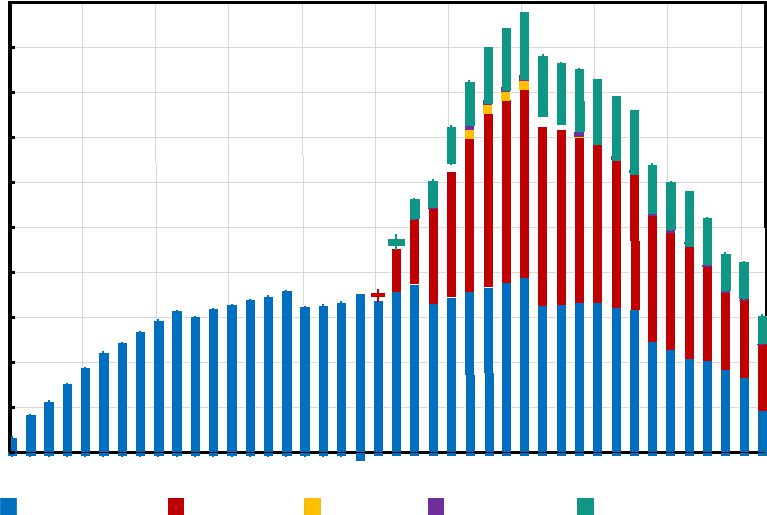
Even as the policy rates spiked, the Riksbank continued to purchase assets for reinvestment purposes, only ceasing purchases altogether in January 2023, three quarters of a year after the decision to increase the policy rate back in April 2022. At that point, the Bank’s monetary policy asset holdings had peaked at just under SEK 1 trillion, with a heavy skew towards covered bonds (see Figure 6). It should, though, be noted that while the rise in the Riksbank’s asset holdings was steep, the overall size of the Riksbank balance sheet as a share of GDP reached only 25 percent, much smaller than in many peer jurisdictions (Figure 7).
By April 2023, the Riksbank had not only terminated its asset purchases, but had also initiated active sales of government bonds (quantitative tightening, QT), becoming one of the first major central banks to move from passive to active QT. As of June 2025, total sales of government bonds had reached approximately SEK 100 billion. This active reduction, combined with natural maturities in the bond portfolio, led to a sharp decline in the Riksbank’s
39
| 2025/26:RFR8 | 3 MONETARY POLICY ACTIONS, |
holdings of Swedish government bonds: from SEK 405 billion at the end of May 2022 to just SEK 100 billion June 2025. Its overall portfolio of Swedish
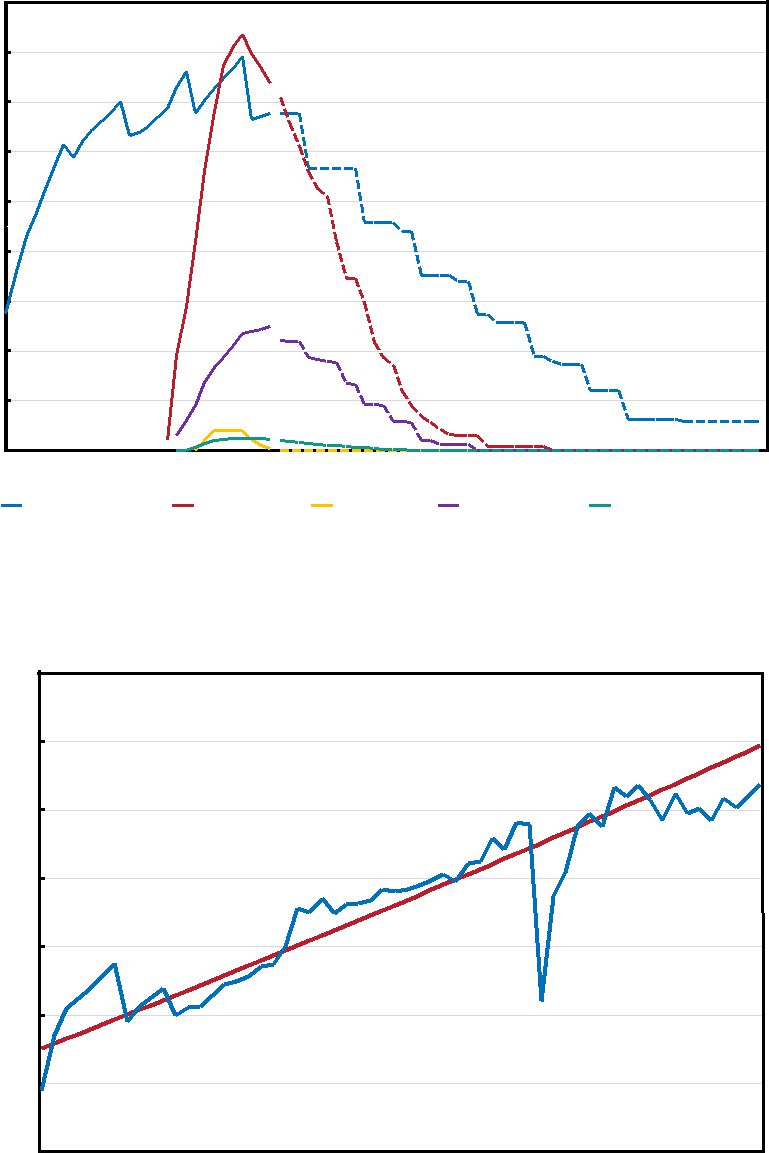
The idea of selling bonds was first debated by the Executive Board in early 2023. Prior to that, Deputy Governor Flodén had argued that the bonds should be held to maturity as it would by itself still lead to a meaningful reduction in the balance sheet (Figure 8), and that
Figure 6: The Riksbank’s monetary policy asset holdings
1000 900 800 700 600 500 400 300 200 100 0
| 2015 | 2016 | 2017 | 2018 | 2019 | 2020 | 2021 | 2022 | 2023 | 2024 | 2025 |
| Government bonds | Covered bonds | Treasury bills | Corporate bonds | Municipal bonds | ||||||
Note: Billion SEK. Last observation is June 2025.
Sources: Sveriges Riksbank.
The Riksbank began its
40
| 3 MONETARY POLICY ACTIONS, |
2025/26:RFR8 |
that the risks had shifted toward weak growth but that inflation uncertainty still warranted a gradual approach.
This cautious policy stance shaped the Riksbank’s strategy throughout the remainder of 2024. The policy rate was lowered again by 25 basis points in each of August and September, as inflation continued to ease and forwardlooking indicators (e.g., consumer sentiment and private investment) remained subdued. By November, the Executive Board implemented a more decisive cut of 50 basis points, given inflation readings below 2 percent, slowing wage growth, and persistent slack in the labour market. The final cut of the year came in
Figure 7: Central bank balance sheets (percent of GDP)
150
125
100
75
50
25
| 0 | |||||||
| 2007 | 2010 | 2013 | 2016 | 2019 | 2022 | 2025 | |
| Riksbank | ECB | Federal Reserve | Bank of England | Bank of Japan | Swiss National Bank | ||
Sources: Eurostat, Japanese Cabinet Office, Statistics Sweden, Swiss State Secretariat for Economic Af- fairs, U.K. Office for National Statistics, US Bureau of Economic Analysis, respective central bank and Sveriges Riksbank.
3.4The Path of the Economy: Real GDP and Unemployment
Figure 9 illustrates the development of real GDP per capita in Sweden (in constant SEK) relative to its trend since 2010. Over the first half of the reporting period, Swedish real GDP per capita was stabilised at a level close to its trend after having been below trend prior to that during
41
| 2025/26:RFR8 | 3 MONETARY POLICY ACTIONS, |
Figure 8: Monetary policy assets
450
400
350
300
250
200
150
100
50
0
| 2015 | 2020 | 2025 | 2030 | 2035 |
| Government bonds | Covered bonds | Treasury bills | Municipal bonds | Corporate bonds |
Note: In billion SEK. The figure is reproduced from Flodén (2022), and shows the projected evolution of the Riksbank’s asset holdings as of December 2022, based on no further asset purchases after 2022. Sources: Sveriges Riksbank.
Figure 9: Real GDP per capita in Sweden and its trend
160 000
155 000
150 000
145 000
140 000
135 000
130 000
125 000
| 2010 | 2012 | 2014 | 2016 | 2018 | 2020 | 2022 | 2024 |
Note: In billion SEK. The figure is reproduced from Flod´en (2022), and shows the projected evolution of the Riksbank’s asset holdings as of December 2022, based on no further asset purchases after 2022. Sources: Sveriges Riksbank.
The
42
| 3 MONETARY POLICY ACTIONS, |
2025/26:RFR8 |
struggle to return GDP growth to trend. Figure 10 shows real GDP per capita corrected for differences in the cost of living of Sweden together with the corresponding series for Denmark, Great Britain, the US, and the euro area (normalised to 100 for each geographical unit in the first quarter of 2000). Only the US and Denmark have managed to return to their
Figure 11 shows the unemployment rate in Sweden since 2000 in comparison with other economies. Unemployment in Sweden – and all other geographical units shown – rose sharply after the GFC and reached at its maximum (in the third quarter of 2009) 9.1 percent, a 3 percentage points increase from its trough in the third quarter of 2007.
Figure 10: Real GDP per capita: international comparison
140
135
130
125
120
115
110
105
100
2010 2011 2012 2013 2014 2015 2016 2017 2018 2019 2020 2021 2022 2023 2024
| Sweden | Euro Area | US | UK | Denmark |
Note: The figure shows real GDP per capita in Sweden, the US, Great Britain, the Euro Area and Denmark. Real GDP per capita is measured in USD, constant purchasing power parity. The series for each country is normalised to 100 in 2000 quarter 1.
Sources: OECD and own calculations.
It is noticeable, though, that Sweden has not managed to return the unemployment rate to its
In the first half of the reporting period, unemployment in Sweden did show signs of a recovery falling from 7.7 percent at the start 2015 of to 6.8 percent at the end of 2019. This recovery was interrupted in the early stages of the
43
| 2025/26:RFR8 | 3 MONETARY POLICY ACTIONS, |
pandemic where it rose sharply to 9.6 percent by the first quarter of 2021. Since then, unemployment in Sweden has only recovered very gradually, and it has not returned to the
In a comparative light, the unemployment situation has been somewhat disappointing in the second half of the reporting period. The high unemployment rate is partially explained by the Swedish labour market participation rate which is high and rising. In the third quarter of 2024, for example, the activity rate of the Swedish population between 15 and 74 years old was 75.3 percent as compared to 65.8 percent in the euro area and 68.1 percent in the US. However, the Swedish activity rate is comparable to Denmark (74.4 percent) while the unemployment rate is significantly lower in Denmark. The comparatively high unemployment rate in Sweden is therefore likely to derive from structural issues related to the labour market rather than from actions of the Riksbank given the relatively similar interest rate paths of Sweden, Denmark and the euro area.
Figure 11: Unemployment rates in Sweden and other economies
14
12
10
8
6
4
2
0
| 2000 | 2004 | 2008 | 2012 | 2016 | 2020 | 2024 |
| Sweden | Euro Area | United States | United Kingdom | Denmark |
Note: The figure shows the unemployment rate in percent Sweden and other economies since 2000.
Sources: OECD.
3.5 Points of Discussion
Given this record of monetary policy actions and the related challenges faced by the Riksbank over the evaluation period, five issues merit further consideration:
•How does monetary policy affect the economy, both when the policy rate is available and when unconventional instruments are used? Understand-
ing the transmission channels, including the effects of quantitative easing,
44
| 3 MONETARY POLICY ACTIONS, |
2025/26:RFR8 |
is central to interpreting policy over the past decade. We discuss this in Section 4 and Section 5.
•Why did the Riksbank not begin raising the policy rate earlier during the inflationary episode that started in the autumn of 2021, and what is the role of the forecast performance for explaining this? We discuss this in Section 6.
•What are the
•What are the implications of Sweden’s status as a small open economy operating flexible inflation targeting under a floating exchange rate? Considerations with regard to the choice of Sweden’s exchange rate regime are assessed in Section 8.
•What are the risks associated with capital inflows and outflows, particularly in times of financial stress, and what is the rationale for the Riksbank’s sizeable
Although we present these issues separately, many are closely connected, and we draw out those links in the discussion that follows. Moreover, the historical context in Section 2 bears on several of these issues, and we draw on it when relevant in the analysis that follows.
45
2025/26:RFR8
4 Conventional and Unconventional
Monetary Policy Tools
As outlined in Section 3, the Riksbank has made extensive use of unconventional tools since the Global Financial Crisis (GFC), including negative nominal interest rates, quantitative easing and forward guidance. These tools were examined in the previous assessment of the Riksbank by Flug and Honohan (2022), which covered the 2015 to 2020 period. Building on that analysis, we draw on additional experience and hindsight to offer further perspective into their effectiveness and associated risks.
We start by outlining the channels through which monetary policy affects the economy under normal circumstances (i.e., when there are no constraints on the use of the policy rate), and present some evidence on the strength of monetary policy transmission in Sweden. We then explore the arguments for why and how unconventional policies, such as negative nominal interest rates and QE, are considered options when the policy rate is at the zero lower bound. After this, we examine the evidence on the effectiveness of unconventional monetary tools in the Swedish case over the assessment period.
4.1 Conventional Monetary Policy
The main way central banks attempt to influence inflation and other aims, such as general activity or employment, is by making interventions that impact on the cost of
Before the GFC, the Riksbank, and most other central banks, operated a scarce reserves system in which the policy rate affected liquidity conditions through
By varying the policy rate, the Riksbank attempts to influence market interest rates faced by Swedish economic entities both on their borrowing and on savings. For instance, when the policy rate rises, banks earn more on their
16Banks can also obtain liquidity at the supplementary liquidity facility, but at a 75 basis points premium relative to the policy rate.
46
| 4 CONVENTIONAL AND UNCONVENTIONAL MONETARY POLICY TOOLS | 2025/26:RFR8 |
central bank deposits, but their cost of liquidity also rises. Hence, typically they will raise their lending rates. Similarly, the rates offered by banks on bank customer deposits may also rise given the increase in the cost of liquidity when obtained from the Riksbank, although there is evidence that the
In this paradigm, when the Riksbank lowers the policy rate, households are encouraged to spend rather than save, while firms are more likely to undertake investment, thus boosting demand and, eventually, inducing firms to raise prices.18 Conversely, rate hikes restrain demand and put downward pressure on inflation. Central bank credibility matters for the effectiveness of monetary policy: If firms and households doubt the
Three additional transmission channels reinforce these effects. First, as interest rates rise, lower demand reduces income, which leads to further spending cuts (the
These mechanisms are best seen as operating over the
17This reflects a shift in monetary theory. Earlier approaches, such as the quantity theory of money, emphasized money supply growth. The key assumptions were that prices are flexible and the velocity of money is stable. In contrast, modern frameworks assume that prices and wages adjust slowly (are “sticky”), such that changes in nominal interest rates directly affect real interest rates in the short run.
18In the very short run, firms may also deplete inventories, but rebuilding these requires higher input use.
19Flodén et al (2021) study high quality Swedish data and document that indebted households’ consumption spending declines significantly more in response to variations in the policy rate than spending of households without debt.
47
| 2025/26:RFR8 | 4 CONVENTIONAL AND UNCONVENTIONAL MONETARY POLICY TOOLS |
| recent surge in inflation but steepened as inflationary pressures built up. This | |
| was another important consideration of the Riksbank decisions regarding the | |
| appropriate level of the policy rate. | |
| While it is important to understand the theoretical channels through which | |
| monetary policy works, just how effective the Riksbank’s policy actions are is | |
| an empirical question about the strength of the transmission mechanism. |
4.1.1Evidence on the Impact of Conventional Monetary Policy in Sweden
Evaluating the causal effects of monetary policy is not straightforward. The main challenge is that not only does the economy react to interest rates, but the interest rate set by the Riksbank also reacts to the state of the economy (known as “reverse causality”). If both interest rates and inflation rise, this may reflect either (i) a central bank tightening of monetary policy in response to inflationary pressures, or (ii) higher interest rates themselves pushing inflation up.20
Disentangling the channels requires following special econometric strategies to address the issues relating to reverse causality by identifying monetary policy “shocks.”21 No method is perfect, as each empirical strategy rests on specific assumptions that may affect the results. To build a more credible picture, it is therefore useful to compare results across methods. We look at three recent studies of the impact of conventional monetary policy in Sweden, each using a different way to identify exogenous monetary policy shocks, as summarised in Table 3. All studies use Swedish data over periods in which the Riksbank has operated the inflation target and exchange rates have been floating (post 1993).
Berggren, Mammos, and Strid (2024) use a statistical approach combined with minimal
20Economists describe this an “endogeneity” problem, in that policy actions are not random, but systematic responses to economic shocks.
21A monetary policy shock is an unexpected change in the central bank’s policy stance (such as the policy interest rate) that is not a systematic response to current economic conditions.
48
| 4 CONVENTIONAL AND UNCONVENTIONAL MONETARY POLICY TOOLS | 2025/26:RFR8 | ||
| Table 3 Three empirical methods for identifying the causal effects of | |||
| Swedish monetary policy | |||
| Study / Method | Method Description | Pros and Cons | |
Berggren et al. (2024), Bayesian VAR with timing restrictions
Statistical model of inflation, GDP, unemployment, exchange rate, and foreign variables
Pros: Captures rich dynamics across many variables; widely used tool. Cons: Relies on timing assumptions that may not be realistic;
Almerud et al. (2024),
Coglianese et al. (2025), Narrative
Uses changes in asset prices within 30 minutes of Riksbank announcements as “surprise” policy shocks. Decomposes into target (current rate) and path (forward guidance) shocks.
Examines
Pros: Exploits very
Pros: Grounded in a clear historical episode; intuitive and transparent. Cons: Hinges on interpreting the episode as fully exogenous; findings may not generalise beyond that case.
restriction. The Bayesian aspect of the analysis is adopted due to the fact that the
This study finds that a one percentage point increase in the policy rate gives rise to a decline in Swedish inflation of around 0.5 percent which occurs with
Interestingly, this study also takes a detailed look at the
49
| 2025/26:RFR8 | 4 CONVENTIONAL AND UNCONVENTIONAL MONETARY POLICY TOOLS |
| These results suggest that the policy rate is a powerful tool to regulate de- | |
| mand in the Swedish economy through the channels discussed above. There | |
| are potential weaknesses of this statistical analysis, though. One may question | |
| the assumption that the inflation rate and other variables apart from the ex- | |
| change rate cannot respond within a |
|
| may also wonder whether it is appropriate to focus entirely on the policy rate | |
| given, as discussed further below, the use of unconventional monetary policy | |
| instruments since 2015. | |
| An alternative approach to estimating monetary policy shocks is to study in | |
| detail asset price movements in the vicinity of monetary policy events such as | |
| the communication of the Riksbank after its Executive Board meetings. The | |
| press releases of the Riksbank, as well as other channels of communication, | |
| impact on financial markets to the extent that they contain information that is | |
| news to market participants. The surprise component of monetary policy an- | |
| nouncements can be isolated by examining swap rates or other |
|
| asset prices, in narrow windows around these events. Following such an | |
| approach, often referred to as a High Frequency Identification (HFI), Almerud | |
| et al (2024) measure monetary policy surprises by exploiting |
|
| on asset prices in narrow windows around monetary policy announcements | |
| from January 2000 to June 2024. | |
| One issue with the corresponding monetary policy news measure is that it | |
| may contain information about separate aspects of monetary policy, including | |
| the surprise movement in the policy rate and forward guidance. Forward guid- | |
| ance refers to central bank communication about future policy rate changes | |
| rather than surprises about current rate, a particularly relevant consideration | |
| during the period studied (further discussed below). A third aspect also dis- | |
| cussed below is QE. To address this issue, Almerud et al (2024) decompose | |
| the overall surprise element into different components. This type of decompo- | |
| sition relies on making a number of statistical assumptions, and so the results | |
| are not unique. Nonetheless, relative to the monetary policy shock identified | |
| with the method of the previous approach discussed above, the approach in | |
| Almerud et al (2024) presents a more refined measure of monetary policy | |
| shocks. | |
| In a second step, Almerud et al (2024) use the identified monetary policy | |
| news components in a |
|
| of interest. In this step they apply a Proxy SVAR approach that uses the | |
| different dimensions of the monetary policy news as instruments for the shocks | |
| of interest. For the conventional monetary policy shock, they find results that are | |
| generally qualitatively consistent with Berggren, Mammos, and Strid (2024), | |
| Specifically, a hike in the policy rate produces a decline in inflation and output, | |
| an appreciation of the real effective exchange rate, and an increase in unem- | |
| ployment. Quantitatively, this study finds an even larger impact of monetary | |
| policy on output (1.5 percent at its peak that occurs with a |
|
| The exchange rate effects are also substantially larger with the real apprecia- | |
| tion varying between four and six percent in the first 18 months following the |
50
| 4 CONVENTIONAL AND UNCONVENTIONAL MONETARY POLICY TOOLS | 2025/26:RFR8 |
interest rate hike. The effects of monetary policy tightening on the price level peak after two years, similar to Berggren, Mammos, and Strid (2024).22
Coglianese, Olsson and Patterson (2025) take a different perspective and use what is referred to as a “natural experiment” approach exploiting the monetary policy tightening in Sweden in
The authors find that, at its peak, the monetary policy tightening was associated with a one percentage point increase in the policy rate above its expected “normal level” given economic circumstances (with the peak interest rate effect occurring in
An interesting finding in this paper is that the increase in the policy rate did have powerful effects on the Swedish housing market in terms of depressing house prices and household sector indebtedness, but that this came at significant economic cost. This study also argues that the large estimated monetary policy effects are related to significant downward rigidity of nominal wages in Sweden.
In summary, the qualitative results of these empirical studies are broadly consistent with the mainstream thinking about monetary policy transmission mechanisms discussed in the previous section. The statistical evidence reviewed here, while subject to important caveats, points to a qualitatively significant role for the Riksbank in terms of inflation outcomes. It also indicates that there are important
22 Berggren, Mammos, and Strid (2024) estimate the impact on the inflation rate while Almerud et al (2024) estimate the impact on the price level. To make the two estimates comparable one needs to cumulate the inflation response in the former study.
51
| 2025/26:RFR8 | 4 CONVENTIONAL AND UNCONVENTIONAL MONETARY POLICY TOOLS |
| Swedish economy. There is some disagreement across studies about the sizes | |
| of the effects, however, indicating that a detailed analysis on the part of the | |
| Riksbank would be helpful. |
4.2 Unconventional Monetary Policy
In normal times, as just discussed, the Riksbank can regulate inflationary pressures by adjusting its policy rate as it deems necessary given forecasts of inflation and other conditioning information. However, when deflationary pressures are sufficiently strong, the conventional monetary policy tool may become constrained by the “effective lower bound” (ELB).
Such a constraint can arise because of the availability of physical cash, which pays a zero nominal return. If deposit rates turn deeply negative, households and businesses may withdraw funds to hold cash, limiting how deeply negative the policy rate can go in practice. This is viewed as a binding constraint even in economies such as Sweden where cash usage is low (Armelius, Boel, Claussen, and Nessén (2018)). An ELB on the policy rate can also arise because households at some point become satiated with cash, implying that further nominal interest rate reductions become ineffective in affecting real cash balances.
When the ELB binds, conventional rate reductions are ineffective, and central banks, including the Riksbank, may therefore turn to unconventional policy tools. The key characteristic of such policies is that they place greater emphasis on channels of monetary transmission other than movements in
4.2.1 Negative Nominal Interest Rates
Negative nominal interest rates involve charging commercial banks and other financial institutions interest on their
Negative interest rates are, in principle, relatively easy to implement operationally, but their effectiveness in stimulating aggregate demand depends on the
A potential issue with regard to the effectiveness of negative nominal interest rates relates to bank profitability. Abadi, Brunnermeier, and Koby (2023) argue that there exists a lower bound, which they call the “reversal rate,” below
52
| 4 CONVENTIONAL AND UNCONVENTIONAL MONETARY POLICY TOOLS | 2025/26:RFR8 |
which further cuts become counterproductive because they are inconsistent with the profitability of the banking sector. The reversal rate may even be positive in circumstances where capital gains from banks’ maturity transformation are small.
4.2.2 Quantitative Easing
A second type of unconventional monetary policy is QE, also referred to as
There are several reasons why central banks may engage in such purchases. The first is as an emergency action in situations where financial market stress calls for central bank intervention to avoid market freezes. The second is to increase the supply of liquid assets in circulation as an alternative to conventional monetary policy when policy rates are constrained by the ELB. The third, and related, reason involves an attempt to manipulate
Prior to the GFC, mainstream thinking among economists was that central bank asset purchases have limited macroeconomic effects in
That said, several theoretical frameworks developed before and after the GFC provide candidates for channels through which QE can affect financial conditions, even in the absence of market dysfunction. The portfolio balance channel, formalised by Tobin (1969) and resurrected by Bernanke and Reinhart (2004), describes how central bank purchases of
23Fieldhouse, Mertens and Ravn (2018) find evidence against this neutrality view for such GSE asset purchases even before the GFC.
53
| 2025/26:RFR8 | 4 CONVENTIONAL AND UNCONVENTIONAL MONETARY POLICY TOOLS |
| builds on the idea that asset purchases can affect yields if investors have pref- | |
| erences over specific asset types so that substituting |
|
| gliani and Sutch (1966), and Vayanos and Vila (2021)). | |
| QE comes with many unknowns and with several layers of risk. The central | |
| issue is the extent to which it is effective, particularly in a small open economy | |
| such as Sweden. Swedish bond yields are strongly influenced by global finan- | |
| cial conditions, and international arbitrage limits the extent to which domestic | |
| asset purchases can compress |
|
| other hand, in an open economy, if domestic and foreign bonds are imperfect | |
| substitutes, QE may also impact on inflation through the exchange rate. | |
| Evaluating the importance of these channels empirically is inherently hard | |
| for a variety of reasons. First, we simply do not know how the economy would | |
| have evolved in the absence of such purchases, although reasonable attempts | |
| can be made using statistical analysis. Secondly, much of QE was conducted | |
| for endogenous reasons, thus making empirical analysis difficult due to re- | |
| verse causality issues. Nonetheless, efficacy is an important issue that we will | |
| return to below. |
4.3Evidence on the Effectiveness of Unconventional Policy Tools in Sweden
4.3.1 Policies implemented over the 2015 to 2019 period
As outlined in Section 3, the main aim of introducing unconventional monetary policies was to bring inflation back to its two percent target and to stabilise longer term inflation expectations. CPI inflation in this period increased steadily from
Figure 12: Inflation expectations
| 2- and |
|||||||||||||||||||
| 6 | 3,5 | ||||||||||||||||||
| 5 | 3 | ||||||||||||||||||
| 2,5 | |||||||||||||||||||
| 4 | |||||||||||||||||||
| 2 | |||||||||||||||||||
| 3 | |||||||||||||||||||
| 1,5 | |||||||||||||||||||
| 2 | |||||||||||||||||||
| 1 | |||||||||||||||||||
| 1 | 0,5 | ||||||||||||||||||
| 0 | 0 | ||||||||||||||||||
| 2010 | 2011 | 2012 | 2013 | 2014 | 2015 | 2016 | 2017 | 2018 | 2019 | 2010 | 2011 | 2012 | 2013 | 2014 | 2015 | 2016 | 2017 | 2018 | 2019 |
| Household Expectations | Money Market Participants | Money Market Participants, 2 years | Money Market Participants, 5 years | ||||||||||||||||
Note: Percent. Expectations at the time of measurement of different agents about CPIF inflation 1, 2, and 5 years ahead.
Sources: Origo Group, Sveriges Riksbank and Konjunkturinstitutet.
54
| 4 CONVENTIONAL AND UNCONVENTIONAL MONETARY POLICY TOOLS | 2025/26:RFR8 |
Inflation expectations also appear to have been
•The
•The measures relating to longer term inflation expectations at the twoor
The evidence from market interest rates is also consistent with
55
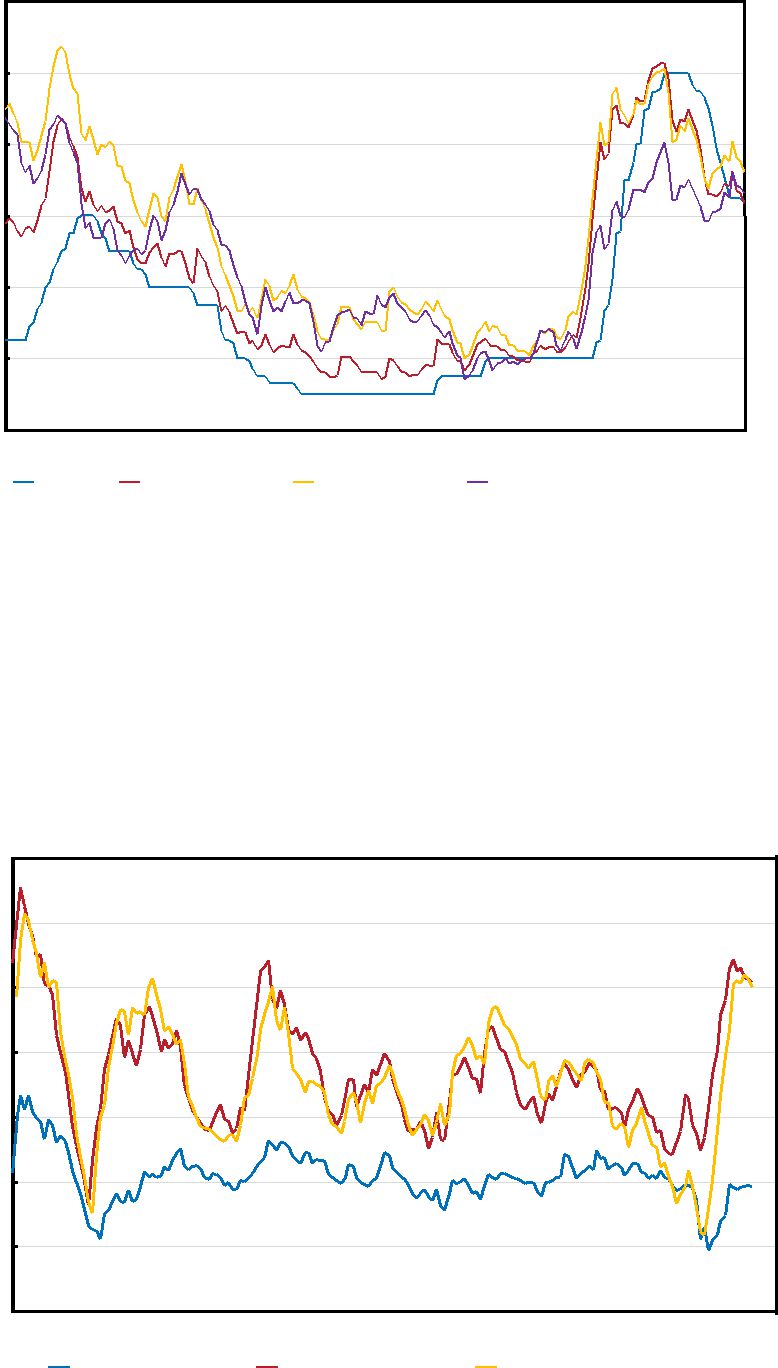
2025/26:RFR84 CONVENTIONAL AND UNCONVENTIONAL MONETARY POLICY TOOLS
Figure 13: The policy rate and longer term interest rates
| 5 | |||||||
| 4 | |||||||
| 3 | |||||||
| 2 | |||||||
| 1 | |||||||
| 0 | |||||||
| 2010 | 2012 | 2014 | 2016 | 2018 | 2020 | 2022 | 2024 |
| Policy Rate | |||||||
Note: Percent.
Source: Sveriges Riksbank.
Another indicator comes from the spreads between various bond yields and to the policy rate. These spreads remained relatively constant as the unconventional policies were implemented. Although many factors such as changing risk premia can affect these spreads, relatively stable spreads are consistent with
Figure 14: Interest rate spreads over the policy rate
| 5 | |||||||
| 4 | |||||||
| 3 | |||||||
| 2 | |||||||
| 1 | |||||||
| 0 | |||||||
| 2010 | 2012 | 2014 | 2016 | 2018 | 2020 | 2022 | 2024 |
| 6 Months |
|||||||
Note: Percentage points.
Source: Sveriges Riksbank.
56
| 4 CONVENTIONAL AND UNCONVENTIONAL MONETARY POLICY TOOLS | 2025/26:RFR8 |
More formal and rigorous assessments also find evidence of pass through, although the findings are nuanced. De Rezende (2017) examines the impact of the initial rounds of QE Sweden in combination with negative interest rates. The results in this study indicate that the combination of the two policies reduced both
The evidence of whether QE translated into the desired outcomes for the economy and inflation is more mixed. Christensen and Zhang (2024) find impacts of QE on inflation and inflation expectations in Sweden, with the desired improvements in Swedish bond prices working through portfolio
A complementary approach is to construct a counterfactual using a structural model of the economy. Kolasa, Laséen, and Lindé (2025) use an openeconomy DSGE model, calibrated to the Swedish economy, to assess the impact of negative interest rates and QE over the
24A DSGE (Dynamic Stochastic General Equilibrium) model is a macroeconomic model built on explicit microeconomic foundations, such that households, firms, and policy institutions interact under constraints such as budget and technology. It is “structural” in the sense that the equations are derived from optimizing behaviour and equilibrium conditions rather than from purely statistical correlations. This makes the model suitable for policy analysis and counterfactual simulations.
57
| 2025/26:RFR8 | 4 CONVENTIONAL AND UNCONVENTIONAL MONETARY POLICY TOOLS |
| in the early stages of the use of unconventional policies. These effects, though | |
| significant, are still relatively modest. | |
| In summary, there is some degree of uncertainty regarding the power of QE | |
| as a monetary policy instrument. The evidence for Sweden does not contradict | |
| that QE has been a contributing factor in bringing inflation back towards its | |
| target, and with a stabilisation of inflation expectations, but the evidence is | |
| somewhat mixed. One may also wonder about the extent to which the net ben- | |
| efits outweigh the potential risk to the balance sheet of the Riksbank (discussed | |
| below). Nonetheless, when the policy rate was reduced to zero, the limited | |
| coordination of actions of Swedish policy institutions (a |
|
| strict separation of responsibilities that was built into the Swedish macroeco- | |
| nomic framework in the aftermath of the 1992 crisis) gave the Riksbank little | |
| choice but to reach for unconventional monetary policy instruments. |
4.3.2Policies Implemented in Response to Covid: QE in 2020 to
2022
The evidence on the effectiveness of the Riksbank’s
1.to restore market functioning
2.to ease monetary conditions in order to achieve the inflation target.
The
By contrast, the case for the
58
| 4 CONVENTIONAL AND UNCONVENTIONAL MONETARY POLICY TOOLS | 2025/26:RFR8 |
1.the size of the pandemic era QE purchases was smaller; and
2.the composition of assets was weighted towards assets with weaker transmission channels (recall Figure 6).
Moreover, from a narrow fiscal perspective, the
Figure 15:
| 0,6 | |||||||
| 0,5 | |||||||
| 0,4 | |||||||
| 0,3 | |||||||
| 0,2 | |||||||
| 0,1 | |||||||
| 0,0 | |||||||
| Government bonds | Corporate bonds | Covered bonds | |||||
Note: Percentage points. Reproduced from Jansson (2021). The broken vertical line marks 11 March 2020, when the WHO declared
Source: Macrobond, Refinitiv, ASTRID (Reuters) and Sveriges Riksbank.
Another factor relates to the Riksbank’s purchases of covered bonds. These purchases did reduce interest rate spreads in the early part of the pandemic. However, the continuation of the acquisition of these bonds in the subsequent period likely further boosted Swedish housing prices (which were already growing at a high rate in the
Given the extraordinary uncertainty in the early months of the pandemic, it was reasonable for the Executive Board to err on the side of doing too much rather than too little, particularly given the risks of a significant deflationary pressure from the pandemic in a situation when policy was already at the ZLB. The Riksbank should also be commended for having included balance sheet risks in their discussions from the very start of the implementation of QE. That said, it is less easy to see how the Board assessed the costs and benefits of their
59
| 2025/26:RFR8 | 4 CONVENTIONAL AND UNCONVENTIONAL MONETARY POLICY TOOLS |
| November 2020 decision to raise the amounts of assets purchased and extend- | |
| ing the length of the QE programme. In this instance, more rigorous |
|
| efit assessments might have led to a |
|
| A final point on the QE programme is related to the composition of pur- | |
| chases, with multiple rounds of |
|
| that its heavy purchases of covered and municipal bonds reflected the fact that | |
| it already held a very large share of the outstanding stock of government | |
| bonds, limiting room for further purchases without impairing market function- | |
| ing. As noted in Section 3, there was relatively little discussion of the potential | |
| repercussions in terms of financial stability. While |
|
| considered from the outset, we agree with other external evaluations that high- | |
| light the need to weigh potential |
|
| Honohan (2022), Hassler, Krusell, and Vestman (2024)). | |
| The “funding for lending” scheme launched in March 2020, intended to | |
| support bank credit to businesses, also had limited take up. It was, therefore, | |
| not an active driver of lending, and it is difficult to see if it served as an effec- | |
| tive precautionary backstop. Although this kind of programme, in principle, | |
| could be effective in some circumstances, it risks treading on fiscal territory | |
| (Flug and Honohan (2022); Hassler, Krusell, and Vestman (2024)). | |
| Overall, the Riksbank’s emergency measures early on during the |
|
| pandemic were effective at stabilising markets and avoiding a credit crunch, | |
| but the |
|
| est macroeconomic benefits, while, at the same time, incurring significant | |
| risks. A lesson for the future is that unconventional measures should be subject | |
| to more systematic |
|
| conditions evolve, so that decisions can be adapted in real time. This would | |
| also enhance the transparency and accountability of the Riksbank operations. | |
| In addition, the programme designs need to allow for flexible exit so that pro- | |
| grammes do not linger longer than they are needed (see Section 7 on how | |
| changes in forward guidance for QE and other programmes could help). |
4.3.3Effectiveness of Policies in Response to the Spike in inflation (2022 to 2024)
There has been much discussion as to whether the Riksbank’s large and rapid rate hikes were overdone, particularly given the central role Sweden’s wagesetting institutions play in shaping the inflation process (see Box 1).
60
| 4 CONVENTIONAL AND UNCONVENTIONAL MONETARY POLICY TOOLS | 2025/26:RFR8 |
Box 1: Sweden’s
As discussed in 2.1.5, Sweden’s coordinated wage bargaining dates back to the postwar “solidarity wage policy,” when centralised deals between unions and employers provided the vehicle for determining
This mechanism has historically been viewed as restraining
As it turned out, wage increases after 2022 were relatively modest, and real wages have fallen considerably (Figure 16). The 2023 national bargaining round delivered wage increases of about 7.4 percent over two years (4.1 percent in 2023 and 3.3 percent in 2024). Averaged across the two years, this corresponds to roughly 3.7 percent annual wage growth, well below peak inflation. These wage increases were also moderate compared with several other European economies such as Germany and the Netherlands facing similar shocks (Hassler, Krusell, and Seim (2023)).
One might argue that the wage restraint should have held back the Riksbank from increasing the policy rate as much as it did. However, while the labour market partners did agree to moderate wage increases, it is also true that
61
2025/26:RFR84 CONVENTIONAL AND UNCONVENTIONAL MONETARY POLICY TOOLS
Figure 16: Real wages and inflation
| 12 | ||||||||||||||||
| 10 | ||||||||||||||||
| 8 | ||||||||||||||||
| 6 | ||||||||||||||||
| 4 | ||||||||||||||||
| 2 | ||||||||||||||||
| 0 | ||||||||||||||||
| 2000 | 2001 | 2003 | 2004 | 2006 | 2007 | 2009 | 2010 | 2012 | 2013 | 2015 | 2016 | 2018 | 2019 | 2021 | 2022 | 2024 |
| CPIF | Real Wages | |||||||||||||||
Note: Yearly percentage changes.
Sources: Macrobond.
4.3.4 Balance Sheet Implications
The implications for the size and structure of Riksbank’s balance sheet from the use of QE is a
25For more information see
62
| 4 CONVENTIONAL AND UNCONVENTIONAL MONETARY POLICY TOOLS | 2025/26:RFR8 |
Box 2: The Riksbank balance sheet
The Riksbank’s balance sheet records its assets, liabilities, and net equity.
Liabilities: The most important component of liabilities today are commercial banks’
Assets: The
Income: The Riksbank earns income from supplying cash and from the returns on its financial assets. Strong income over time increases equity, but periods of losses reduce it and may create a need for capital injections according to the rules in the new Riksbank Act.a
Risks: There are two main sources of balance sheet risk. First, there is a maturity mismatch between its holdings of
aThe Riksbank Act (2022:1568), which entered into force on 1 January 2023, establishes a capital target level of SEK 60 billion, expressed in 2023 prices and adjusted over time by the CPI.
Prior to the global financial crisis, the balance sheet was modestly sized, at about 6 percent of GDP (see Figure 17). The GFC prompted a sharp, but temporary, increase in the size of the balance sheet, because of lending from the Riksbank to Swedish banks and because the Riksbank doubled its foreign exchange reserves. Assets rose from 6.2 percent of GDP in 2007 to 22 percent in 2009 before falling back to 8.5 percent in 2011. With the launch of QE, the
63
| 2025/26:RFR8 | 4 CONVENTIONAL AND UNCONVENTIONAL MONETARY POLICY TOOLS |
balance sheet expanded again steadily, reaching 20 percent of GDP by mid- 2018. It remained at this level until the
Figure 17: Riksbank assets, percent of GDP
30
25
20
15
10
5
0
| 2006 | 2008 | 2010 | 2012 | 2014 | 2016 | 2018 | 2020 | 2022 | 2024 |
| Krona Denominated Assets | Gold and Foreign Currency | ||||||||
| Lending to Swedish Credit Institutions | Total | ||||||||
Source: Sveriges Riksbank.
This balance sheet growth was a direct consequence of policy aimed at easing financial conditions and achieving the inflation target. Still, changes in the maturity structure of its assets left the Riksbank exposed to losses, with risks crystallising as interest rates increased. Holding bonds to maturity would have avoided immediate realisation of capital losses on
It is important to note that other actions that increased the size of the balance sheet over the period did not increase duration and interest rate risk per se, including the change to an ample reserves system and the financing of the foreign exchange reserve. In the ample reserves framework, banks hold large amounts of remunerated certificates and deposits at the Riksbank, which makes the balance sheet structurally larger than before the GFC. The increase in the size of the balance sheet in and of itself is not the issue, the key vulnerability arose from QE’s maturity mismatch, where
Looking ahead, as asset holdings are reduced, choices will need to be made about both the size of the balance sheet and whether to maintain an ample reserve system or revert to a scarce reserve system. While a scarce reserve system would require the revival of an active interbank market and that banks are willing to use the Riksbank’s standing lending facilities, it has the advantage of imposing
64
| 4 CONVENTIONAL AND UNCONVENTIONAL MONETARY POLICY TOOLS | 2025/26:RFR8 |
greater market discipline on banks. Indications are that the Riksbank is inclined to reintroduce a scarce reserve system (Thedéen (2025)).
Figure 18: Bond holdings and overnight deposits and certificates
1 400 000
1 200 000
1 000 000
800 000
600 000
400 000
200 000
0
| 2006 | 2008 | 2010 | 2012 | 2014 | 2016 | 2018 | 2020 | 2022 | 2024 |
| Assets denominated in kronor | Overnight deposits and Certificates | ||||||||
Note: Million SEK.
Source: Sveriges Riksbank.
As Figure 18 illustrates, the maturity mismatch was stark since
One might reasonably ask whether the Bank should have held the assets to maturity rather than selling them. Because the Riksbank applies
26The underlying economic losses associated with QE would have reduced cumulative remittances regardless of accounting treatment. The accounting framework affects the timing and presentation of losses: under the Riksbank’s approach, losses are recognised largely up front through asset
flected more gradually through negative net interest income.
65
| 2025/26:RFR8 | 4 CONVENTIONAL AND UNCONVENTIONAL MONETARY POLICY TOOLS |
| (Sveriges Riksbank (2022d); Kjellberg and Åhl (2022)). With the benefit | |
| of hindsight, one might also ask whether the asset purchases were associated | |
| with acceptable and transparent risks to consolidated public finances. We re- | |
| turn to this second issue in Section 7. |
4.4 Thinking Ahead: a Return to Unconventional Policies?
The long period of
One way of thinking about this is to consider the “neutral interest rate.” This concept refers to the interest rate that, given economic circumstances, is neutral on inflation (relative to its target). When the neutral rate becomes negative, the Riksbank has to reach for unconventional policies unless it is willing to undershoot on inflation.
Unfortunately, the neutral interest rate is not directly observable, but must instead be estimated and is subject to considerable uncertainty. Economists typically use methods that make inferences from economic forces that impact on aggregate savings and investment in the economy. There are many economic forces of interest, such as demographic trends, trends in inequality, technological trends affecting productivity, supply chains, fiscal policy, etc. Moreover, the neutral rate can be affected by shocks to the economy. It is therefore, in practice, inadvisable to rely solely on point estimates for policy guidance in the short run. Yet, estimates of neutral interest rates are informative about the potential need for unconventional policies.
Many commentators believe that the neutral interest rate has shifted upwards since the
There is also prominent research that points towards continued declines in
66
| 4 CONVENTIONAL AND UNCONVENTIONAL MONETARY POLICY TOOLS | 2025/26:RFR8 |
more pessimistic on the mediumto
Therefore, a balanced view suggests that although immediate concerns about a return to unconventional monetary policies have dissipated, one should not discount the possibility of renewed periods of
We will discuss further issues surrounding this issue in Section 7.
67
2025/26:RFR8
5 Forward Guidance and Other
Communication Tools
Monetary policy communication underpins not only the effective transmission of policy actions, but also central bank transparency and accountability. Communications are multifaceted, ranging from the explanation of policy decisions to broader discussions of how monetary policy contributes to the welfare of citizens. It is always essential for central banks to explain credibly how its policy actions will return inflation to target, thereby reinforcing commitment to its monetary policy mandate.
As noted earlier, the period before 2015 was problematic in this regard, since the Riksbank simultaneously pursued financial stability goals, and inflation persistently undershot the two percent target. From 2015 onward, however, its communications framework matured considerably. For this evaluation, the focus is on three challenges that mattered most over the 2015 to 2024 period:
1.explaining the use and risks of unconventional tools;
2.clarifying forward guidance; and
3.communicating uncertainty.
The Riksbank has a rich and increasingly sophisticated set of communication tools centred around its policy meetings, which now occur eight times a year (Table 4).27 Communication about monetary policy decisions happens in the morning the day after the regular meeting (usually at 9:30 a.m.) with a press release that contains short and concise motivation for the decisions. Simultaneously, at four of these, the Riksbank publishes a full Monetary Policy Report (MPR) with forecasts, a
On occasion, the Riksbank may also hold extraordinary meetings outside the schedule of the eight regular meetings. Such extraordinary meetings occur in the face of significant economic events, which may trigger Riksbank intervention such as the
27The number of scheduled meetings has changed over time: six per year between 2015 and 2019, five per year from 2020 to 2023, and eight per year beginning in 2024. The move to eight meetings puts the Riksbank more in line with other central banks, including the ECB, the Bank of England, and the Federal Reserve.
68
| 5 FORWARD GUIDANCE AND OTHER COMMUNICATION TOOLS | 2025/26:RFR8 |
5.1Explaining the Use and Risks of Unconventional Tools
The formal Riksbank communication documents are complemented by speeches, parliamentary hearings, online “explainers,” and by research papers. Such channels became particularly important during the use of extraordinary measures such as negative interest rates, quantitative easing, and
5.2 Clarifying Forward Guidance
Conceptually, forward guidance can take the form of qualitative or quantitative assessments of the outlook that inform decisions (“Delphic”) or explicit commitments to future policy stances conditional on outcomes (“Odyssean”). While the Riksbank has consistently emphasised conditionality, forward guidance nevertheless carries risks of time inconsistency: if the economy recovers faster than expected,
The Riksbank stands out among peers for speed and transparency of its Delphic guidance. Importantly, the Riksbank publishes a single path agreed by the Executive Board that is consistent with its economic forecast. Forward guidance can have the benefit of easing monetary conditions and anchoring inflation expectations without expanding the central bank’s balance sheet. Al- merud et al (2024) find that forward guidance in Sweden over the 2020 to 2024 period was, indeed, effective especially in terms of inflation outcomes. They estimate that a
0.75percentage points above its normal level around 18 months after the announcement. They argue that forward guidance announcements are close substitutes for actual interest rate changes; a forward guidance shock that increases the
69
| 2025/26:RFR8 | 5 FORWARD GUIDANCE AND OTHER COMMUNICATION TOOLS |
| In order to avoid the pitfalls of time inconsistency, the Riksbank has taken | |
| great pains to emphasise that this type of guidance has always been explicitly | |
| conditional, not Odyssean. Because conditional guidance was provided habit- | |
| ually for many years (interest rate paths were introduced in 2007), households | |
| and firms have likely come to expect that forecasts will change if the outlook | |
| changes. Having this framework in place in normal times reinforced the un- | |
| derstanding that |
|
| avoid some of the communication difficulties faced by other central banks. | |
| The Reserve Bank of Australia, for example, stated as late as September 2021 | |
| that, in its central scenario, the cash rate would remain at the lower bound until | |
| 2024, only to reverse course abruptly in May 2022 (Australian Treasury | |
| (2023)). | |
| That said, there were aspects of communication around extraordinary tools | |
| that may have inadvertently “boxed in” the Riksbank. Asset purchase pro- | |
| grammes launched during the |
|
| fixed amounts to be implemented over a set horizon, rather than as conditional | |
| on the evolving outlook. This stood in contrast to the Riksbank’s forward guid- | |
| ance on interest rates, where conditionality was emphasised and well under- | |
| stood. As Flug and Honohan (2022) noted, this design reduced flexibility be- | |
| cause, once a purchase programme had been announced, the Bank could feel | |
| obliged to complete it even if the conditions that had justified it no longer | |
| prevailed. The corporate bond purchase programme illustrates this dynamic. | |
| The programme was announced in July 2020, but it was not implemented until | |
| September because time was needed for it to be operationally ready. When it | |
| went ahead, market spreads had already narrowed. Arguably, the decision to | |
| persevere with the programme despite changing market conditions was made | |
| to preserve credibility. |
5.3 Communicating Uncertainty
Fan charts were first introduced in the early 2000s but became a systematic feature of the MPR by the
Overall, the Riksbank’s communication efforts were excellent at explaining decisions and forward guidance, and increasingly innovative in making information accessible through
70
| 5 FORWARD GUIDANCE AND OTHER COMMUNICATION TOOLS | 2025/26:RFR8 |
nonetheless ahead of its peers and has innovated since. The main gap was in assessing and explaining quantitative easing, including its costs, benefits, and risks, and the difference between purchases for market functioning and for policy stimulus.
Table 4 Riksbank communication tools
| Communication Tool | Frequency / Timing | Main Content |
| Monetary Policy | 8 times/year | |
| Decision | ||
| Press Release | (after each EB meeting) | concise rationale, summary of eco- |
| nomic conditions | ||
| Press Conferences | 8 times/year | Governor presents decision, ex- |
| (after each decision) | plains assessment, Q&A with jour- | |
| nalists | ||
| Monetary Policy | 4 times/year | Full forecasts |
| Report | ||
| (MPR) | (Mar, Jun, Sep, Dec) | inflation, GDP, unemployment) |
| fan charts (discontinued March | ||
| 2024), alternative scenarios, risk | ||
| analyses | ||
| Monetary Policy | 4 times/year (alternating | Updates on economic develop- |
| Update | with MPRs) | ments and related Board views (no |
| new forecast) | ||
| Minutes & Voting Rec- | Published 5 working days | Detailed discussion, individual |
| ords | after each of the 8 meetings | board members’ arguments, and |
| voting records | ||
| Speeches and | Continuous |
Broader policy context, forward |
| Presentations | year, | |
| (Executive Board mem- | not all published) | guidance, topical issues |
| bers) | ||
| Parliamentary | Several times/year | Governor and Board explain deci- |
| Hearings | sions, face questions from MPs | |
| (Riksdag Finance Com- | ||
| mittee) | ||
| Website, Infographics | Ongoing | |
| & Social Media | plainers, videos, infographics | |
| Research & Working | Ongoing | Technical foundations of, fore- |
| Papers | casts, transmission analysis, policy | |
| evaluation |
71
2025/26:RFR8
6 Forecast Performance
As Figure 5 makes clear, in the
As shown in Figure 19, the Riksbank, as many other central banks, only started to raise interest rates once inflation (both headline and core) was well above target. Indeed, inflation was persistently above the two percent target from August 2021, but it was not until April 2022 that the policy rate was raised, and the Riksbank, as previously discussed, continued its QE asset purchases throughout 2022.
Figure 19: Inflation at time of policy rate
10 9 8 7 6 5 4 3 2 1 0
| Brazil | Mexico | Chile | Korea | South Africa | United Kingdom | Canada | United States | Sweden | Australia | India | Euro area | Indonesia | Switzerland |
| 2021 | 2022 | ||||||||||||
| Core | Headline |
Note: Reproduced from English, Forbes, and Ubide (2024). Economies ordered by date of
Sources: World Bank Global Inflation Database, OECDStat, national sources.
Drivers of Inflation Forecast Errors
A critical consideration in assessing the Riksbank’s
72
| 6 FORECAST PERFORMANCE | 2025/26:RFR8 |
instance, central banks typically look through
While forecasting is inherently difficult, it is nonetheless a crucial tool for the Riksbank when it makes its policy decisions. Inflationary pressures can come from many different sources, such as variations in
To calibrate an appropriate response of the policy rate, central banks need to have an informed view on how current inflationary pressures will evolve, and how their own policy actions will be transmitted through economy to return inflation back to target. Not only are shocks to the economy by nature unpredictable, but there is a second layer of uncertainty stemming from incomplete knowledge about the timing and impact of monetary policy actions on inflation and economic activity. In addition, channels of transmission may change over time, which makes the task even more difficult.
Doing a good job at forecasting, including taking appropriate account of risks and considering alternative scenarios, is clearly extremely important for informing Executive Board’s decisions that support economic outcomes consistent with its mandate and, crucially, maintain its credibility. This is the reason why the Riksbank, along with many other central banks, devote significant resources to a multitude of statistical methods and data sources.
In this respect, the Riksbank should be commended for facilitating continuous and timely assessment of its forecasting performance. It does so in two ways. First, it publishes the economic forecast that informs the Executive Board’s policy discussions, including the path for the policy rate consistent with the forecast. Since inflation almost always returns close to its target in central bank forecasts that are conditional on an endogenous policy rate path, including the paths of policy actions is essential to interpreting a central bank’s views on the underlying pressures on inflation. Only a handful of central banks, including Norges Bank and the Reserve Bank of New Zealand, follow similar practices, while others publish forecasts based on rate paths consistent with market expectations. Second, the Riksbank publishes on its website a full set of projections and outturns for key variables such as GDP growth, inflation and interest rates. This level of transparency helps financial markets and other key players in the economy to better understand the decisions made by the
73
| 2025/26:RFR8 | 6 FORECAST PERFORMANCE |
| Riksbank, and to arrive at an informed view about the likely future path of the | |
| economy. |
6.1 Drivers of
Swedish inflation was relatively stable during the first half of the assessment period
Following the onset of Covid, however, central bank forecast errors ballooned, particularly over the period when inflation spiked in 2022 (see Figure 20).
One cannot directly observe the sources of changes in inflation as they ultimately depend on the economic structure and shocks of various origin are transmitted to the economy through many different channels. However, the Riksbank has at its disposal models of the economy that are helpful for understanding these sources of changes in inflation
74
| 6 FORECAST PERFORMANCE | 2025/26:RFR8 |
Figure 20:
10
8
6
4
2
0
| 2016 | 2017 | 2018 | 2019 | 2020 | 2021 | 2022 | 2023 | |||||||||
| Riksbank | ECB | Fed | BoE | BoC | Bank of Norway | RBNZ | ||||||||||
Note: Percentage points. The figure is reproduced from Bernanke (2024), Figure 4. The data was kindly made available by the Bank of England.
Sources: Bernanke (2024).
According to this model, domestic demand pressures contributed very little (Sveriges Riksbank (2023e), Sveriges Riksbank (2024b)).
Riksbank staff research also found that Swedish firms passed through external cost increases more quickly and frequently than in the past. Microdata and the Riksbank Business Survey indicate that firms adjusted prices with shorter lags than in the past with the average size of price changes remaining broadly stable overall, suggesting a greater desire to protect margins in an uncertain environment (Klein, Strömberg, and Tysklind (2024), Ewertzh, Klein, and Tysklind (2022), Sveriges Riksbank (2022e)). This faster
6.2 Sources of Inflation Forecast Errors in 2022
The scale of the Riksbank’s forecast misses in
75
| 2025/26:RFR8 | 6 FORECAST PERFORMANCE |
Accordingly, the Executive Board described inflationary pressures as moderate, and did not see signs of a broad upturn in inflationary pressures (Sveriges Riksbank (2022b)).
Figure 21: The Riksbank’s forecast errors, CPIF inflation and the policy rate
7
6
5
4
3
2
1
0
| CPIF | Policy rate |
Note: Percentage points. The lines refer to forecasts for the 2022 annual average of inflation and the policy rate in the Riksbank’s published forecasts in 2021 and 2022. For example, the first value in each time series refers to the forecast error in the forecast from February 2021, when CPIF inflation in 2022 was underestimated by just over six percentage points.
Source: Reproduced from Sveriges Riksbank (2023e).
By the time of the April policy meeting, however, CPIF inflation had shot above 6 percent (February 2022, which was the latest observation available). The Board raised the policy rate, and sharply revised the forecast paths for both inflation and the policy rate. This increase was largely expected by market participants, given communications leading up to the decision. Still, the shift underscores how the largest surprises materialised between the February and April 2022 meetings, as energy, food and goods prices surged and global cost shocks fed rapidly through Swedish consumer prices. External reviewers later noted that the Riksbank was relatively slow to recognise how quickly international inflation pressures were spilling over into Sweden, even as peer central banks such as the Bank of England had already begun tightening policy, see Figure 19. We agree with Hassler, Krusell, and Seim (2023) that this contributed to the scale of the forecast errors, while acknowledging that these shocks were exceptionally difficult to anticipate.
76
| 6 FORECAST PERFORMANCE | 2025/26:RFR8 |
Figure 22: CPIF inflation and Riksbank forecasts during 2021 and 2022
12
10
8
6
4
2
0
| 2019 | 2020 | 2021 | 2022 | 2023 | 2024 | 2025 |
| CPIF | November 2021 | September 2021 | July 2021 | |||
| April 2021 | February 2021 | November 2022 | September 2022 | |||
| June 2022 | April 2022 | February 2022 | ||||
Note: Percent. The dotted lines indicate vintages of CPIF inflation forecasts.
Source: The Riksbank.
During the period from early 2021 to early 2022, the Riksbank repeatedly forecast a swift return of inflation to its target, while actual inflation continued to rise (Figure 22). It was not until well into 2022 that the forecasts began to reflect persistence in the inflationary surge.
Figure 23 compares forecast errors for GDP growth and CPIF inflation. The asymmetry is striking in that GDP growth in 2022 came in about one percentage point below forecast, reflecting modest overoptimism, while inflation overshot by a far larger margin. The Riksbank’s own evaluation finds a strong negative correlation of around
77
| 2025/26:RFR8 | 6 FORECAST PERFORMANCE |
Figure 23: The Riksbank’s forecast errors, CPIF inflation and GDP growth
7
6
5
4
3
2
1
0
| CPIF | GDP |
Note: The lines refer to forecasts for the 2022 annual average of inflation and growth in the Riksbank’s published forecasts in 2021 and 2022. For example, the first value in each time series refers to the forecast error in the forecast from February 2021, when CPIF inflation in 2022 was underestimated by just over six percentage points while GDP growth was overestimated by just over one percentage point.
Source: Reproduced from Sveriges Riksbank (2023e).
On average in 2022, CPIF inflation came out as 7.7 percent, and the forecast error reached more than six percentage points. The fact that inflation was driven primarily by external supply shocks does not, on its own, explain why the forecast errors were so large. The main source of the forecast errors, and probably a key reason for why the Riksbank only started increasing the policy rate in April 2022, is that policy makers believed early on that the rise in inflation had modest persistence, and that the inflationary shocks were not sufficiently strong to call for a monetary policy correction. As with many other central banks, the Riksbank judged that global supply disruptions and energy price spikes would fade quickly, consistent with
This explains why, even as inflation was moving sharply higher, forecasts continued to show CPIF inflation close to 1 percent and returning smoothly to target. As late as February 2022, the Executive Board described inflationary pressures as “moderate,” even though actual inflation had already reached 4 percent. By April, when the latest data showed CPIF above 6 percent, the Riksbank was forced into a sharp forecast revision and its first rate hike of the cycle. Hassler, Krusell, and Seim (2023) argue that this misjudgement reflected an
However, it is worth highlighting that the Riksbank’s inflation forecasts were not out of line with
24illustrates a variety of such measures for either the
measures, which are derived from surveys of consumers or from surveys of
78
| 6 FORECAST PERFORMANCE | 2025/26:RFR8 |
money market players, show that inflation expectations at the
In the case of
79
| 2025/26:RFR8 | 6 FORECAST PERFORMANCE |
Figure 24: Survey inflation expectations
12
10
8
6
4
2
0
| NIER, CPI inflation 1 year | Origo, CPIF inflation median 1 year | ||||
| Origo, CPI inflation median 1 year | Origo, CPIF inflation median 2 year | ||||
| Origo, CPIF inflation median 5 year | Origo, CPI inflation median 5 year | ||||
Note: “KI, 1 year ahead inflation” is the Consumer Surveys, Konjunkturinstitutet (KI), Inflation, All Consumers, Expected Inflation 12 Months Ahead, Excluding Extreme Values (New Method). “Origo, 1 year ahead CPIF, median” is the Origo Group, Inflationary Expectations CPIF, Money Market Players, 1 Year, Median measure. “Origo, 1 year ahead inflation, median” is the Origo Group, Inflationary Expectations, Money Market Players, 1 Year, Median measure. The other measures are the corresponding
Source: The Riksbank and Origo.
6.3 Models Used in Forecasting
The large forecast errors in 2022 underscore that no model is perfect, and that forecast misses offer an opportunity to understand where tools fall short. As with many central banks, the Riksbank does not rely on a single model, but rather combines three main approaches:
80
| 6 FORECAST PERFORMANCE | 2025/26:RFR8 |
Figure 25: International comparison of RMSEs of forecasts for inflation in 2021 and 2022
| 12 | |||
| Riksbank | |||
| ECB | |||
| 10 | Federal Reserve | 9.8 | |
| 9.2 | |||
| Bank of England |
8Norges Bank Bank of Canada
RBA
| 6 | RBNZ | 5.6 | 5.3 | ||||
| 5.1 | |||||||
| CNB | |||||||
| 4.4 | |||||||
| 4 | NBP | 4.0 | 4.0 | ||||
| 3.5 | 3.5 | ||||||
| 2.3 | 2.3 | ||||||
| 2 | 1.7 | 1.6 | 1.4 | ||||
| 1.2 | |||||||
| 1.0 | |||||||
| 0.9 | 0.9 | ||||||
| 0.6 | |||||||
| 0 | |||||||
| 2021 | 2022 | ||||||
Note: Root Mean Square Errors (RMSEs) are computed on forecasts made in 2020, 2021 and 2022 for average inflation during 2021 and 2022.
Source: Håkansson and Laséen (2024).
6.3.1 Nowcasting
Other assessments of central banks have noted a widespread failure of statistical models in predicting turning points during the pandemic, particularly when these models are estimated using data for periods that are very different to current circumstances (Furman (2022)). The Riksbank’s own forecast evaluation similarly acknowledged that its
The Riksbank relies on
Unfortunately, because these models rely on historical patterns, they performed badly during
81
| 2025/26:RFR8 | 6 FORECAST PERFORMANCE |
| consumption patterns. Accordingly, even |
|
| months ahead), which had been relatively modest, widened sharply in 2022 | |
| (Sveriges Riksbank (2023e)). An exception to this during Covid was the NY | |
| Fed’s Weekly Economic Index (WEI), which tracked US real activity surpris- | |
| ingly well during the early phase of the pandemic (Lewis, Mertens, and Stock | |
| (2021). However, it was much less accurate in the years that followed.28 | |
| Experience elsewhere also suggests that nowcasting models can be useful, | |
| and are worth further investment. For example, the ECB has recently devel- | |
| oped a structured nowcasting toolbox that incorporates robustness checks for | |
| tions (European Central Bank (2024)). Similarly, the Cleveland Fed’s daily | |
| inflation nowcasting framework has been shown to outperform professional | |
| forecasters during the pandemic period, offering more accurate |
|
| nals on CPI and PCE inflation (Knotek and Zaman (2023)). |
6.3.2 MAJA and other Models
The Riksbank’s main forecasting tool for the medium to long term is its dynamic stochastic general equilibrium (DSGE) model, MAJA (“Modell för Allmän JämviktsAnalys”). MAJA is a
A major strength of MAJA is that it provides a unified framework for understanding the main economic developments in Sweden, for forecasting the future path of the economy, and for normative and positive policy analyses. Therefore, it offers the Riksbank a tool that can assist in forecasting inflation, as well as the paths of general activity and the labour market. It can also help the Riksbank understanding how changes in monetary policy are likely to impact on the economy, and the extent to which such policy interventions are called for. A second major strength is that MAJA includes sophisticated modelling of the economy that is tailored to encompass key features of the Swedish economy discussed in 2.1.5. Sweden is modelled as a small open economy that is integrated with the rest of the world through trade in goods and financial assets, and the influential role of labour unions in wage setting is accounted for. It also includes detailed mechanisms through which various demand and supply factors affect inflation dynamics, including the special role of energy. As such, MAJA is one of the more consistent and sophisticated DSGE models used by central banks. In addition, the statistical underpinning of MAJA is very rigorous, which provides it with a high level of credibility for policy analysis.
MAJA, like all economic models, is not perfect. On the structural side, MAJA does not pay much attention to housing, even though it has been an
28 This observation is based on publicly available WEI data for
82
| 6 FORECAST PERFORMANCE | 2025/26:RFR8 |
important consideration in the deliberations of the Riksbank. MAJA also pays little attention to fiscal policy. The fiscal framework is an important aspect of the Swedish macroeconomic setting, and, given the size of the public sector in Sweden and the level and structure of taxation, fiscal aspects are important for macroeconomic developments, including inflation dynamics. Given changes in the fiscal framework, it is perceivable that fiscal policy will be an even more important factor in the Swedish economy. We believe that future extensions of MAJA should address these issues.
Another weakness is that MAJA is tailored to provide a rigorous framework for
These latter two aspects matter for the ability of MAJA, and DSGE models used by other central banks, to produce accurate forecasts in the face of large, and unusual shocks such as those that impacted on the economy during the
Relatedly,
29Specifically, MAJA follows a Calvo framework in which only a fixed proportion of firms are allowed to change prices in any given period. This is a convenient way of generating sticky prices, but does not allow the frequency of price adjustment to vary with circumstances (e.g. firms raising prices more often in a
83
| 2025/26:RFR8 | 6 FORECAST PERFORMANCE |
•These considerations matter for thinking about the sources of forecast errors over the inflationary period in
•During
•
•The role of international commodity price dynamics and productivity shocks are not full articulated in MAJA, both of which were central to the inflation surge (Löf and Stockhammar (2024)).
Finally, the DSGE literature typically builds on the assumption that inflation expectations are anchored. In the recent inflationary episode, there were serious concerns about
The limitations identified here are not unique to MAJA. They reflect broader concerns about
Nonetheless, a strength of MAJA is that it provides the Riksbank with a structured a consistent way of thinking about the Swedish economy which can be used for policy analysis and forecasting under normal circumstances.
Complementing MAJA, the Riksbank uses statistical tools like Bayesian VARs to provide
6.3.3 Scenario Analysis and Judgement
The Riksbank has, to its credit, made greater use of scenario analysis than many of its peers. It reintroduced regular alternative scenarios for inflation and interest rates alongside its baseline in 2023, after a period when such exercises
84
| 6 FORECAST PERFORMANCE | 2025/26:RFR8 |
were used only ad hoc.30 Still, the scenarios explored failed to consider sufficiently adverse or nonlinear alternatives. For instance, they did not examine the possibility that global supply shocks and energy disruptions would persist for several years, or that firms’
Moreover, the process for coming to a decision is heavily weighted to discussing the base case scenario, with relatively less time spent on considering risks and alternative scenarios (which
6.4 Summing Up
When inflation started to rise in 2021 in the aftermath of the
In the face of the sharp rise in inflation at the end of 2021 and beginning of 2022, the Riksbank eventually decided to tighten monetary policy. With the benefit of hindsight, one may argue that the tightening should have been implemented slightly earlier – for example in February 2022 – rather than in April 2022. Nonetheless, it should also be recognised that the pandemic induced a lot of uncertainty. In this context, it is understandable that the Riksbank was hesitant to tighten policy too early, and considered the risk of derailing the economic recovery to be larger than the risk of inflation overshooting its target.
Given this experience, the Riksbank should work to sharpen its suite of forecasting tools, including its nowcasting models. More and more real time data is becoming available from many sources which could be exploited by the Riksbank. The Riksbank should be praised, though, for the fact that it has a multitude of different forecast approaches and for its use of scenario analysis. Indeed, the Riksbank is a role model for many other central banks. We encourage the Riksbank to exploit these abilities even further.
30The Riksbank first began publishing alternative scenarios in 2007, made some pauses or ad hoc use of them over the following decade, and from April 2023 onwards has again included numerical paths for inflation, GDP, and the policy rate in every Monetary Policy Re- port (Breman and Seim (2025)).
85
2025/26:RFR8
7The
So far, we have considered the Riksbank’s performance in isolation, yet monetary and fiscal actions are tightly connected. Monetary policy choices have fiscal consequences. Actions that affect the yield curve, economic growth and inflation affect debt servicing costs, the real value of public debt, and the debt-
These interactions create
7.1 Theory on Fiscal and Monetary Dominance
To clarify
This framework was reformulated in terms of “active” and “passive” policies by Leeper (1991). An active fiscal authority pursues its goals unconstrained by the government budget constraint. A passive fiscal authority instead adjusts deficits to assure government sector solvency. Active monetary policy entails the central bank having a sharp focus on inflation stabilisation and responding aggressively to deviations of inflation from its target. Passive monetary policy arises when the monetary authority is less focused on inflation stabilisation. In simple settings with Ricardian Equivalence,31
31Ricardian Equivalence refers to the case in which government debt is not considered as wealth by the private sector.
86
| 7 THE |
2025/26:RFR8 |
dominance). Much thinking in contemporary macroeconomics rests on assuming monetary dominance in which case inflation – in simple settings – is insulated from fiscal deficits. In more general settings in the absence of Ricardian Equivalence (when government indebtedness impacts directly on household spending), the distinction between active and passive policies is less clear and inflation cannot be totally insulated from deficits. Nevertheless, even in such cases, a stronger inflation focus of the central bank and a stronger response of primary deficits to public sector debt, tends to stabilise inflation dynamics, see Rachel and Ravn (2025).
Importantly, monetary dominance requires not only that the central bank is active, but also that fiscal authorities commit to rules or practices that guarantee solvency. Without such fiscal practices, even an independent and active central bank cannot ensure lasting price stability, because fiscal imbalances will eventually dominate. While the central bank may initially pursue an independent inflation target, the Government’s intertemporal budget constraint forces eventual monetary accommodation of fiscal imbalances. In practice, such a constellation slides into fiscal dominance by default, as emphasised in Sargent and Wallace (1981).
For these reasons, the standard view today is that it is better for the central bank to focus firmly on the inflation target, while the Government keeps its finances in order by following clear rules such as spending limits or debt targets. This arrangement helps anchoring private sector expectations of inflation and prevents surprise increases in government borrowing from undermining monetary policy.32
7.2 The Swedish Case
Reality is of course more complicated than even very sophisticated macroeconomic theories, and regimes can shift over time. That said, the contrast between monetary and fiscal dominance is still informative for the design and operation of macroeconomic policies. Indeed, as discussed in Section 2, Sweden not only faced the challenges of fiscal dominance following WWII, it also faced considerable difficulties in balancing monetary and financial stability with fiscal needs in the period leading up to the crisis in the early 1990s.
The institutional design that followed the 1992 crisis led to the adoption of a rather stark version of monetary dominance where the Riksbank pursues a 2 percent inflation target while fiscal policy adheres to a number of strict targets and constraints. Consistent with this, evidence shows that Swedish monetary
32The Swedish framework is characterised by the use of explicit targets while economic theory often goes further and considers rules for how policy instruments are adjusted when outcomes differ from targets. Leeper (2018) discusses the Swedish framework in some detail.
87
| 2025/26:RFR8 | 7 THE |
| caps central government spending, and a 35 percent debt anchor introduced in | |
| 2019. These constraints provide a fiscal route for adjusting deficits when gov- | |
| ernment indebtedness deviates from the target. | |
| In November 2025, the Riksdag approved a reform replacing the surplus | |
| target with a general balance target to apply from 2027 onward, while leaving | |
| the expenditure ceiling and debt anchor unchanged. The flexible inflation tar- | |
| geting regime defined in the Sveriges Riksbank Act (SFS 2022:1568) also sig- | |
| nals a less strict inflation targeting framework for the Riksbank. In combina- | |
| tion, these developments indicate a less extreme version of monetary domi- | |
| nance in Sweden, but we do not think that the recent reforms signal any strong | |
| concerns about the overall Swedish policy framework unless there are further | |
| reforms of the fiscal framework allowing for large unfunded deficits. | |
| A monetary dominance regime has two advantages. First, it typically allows | |
| the Riksbank to balance inflationary pressures with concerns about aggregate | |
| activity (or the employment situation). Exactly how this balance is achieved | |
| depends on the events driving inflation and on the state of the Swedish econ- | |
| omy, with the ultimate decision on how to balance these left to the discretion | |
| of the Riksbank conditional on being consistent with its |
|
| date. Second, the fiscal framework delivers a strong fiscal position with low | |
| public sector indebtedness, yet allows for a small degree of flexibility in the | |
| face of unforeseen circumstances. The strong fiscal position makes Sweden | |
| less prone to debt crises and less sensitive to variations in capital flows, as long | |
| as low |
|
| indebtedness. | |
| The results of introducing this policy regime in Sweden have been striking. | |
| As Figure 26 shows, Sweden’s |
|
| to 31 percent in 2023, while CPIF inflation converged to its two percent target | |
| apart from the temporary spike in |
|
| term growth, Sweden has performed well (see Figure 10 and Table 5). This | |
| outturn has provided Swedish households and firms with a macroeconomic | |
| environment in which high and volatile inflation no longer interferes with their | |
| decision making. The low level of government indebtedness provides Sweden | |
| with the ability to undertake investments in its economy without unduly risk- | |
| ing the onset of a |
|
| concerns about government solvency that would make the economy sensitive | |
| to capital outflows. |
88
7 THE
Figure 26 Public debt and inflation
| 80 | 12 | ||||||||||
| 70 | 10 | ||||||||||
| 60 | 8 | ||||||||||
| 50 | 6 | ||||||||||
| 40 | 4 | ||||||||||
| 30 | 2 | ||||||||||
| 20 | 0 | ||||||||||
| 10 | |||||||||||
| 1990 | 1993 | 1996 | 1999 | 2002 | 2005 | 2008 | 2011 | 2014 | 2017 | 2020 | 2023 |
| Debt to GDP (left axis) | CPIF (right axis) | ||||||||||
Note: Public debt in percent of GDP, and annual CPIF inflation in percent.
Source: Sveriges Riksbank
That said, the framework was forged in the aftermath of crisis and with infla-
Thus, the decision of the Riksbank to engage in unconventional policies should be seen in the light of Swedish fiscal policy adhering to the fiscal rules. It is also important to realise that the asset purchases made by the Riksbank were made in an environment where the Swedish National Debt Office did not adjust the maturity structure of its debt issuance. Thus, throughout the evaluation period, the National Debt Office issued
It is useful to compare this approach with two alternative strategies that might have been adopted:
89
| 2025/26:RFR8 | 7 THE |
Alternative Strategy A: Joint
That said, several considerations weighed against it. Sweden’s small, open economy and floating exchange rate regime imply that a fiscal expansion could have induced an appreciation of the krona, which could have blunted the intended inflationary effect (see Kolasa, Laséen, and Lindé (2025)). As far as the
Alternative Strategy B: Unconventional monetary policy with altered debt management. This strategy would have combined QE with a shortening of the maturity profile of government debt. Since the Riksbank’s asset purchases were already substituting
In practice, the National Debt Office continued to emphasise
33Other components include foreign currency denominated debt and
90
| 7 THE |
2025/26:RFR8 |
Figure 27 Gross government debt components and Riksbank Swedish currency asset holdings
800
700
600
500
400
300
200
100
0
2012 2013 2014 2015 2016 2017 2018 2019 2020 2021 2022 2023 2024 2025
| Riksbank holdings of Government bonds | Nominal government bonds |
Note: Billion SEK.
Source: Sveriges Riksbank.
Combining QE with a shortening of the government debt maturity does not require fiscal expansion, but rather a different
The two potential strategies outlined – QE as implemented, the joint mon-
An important argument in favour of the actual option taken (Riksbank asset purchases and unchanged government debt maturity) is that it allowed the consolidated government sector to smooth the interest rate risk associated with government debt. To realise this, imagine that the National Debt Office had switched to issuance of
91
| 2025/26:RFR8 | 7 THE |
| consolidated government to fully realise the gains that QE offered along this | |
| dimension, the Riksbank would have needed to hold their government debt | |
| holdings to maturity. Strictly speaking, this is not “monetary financing” so | |
| long as the Riksbank retains the option of selling assets back into the market.34 | |
| That said, the closer the practice approached an indefinite |
|
| stance,” the more it blurs that boundary. | |
| As it turned out, interest rates did rise and the Riksbank did suffer losses on | |
| its QE portfolio. The latter losses arose because unrealised capital gains and | |
| losses are included in the calculation of the Riksbank’s equity since assets are | |
| valued at |
|
| Riksbank holdings of |
|
| risk of default on the Riksbank holdings of |
|
| essentially inexistent. In other words, while holding these government bonds | |
| to maturity would not have eliminated the economic cost of QE once interest | |
| rates rose, it would have avoided the recognition of large |
|
| losses and instead spread the cost over time through lower net interest income. | |
| In practice, because of |
|
| large and (1) led to the Riksbank requesting a capital injection of SEK 43.7 | |
| billion but receiving a smaller injection of SEK 25 billion; and (2) led the | |
| Riksbank to gradually sell off Swedish government debt rather than holding | |
| to maturity. | |
| We believe that (1) and (2) raise some concerns |
|
| clear publicly that all parties understood and accepted that interest rate risk | |
| would unavoidably be shifted to the central bank under the chosen monetary | |
| dominance regime. This lack of clarity added to reputational costs when the | |
| Riksbank requested a capital injection. If QE were to be reintroduced in the | |
| future, it should be publicly acknowledged that it introduces such interest rate | |
| risk on the part of the Riksbank. Second, if the Riksbank were to buy longer | |
| term government assets in the future, there needs to be provisions in place so | |
| that, if it wishes, it can hold the assets to maturity. Related to the latter point, | |
| there is a need for some analysis into whether |
|
| held by the Riksbank should be evaluated at |
|
| The new Riksbank Act states that the equity of the Riksbank should be at | |
| most SEK60bn (2023 kronor, |
|
| exceeds the target, the Riksbank must make capital transfers to the Govern- | |
| ment. In contrast, when equity falls below one third of this level, the Riksbank | |
| may make a request for a capital injection. In principle, having some automatic | |
| limits can be useful in terms providing clarity and bolstering credibility. How- | |
| ever, the equity measure includes unrealised capital gains and losses. In effect, | |
| including such unrealised capital gains and losses provides a strong incentive | |
| for the Riksbank not to hold to maturity, which may be questionable. | |
| 34 “Monetary financing” means |
|
| serves intended to be permanent and subordinated to fiscal needs, with no credible plan or | |
| operational willingness to reverse (via asset sales/runoff or equivalent sterilization) even if | |
| required to meet the inflation target. |
92
| 7 THE |
2025/26:RFR8 |
Third, if QE is applied in the future, the exit strategy should be made clear, and how this might change under different circumstances. Care should be taken to avoid monetary financing (actual or perceived) to affect “interest rate smoothing.”
93
2025/26:RFR8
8 The Role of the External Economy
As we discussed in Section 2, Sweden’s monetary framework of inflation targeting is combined with a floating exchange rate regime. For more than thirty years, this framework has delivered low inflation and policy flexibility, but it has also exposed the economy to currency volatility and to a
To structure the discussion, we examine four elements:
1.Sweden’s integration with the global economy – deep trade and financial linkages that magnify the role of exchange rates.
2.Exchange rate behaviour and its effects – how krona movements have shaped trade, inflation, and financial stability.
3.Conceptual frameworks – different theoretical models of
4.Comparative experiences and alternatives – lessons from the euro area and other neighbours that put Sweden’s outcomes into context.
Taken together, these elements suggest that, despite the strengths of the current framework, the krona’s prolonged weakness, Sweden’s persistent alignment with
8.1Sweden’s Integration with the Global Economy
Sweden is deeply integrated with the world economy. On the trade side, Swedish firms both export heavily and rely on imported inputs, while households consume a large share of
94
8 THE ROLE OF THE EXTERNAL ECONOMY2025/26:RFR8
Figure 28 Trade openness and net foreign trade balance
| 140 | 10 | ||||||||||
| 120 | 8 | ||||||||||
| 100 | 6 | ||||||||||
| 80 | 4 | ||||||||||
| 60 | 2 | ||||||||||
| 40 | 0 | ||||||||||
| 20 | |||||||||||
| 0 | |||||||||||
| 1980 | 1984 | 1988 | 1992 | 1996 | 2000 | 2004 | 2008 | 2012 | 2016 | 2020 | 2024 |
| (Exports + Imports)/GDP (left axis) | Net exports (right axis) | ||||||||||
Note: Percent of GDP. Net exports have been smoothed with a
Sources: Statistics Sweden.
8.1.1 Trade Integration
One straightforward measure of Sweden’s trade integration with the rest of the world is the ratio of (the sum of) imports and exports to GDP. Figure 28 illustrates this measure from 1980 onward. Over this period, international openness has increased substantially: from around 60 percent of GDP in 1980 to above 100 percent by 2025. The chart also shows that Sweden has run a foreign trade surplus for most of the years since the 1992 crisis, averaging 4.4 percent of GDP over
Sweden is typically a net exporter of goods and a net importer of services, with services becoming increasingly important in recent decades relative to “brick and mortar” goods. In the early 1980s, goods accounted for roughly 80 to 85 percent of imports, while services made up only 15 to 20 percent. Today, services represent 35 to 40 percent of total imports. A similar shift is visible on the export side: services rose from about 15 to 20 percent of export revenues in the early 1980s to 30 to 35 percent by 2024.
International trade is not limited to final goods and services. It also encompasses commodities, raw materials, intermediate inputs, technology, and capital goods, which are vital inputs into Swedish production. Access to global supply chains enables Sweden to produce
Geography further reinforces this dependence. Europe is by far Sweden’s dominant trading partner, accounting for more than 70 percent of exports and
95
| 2025/26:RFR8 | 8 THE ROLE OF THE EXTERNAL ECONOMY |
| over 80 percent of imports (Figure 29). Within Europe, the EU accounts for | |
| 74 percent of exports and 82 percent of imports, making it Sweden’s single | |
| most important trade block. In comparison, America accounts for about 12 | |
| percent of exports and 7 percent of imports, while Asia accounts for just over | |
| 10 percent of both exports and imports, with China by far the most significant | |
| Asian partner. | |
| The currency denomination of trade matters for understanding exposure to | |
| exchange rate fluctuations. A study by Friberg and Wilander (2006), commis- | |
| sioned by the Riksbank, examined invoicing practices in 2002, just three years | |
| after the launch of the euro. It found that more than 60 percent of Swedish | |
| goods imports in many sectors were denominated in euros, while krona invoicing | |
| exceeded 30 percent only in furniture. On the export side, euros and kronor | |
| were used in roughly equal proportions, with shares ranging between 14 and | |
| 60 percent depending on the good. More recent estimates are lacking, but | |
| given the euro’s growing international role, it is likely that euro invoicing has | |
| expanded further since then. This inference is consistent with Eurostat evi- | |
| dence showing the euro’s prominent role as an invoicing currency, even in | |
35Such invoicing patterns are commonly described as a “dominant currency paradigm,” with the euro as the vehicle currency. In this setting, krona depreciation against the euro still raises the krona price of imports, even if export prices are fixed in euros.
96
| 8 THE ROLE OF THE EXTERNAL ECONOMY | 2025/26:RFR8 |
Figure 29 Geography of Sweden’s exports and imports
Note: Top pie is exports, bottom pie is imports. Average over
Sources: Statistics Sweden.
8.1.2 Asset Market Integration
Sweden is also strongly integrated with the world economy through asset markets. Figure 30 illustrates the stocks of Sweden’s foreign assets and liabilities and its official international investment position (IIP) as a share of GDP. Swedish gross foreign asset and liability positions are very large and have grown strongly over time. In 1992, Sweden’s foreign asset holdings corresponded to around 52 percent of GDP and its foreign liabilities to just short of 74 percent of GDP. By 2023, these numbers had grown to 362 percent and
97
| 2025/26:RFR8 | 8 THE ROLE OF THE EXTERNAL ECONOMY |
324 percent, respectively.36 The growth in the gross asset and liability positions reflects increasing portfolio diversification of Swedish investors, and higher demand for Swedish assets on international financial markets.
Figure 30 Sweden’s foreign assets, liabilities and the international investment position
| 400 | 60 |
| 350 | 45 |
| 300 | 30 |
| 250 | 15 |
| 200 | 0 |
150
100
50
| 0 | ||||||||||||
| 1970 | 1975 | 1980 | 1985 | 1990 | 1995 | 2000 | 2005 | 2010 | 2015 | 2020 | ||
| Assets excl. gold (left axis) | Liabilities (left axis) | Official IIP (right axis) | ||||||||||
Note: Percent of GDP.
Sources: Lane and
Sweden’s IIP, which represents its net claims on the rest of the world, has also changed significantly over time. After the 1992 crisis, Sweden had a negative IIP position of approximately 40 percent of GDP, reflecting net indebtedness of Sweden towards the rest of the world. By 2023, Sweden held net claims on the rest of the world amounting to 40 percent of GDP, the result of persistent trade surpluses, and net positive capital gains on its foreign assets and liabilities. The favourable net capital gains are partly due to the fact that the composition of Sweden’s foreign assets has a much larger share in equity and a smaller share in debt than the country’s foreign liabilities.
8.2 Exchange Rate Behaviour and Effects
Sweden’s deep integration with world markets has two key implications. First, the economy is highly exposed to fluctuations in global demand for its exports, supply of its imports, and global financial conditions. Second, movements in the krona are especially consequential because they affect both importers and exporters, the valuation of foreign assets and liabilities, and the Riksbank’s capacity to deliver stable inflation around its target.
36These foreign asset and liability estimates are a bit larger than those calculated by Statistics Sweden, which indicate foreign assets corresponding to 324 percent of GDP and foreign liabilities to 296 percent of GDP. The sources of this differences in the estimates are unclear
but both measures highlight the fact that gross positions are very large.
98
| 8 THE ROLE OF THE EXTERNAL ECONOMY | 2025/26:RFR8 |
On the trade side, the ultimate effect of a krona depreciation or appreciation depends on how prices are set. If the “law of one price” (the LOP) held perfectly, when measured in the same currency, identical goods would sell for the same price across borders because market arbitrage should eliminate international price differences of identical tradable goods. The LOP relies on the absence of trade costs, that prices are flexible, or that, when prices are sticky, that prices are set in the producers’ currencies. In these cases, a weaker (stronger) krona would simply translate into higher (lower) import prices to eliminate any induced price difference of the exchange rate movement.
This logic can be extended to aggregate price indices. In particular, when the LOP holds for all goods, national price levels expressed in the same currency should also equilibrate across markets, a property known as Purchasing Power Parity (PPP). Under this hypothesis, the real exchange rate (i.e., the ratio of domestic to foreign CPI expressed in the same currency) should be constant and equal to one (called “absolute” PPP). This theory rests on very strong assumptions, so it needs to be validated by the data. This is difficult however, since CPIs and other measures of price levels, are simply indices. Fortunately, relative PPP can be easily checked by looking at the extent to which the real exchange rate is constant over time.
Figure 31 shows the evolution of the real exchange rate based on BIS measures of the effective Swedish real and nominal exchange rates over the period
Such persistent deviations from PPP are typically attributed to many factors such as deviations from producer currency pricing, trade costs and market power leading firms to charge different prices across markets
37The measures are computed against a set of 27 currencies composed of Sweden’s main trading partners, using trade weights that are adjusted every three years.
99
| 2025/26:RFR8 | 8 THE ROLE OF THE EXTERNAL ECONOMY |
Figure 31 Nominal and real effective krona exchange rates
160
140
120
100
80
60
40
| 1964 | 1969 | 1974 | 1979 | 1984 | 1989 | 1994 | 1999 | 2004 | 2009 | 2014 | 2019 | 2024 | ||
| Nominal Effective Exchange Rate | Real Effective Exchange Rate | |||||||||||||
Note: Monthly data. Index January 1993 =100.
Sources: BIS
A complementary perspective comes from the Big Mac Index. Figure 32 shows the US dollar price of a Big Mac in Sweden, Denmark, Norway and in the euro area. Big Macs are perishable and not directly tradable, but the product is highly homogeneous across markets as is the production process and cost differences relate mainly to wages and local rent. This figure shows that Big Mac price differences have been almost entirely eliminated over time across Danish, Swedish and euro area markets, while Norway appears to be persistently more expensive than other markets (which may be due to high costs of labour in Norway). This suggests that the krona’s depreciation since 2010 may have restored parity rather than created undervaluation. Nonetheless, this evidence is only suggestive and one should not draw strong conclusions from the Big Mac index, given that Big Macs constitute a very small fraction of the consumption basket.
Exchange rate movements also affect Sweden through its balance sheet. According to Statistics Sweden estimates, only 12 percent of Sweden foreign asset claims are denominated in Swedish kronor while the corresponding number for liabilities is 57 percent (2023 data). Thus, when the krona depreciates, Swedish investors experience capital gains (when translated into krona), while foreign investors who hold Swedish
38The estimates in Devereux and Sutherland (2010) relate to data for the
100
| 8 THE ROLE OF THE EXTERNAL ECONOMY | 2025/26:RFR8 |
Figure 32 The price of a Big Mac (expressed in USD)
9
8
7
6
5
4
3
| 2006 | 2008 | 2010 | 2012 | 2014 | 2016 | 2018 | 2020 | 2022 | 2024 |
| Sweden | Denmark | Norway | Euro Area |
Source: The Economist.
In markets characterised by rational investors and frictionless trade in assets, arbitrage should eliminate expected return differences between assets with similar risk profiles. The implication of such arbitrage is that the expected rate of depreciation of the currency is determined by nominal interest rate differentials. Thus, when the Swedish interest rate rises relative to foreign interest rates, the excess return on Swedish assets is eliminated through an expected capital loss on holding kronor. In other words, when translated into the same currency, similar assets should earn the same expected return regardless of their currency denomination. In practice, this arbitrage principle implies that the krona appreciates in the short run when Swedish interest rates rise and vice versa.
Although there is no doubt that asset market arbitrage works to eliminate expected return differences, it is also clear that there is more to exchange rates than such simple arbitrage pressures. For example, during the period with negative interest rates in Sweden, the interest rate differential versus the US dollar was negative. This should have implied an immediate depreciation of the krona and, thereafter, an expected appreciation. Instead, the krona continued to lose value against the US dollar over this period. There are many potential reasons for why uncovered interest rate parity (i.e., the arbitrage principle outlined above) may not hold at every point in time, such as the presence of risk and liquidity premia, noise traders, and pure speculation.
In sum, exchange rate variations affect inflation, induce price differentials across markets, and add risk to asset markets that can induce
101
| 2025/26:RFR8 | 8 THE ROLE OF THE EXTERNAL ECONOMY |
8.3 Conceptual Frameworks for Regime Choice
There are a number of theoretical frameworks to inform the thinking about the impact of the exchange rate on the economy. The first is grounded in the foundational work of Mundell (1963) and Fleming (1962). Modern treatments of their analyses, such as Svensson and van Wijnbergen (1989) or Obstfeld and Rogoff (1995), provide
The expenditure switching effect underpins the classic case for combining a monetary rule (e.g., inflation targeting) with flexible exchange rates (Friedman (1953)). Flexibility provides an additional degree of freedom to offset sticky domestic prices, enabling monetary policy to close output gaps and address price stickiness relative to trading partners through exchange rate adjustments.
A second framework comes to the opposite conclusion. Here, it is assumed that prices are set in local markets (known as local currency pricing) and export and import prices are sticky in the buyer’s currency (e.g., Chari, Kehoe and McGrattan (2002) or Devereux and Engel (2003)). In this environment, a depreciation of the krona would have no expenditure switching effect. Without the central benefit of exchange rate flexibility, pegged exchange rate regimes appear more attractive.
Sweden fits into neither of these extremes. Instead, it reflects a third paradigm in which most international trade is invoiced in a small set of vehicle currencies, above all the euro. Known as “the dominant currency paradigm,” expenditure switching operates mainly on imports, but not on exports. In Sweden’s case, that is because imports are invoiced in producer currencies like the euro, while export prices are often sticky in euros. As Gopinath and Itskhoki (2022) emphasise, monetary policy under this paradigm can still help close Sweden’s domestic output gap, but it cannot influence rigid
There are, however, two drawbacks to this type of regime:
•
•Financial frictions – constraints in international credit or property markets may amplify shocks, creating a role for
102
| 8 THE ROLE OF THE EXTERNAL ECONOMY | 2025/26:RFR8 |
In practice, Sweden not only combines inflation targeting with a floating exchange rate, it also takes measures to address these drawbacks: the Riksbank holds significant foreign exchange reserves and the Financial Supervisory Au- thority (FSA) deploys macroprudential tools.
Figure 33 shows the Riksbank’s foreign
Despite the Riksbank holding such foreign exchange reserves, challenges remain. Interventions can, in principle, counter
Figure 33 Riksbank foreign currency denominated assets and liabilities
16
14
12
10
8
6
4
2
0
| 2006 | 2008 | 2010 | 2012 | 2014 | 2016 | 2018 | 2020 | 2022 | 2024 |
| Assets Denominated in Foreign Currency | |||||||||
| Liabilities to Residents in Sweden Denominated in Foreign Currency | |||||||||
Note: Percent of GDP.
Sources: Sveriges Riksbank.
8.4 Comparative Experiences and Alternatives
Alternative exchange rate regimes have been actively debated. It is a relevant question, particularly given the limited value to Sweden of expenditure switching under the
One alternative option to the current monetary regime would be to peg the krona to the euro. This could reduce
103
| 2025/26:RFR8 | 8 THE ROLE OF THE EXTERNAL ECONOMY |
| limited de facto monetary autonomy. It would also retain the option to exit or | |
| revise the arrangement in the future. | |
| A more |
|
| further lower transaction costs in trade and finance and eliminate most cur- | |
| euro adoption would not remove Sweden’s exposure to USD |
|
| movements, the costs of mitigating these risks would be shared with the | |
| broader euro area and absorbed through deeper, more liquid EUR/USD mar- | |
| kets, making them more efficient to manage. These benefits would come at the | |
| expense of relinquishing monetary independence, leaving Sweden unable to | |
| tailor its monetary policy to domestic Swedish conditions. Moreover, while | |
| euro membership could mitigate some vulnerabilities linked to |
|
| borrowing and property market exposures, it would not insulate Sweden en- | |
| tirely from shocks transmitted through European or global financial markets. | |
| Sweden is not alone in facing the question of which monetary policy regime | |
| best serves a small, |
|
| divergent paths, despite sharing broadly similar economic structures. Iceland | |
| and Norway currently operate regimes that resemble Sweden’s, combining | |
| floating exchange rates with inflation targeting. In contrast, Denmark has | |
| maintained a unilateral peg, first to the Deutschmark (from 1982) and then to | |
| the euro (since January 1999). Finland adopted the euro outright in 1999 after | |
| joining the European Union in 1995. | |
| This diversity of choices of monetary policy regimes amongst similar eco- | |
| nomies could be for a number of reasons. One possibility is that the exchange | |
| rate regime itself has only limited impact on |
|
| (2024)). Another is that sovereignty is perceived differently across countries, | |
| shaping the political economy of regime choice. A third explanation is that | |
| decisions were made against different historical and economic backdrops. For | |
| example, Sweden’s choice in 1992 to abandon its peg came after repeated fail- | |
| ures of fixed exchange rate arrangements to deliver stability. Finland’s deci- | |
| sion to join the euro occurred as it was recovering from a deep |
|
| crisis. Denmark, meanwhile, reaffirmed its commitment to a peg after a 1992 | |
| referendum opted out of euro adoption, followed by a second referendum in | |
| 2000 where a strong majority opposed entry into the single currency. | |
| Against this backdrop, it is reasonable to ask whether Sweden should revisit | |
| its own regime choice.39 As discussed, because Sweden is deeply integrated | |
| with the euro area, eliminating SEK/EUR exchange rate risk could yield effi- | |
| ciency gains in both trade in goods and in |
|
| the European Union dominates Sweden’s external trade: in 2024, the EU27 | |
| accounted for about |
|
| its exports. The corresponding figures for the euro area were 53 percent and | |
| 39 Reflecting similar debates, Iceland in 2025 established an expert commission to examine | |
| the case for euro adoption. |
104
| 8 THE ROLE OF THE EXTERNAL ECONOMY | 2025/26:RFR8 |
41 percent, respectively. These shares have remained remarkably stable since 2000, apart from a marginal rise in EU27 imports.
Trade integration is only one dimension of the relationship. Exchange rate flexibility provides insulation from shocks only if Sweden and the euro area experience significantly asymmetric disturbances. Table 5 reports a range of structural indicators for Sweden and a number of its trading partners: mean real GDP growth, the volatility of real GDP over the business cycle and the correlation of the Swedish business cycle with other countries/regions, the volatility of real GDP growth rates and their correlation with real GDP growth rates of other countries/regions. Results are reported for the period
Table 5 GDP moments
| Mean Growth | Business Cycle | Growth Rates | |||||||
| Rate (percent p.a.) | Std.Dev. | Correlation | Std | .Dev | Correlation | ||||
| Sweden | 2.12 (2.40) | 1.67 | (1.57) | 1 | (1) | 1.35 | (0.64) | 1 | (1) |
| Euro Area | 1.48 (1.57) | 1.79 | (1.12) | 0.79 | (0.84) | 1.62 | (0.57) | 0.76 | (0.52) |
| EU27 | 1.62 (1.72) | 1.79 | (1.11) | 0.80 | (0.84) | 1.54 | (0.56) | 0.78 | (0.56) |
| Norway | 1.88 (2.06) | 1.25 | (1.03) | 0.46 | (0.34) | 1.23 | (0.94) | 0.39 | (0.08) |
| Finland | 1.79 (2.14) | 1.82 | (1.81) | 0.78 | (0.76) | 1.39 | (1.21) | 0.62 | (0.40) |
| Denmark | 1.59 (1.58) | 1.52 | (1.27) | 0.75 | (0.75) | 1.36 | (0.88) | 0.57 | (0.28) |
| United States | 2.46 (2.52) | 1.31 | (1.03) | 0.78 | (0.74) | 1.19 | (0.58) | 0.78 | (0.46) |
| Great Britain | 1.85 (2.08) | 2.62 | (1.09) | 0.68 | (0.77) | 2.68 | (0.58) | 0.76 | (0.52) |
Notes: The table reports moments of GDP in constant prices. The mean growth rate is the average annual growth rate in percent. “Business Cycle” refers to
Source: Fred and own calculations.
The evidence does not suggest that Sweden and the euro area experience significant asymmetric disturbances. Sweden’s growth performance since 1995 has been comparatively strong, averaging about 2.1 percent annually (and 2.4 percent for the
40The analysis uses a
105
| 2025/26:RFR8 | 8 THE ROLE OF THE EXTERNAL ECONOMY |
benefits of a floating exchange rate as a buffer may be correspondingly limited although the evidence should be interpreted with care.
Another consideration relates to policy choices and inflation outcomes. Figure
34 shows that the Riksbank and the ECB did not always move their policy rates exactly in lockstep: Sweden raised rates earlier in
Figure 34 Sweden and the euro area - inflation, policy rate and the krona/euro rate
| Inflation rates | Policy rates | ||||||||||||||||||
| 12 | 6 | ||||||||||||||||||
| 10 | 5 | ||||||||||||||||||
| 8 | 4 | ||||||||||||||||||
| 6 | 3 | ||||||||||||||||||
| 4 | 2 | ||||||||||||||||||
| 2 | 1 | ||||||||||||||||||
| 0 | 0 | ||||||||||||||||||
| 1999 | 2001 | 2003 | 2005 | 2007 | 2009 | 2011 | 2013 | 2015 | 2017 | 2019 | 2021 | 2023 | 2025 | 1999 | 2004 | 2009 | 2014 | 2019 | 2024 |
| Sweden, CPIF | Euro area, HICP | Sweden, HICP | Riksbank | ECB | |||||||||||||||
| The |
|||||||||||||||||||
| 12,5 | |||||||||||||||||||
| 11,5 | |||||||||||||||||||
| 10,5 | |||||||||||||||||||
| 9,5 | |||||||||||||||||||
| 8,5 | |||||||||||||||||||
| 7,5 | |||||||||||||||||||
| 1999 | 2004 | 2009 | 2014 | 2019 | 2024 | ||||||||||||||
Note: Panels (a) and (b) percent, panel (c) SEK/EUR nominal exchange rate. Inflation is the
Sources: Sveriges Riksbank.
tracked below the euro area when the Riksbank was tighter in
While interest rate and inflation trajectories have moved largely in tandem, the krona has steadily depreciated against the euro. In particular, the krona has declined in value from 9.5 kronor per euro in 2015 to about 11.5 kronor per euro at the end of 2024, a nominal depreciation of more than 20 percent. Of course, such changes in exchange rates can quickly reverse, but they do expose Swedish households and businesses to currency risk in their transactions with the euro area. Moreover, the evidence on significant movements in the euro/SEK exchange rate despite very similar inflation and interest rate paths either implies a crucial role for the exchange rate in allowing Sweden to
106
| 8 THE ROLE OF THE EXTERNAL ECONOMY | 2025/26:RFR8 |
stabilise its inflation rate close to its target and ensuring itself against asymmetric shock, or, alternatively, that changes in exchange rates have occurred for
Either way, our conclusion is that policy outcomes in Sweden and the euro area have been more alike than different, leaving the exchange rate as the main distinguishing feature. This suggests that any renewed debate on euro adoption should focus less on the implications for economic stabilisation and more on broader issues such as efficiency, sovereignty, and democratic legitimacy.
107
2025/26:RFR8
9 Sweden’s Foreign Exchange Reserve Management
Central banks hold foreign exchange reserves for several reasons: to provide liquidity in foreign currency during crises, to intervene in the FX market when necessary, to meet international obligations such as IMF commitments, and to generate conservative income that supports financial and operational independence. According to the IMF’s Guidelines for Foreign Exchange Reserve Management (International Monetary Fund (2001)) the primary objectives of foreign exchange reserves management are safety and liquidity, with return a distant third.
Openness to foreign trade and the size of the financial sector typically drive reserve levels (Obstfeld, Shambaugh, and Taylor (2010)). Sweden is highly open and has a large banking system (around 300 per cent of GDP), which explains why its reserve assets are larger than many other open economies with flexible exchange rates (e.g., the UK and Australia), but below Denmark’s
Figure 35 International comparison of FX reserves
Ireland
United States
Croatia
Australia
Slovenia
United Kingdom
Canada
Greece
Finland
Belgium
Spain
Netherlands
Austria
Germany
New Zealand
Lithuania
France
Slovakia
Sweden
Latvia
Italy
Mexico
Portugal
India
Norway
China
Iceland
Denmark
Russia
Japan
Czech Republic
Switzerland
| 0 | 10 | 20 | 30 | 40 | 50 | 60 | 70 | 80 | 90 | 100 |
Note: FX reserves as percent of GDP, 2024 figures
Sources: IMF and Sveriges Riksbank.
9.1 Riksbank Reserve Assets
The Riksbank states that its foreign exchange reserve assets are intended to provide
108
| 9 SWEDEN’S FOREIGN EXCHANGE RESERVE MANAGEMENT | 2025/26:RFR8 |
if required.41 Given Sweden’s floating exchange rate regime, the liquidity function dominates in practice.
Consistent with this approach, the IMF’s 2016 Financial Sector Assessment Program stressed that the Riksbank’s ability to supply
9.2 Assets and Exposure to the Financial Sector
Swedish banks’ balance sheets create large USD and EUR needs. The large gross exposures in these currencies arise not only from direct lending and funding, but also from activities such as providing services to pension funds and to other institutional investors. Table 6 sets out the currency composition of Swedish banks’ foreign assets and liabilities in 2023.
Table 6 Currency composition of Swedish banks’ foreign assets and liabilities, 2023
| Currency | Assets, SEK mn (share) | Liabilities, SEK mn (share) | |
| US Dollar | 710,340 (20%) | 998,546 (29%) | |
| Euro | 1,332,077 (37%) | 1,078,267 (31%) | |
| Yen | 810 (0%) | 2,160 | (0%) |
| British Pound | 213,157 (6%) | 237,631 | (7%) |
| Renminbi | 3,881 (0%) | 2,010 (0%) | |
| SEK | 553,394 (16%) | 810,493 (24%) | |
| Other currencies | 744,842 (21%) | 300,993 | (9%) |
| Total | 3,558,500 (100%) | 3,430,100 (100%) | |
Sources: Statistics Sweden and Sveriges Riksbank.
41 For more information, see the Riksbank website
109
2025/26:RFR89 SWEDEN’S FOREIGN EXCHANGE RESERVE MANAGEMENT
Figure 36 Riksbank foreign exchange reserves
| 700 | 14 | |||||||||||
| 600 | 12 | |||||||||||
| 500 | 10 | |||||||||||
| 400 | 8 | |||||||||||
| 300 | 6 | |||||||||||
| 200 | 4 | |||||||||||
| 100 | 2 | |||||||||||
| 0 | 0 | |||||||||||
| 2000 | 2002 | 2004 | 2006 | 2008 | 2010 | 2012 | 2014 | 2016 | 2018 | 2020 | 2022 | 2024 |
| In billion SEK (left axis) | In percent of GDP (right axis) | |||||||||||
Note: Billion SEK and percent of GDP, respectively.
Sources: Statistics Sweden and Sveriges Riksbank.
The table shows a large USD funding gap, with liabilities exceeding assets, making banks reliant on FX swaps and
110
| 9 SWEDEN’S FOREIGN EXCHANGE RESERVE MANAGEMENT | 2025/26:RFR8 |
Figure 37 Currency composition of Riksbank reserves by currency and gold
| Gold | |
| 117.5 | |
| AUD | |
| 19.5 | |
| CAD | |
| 11.4 | USD |
| DKK | 290.6 |
| 5.4 | |
| EUR | |
| 94.3 | |
| GBP | NOK |
24.511.1
Note: 2024 figures, billion SEK
Sources: Sveriges Riksbank.
9.3 Overall Swedish Currency Exposures
Sweden’s external balance sheet shows even more clearly the predominance of USD and EUR. At the aggregate level, assets and liabilities are heavily denominated in these two currencies, although liabilities are mainly in SEK (Table 7).
In the aggregate, Sweden is a net foreign creditor holding claims on the rest of the world. Sweden has very large holdings of USD and EUR assets, while liabilities are dominated by
Even though Sweden’s net position looks comfortable, liquidity needs in a crisis period depend on gross mismatches and rollover risk. A stark example is the
111
2025/26:RFR89 SWEDEN’S FOREIGN EXCHANGE RESERVE MANAGEMENT
Table 7 Currency denomination of all foreign assets and liabilities (including banks), 2023
| Currency | Assets, SEK mn (composition) | Liabilities, SEK mn (composition) | |||
| US Dollar | 6,365,029 (32%) | 2,407,597 | (13%) | ||
| Euro | 5,814,375 (29%) | 4,168,399 | (23%) | ||
| Yen | 252,226 (1%) | 29,543 | (0%) | ||
| British Pound | 881,031 (4%) | 419,305 | (2%) | ||
| Renminbi | 164,836 (1%) | 12,068 | (0%) | ||
| SEK | 2,356,804 | (12%) | 10,275,932 (57%) | ||
| Other currencies | 3,915,859 | (20%) | 713,528 | (4%) | |
| Total | 19,750,161 (100%) | 18,026,372 (100%) | |||
Sources: Statistics Sweden and Sveriges Riksbank.
The Riksbank ended up meeting demand for USD funding through a combination of its own reserves and a discretionary swap line with the Federal Re- serve. The swap line ultimately provided the Riksbank with up to USD 30 billion, complementing the Riksbank’s own FX reserve stock, but it was temporary and subject to US policy approval. The Riksbank’s conclusion since then has been that sovereign reserves remain essential as a first line of defence, because there is no guarantee that extraordinary facilities will always be available in the future when needed.
9.4 Financing and Risk Management
In 2021, the Riksbank financed a significant share of its foreign exchange reserves through loans in foreign currency from the National Debt Office. These arrangements, introduced after the global financial crisis, allowed foreign exchange reserves to be expanded rapidly without requiring large krona sales. In 2021 the Executive Board decided that future reserves would be financed on the Riksbank’s own balance sheet, and the transition was implemented during 2022.
The new funding model increased the Riksbank’s direct exposure to ex-
The institutional issues surrounding reserve financing had already been considered in a government inquiry in 2007, which identified the open foreigncurrency position as a major source of risk and stressed the need for adequate equity buffers, see SOU (2007). Subsequent commentary by Kjellberg and Vestin (2019) confirmed the continuing relevance of these findings.
The balance sheet risk induced by the decision of the Riksbank to selffinance its foreign exchange reserves led to a decision in 2023 to introduce hedging as part of the reserves management framework, using forwards and
112
| 9 SWEDEN’S FOREIGN EXCHANGE RESERVE MANAGEMENT | 2025/26:RFR8 |
swaps. The objective was to reduce the volatility of the net equity of the Riksbank while retaining the underlying reserve assets in liquid, usable form, see Sveriges Riksbank (2023f). Particular care was taken to implement the new risk management strategy in a gradual fashion and to communicate that the strategy was solely for risk management, and not foreign exchange intervention.
9.5 Assessment
Given Sweden’s exposure to exchange rate risk, we agree that it is sensible for the Riksbank to hold FX reserves. The geopolitical backdrop, including related uncertainty surrounding the future availability of swap facilities, has made the case for FX reserves stronger.
It should, however, also be recognised that once the Riksbank holds sufficient FX reserves to credibly signal its ability to provide
A second issue relates to the financing of the FX reserves. The transition to
Prior to the current
Nonetheless, this accounting neutrality does not imply that
113
| 2025/26:RFR8 | 9 SWEDEN’S FOREIGN EXCHANGE RESERVE MANAGEMENT |
| ultimately borne by the state but absorbed implicitly through the consolidated | |
| public sector balance sheet, rather than appearing directly on the Riksbank’s | |
| own balance sheet. | |
| It is not clear that there is a strong argument for shifting the currency risk | |
| to the Riksbank’s balance sheet. Added to this, the National Debt Office has | |
| substantial expertise related to debt issuance and management which would | |
| seem natural to exploit. From a cost perspective, financing reserves via short- | |
| term swap markets (typical under |
|
| currency debt issuance even in normal times, reflecting rollover risk and ex- | |
| posure to movements in swap spreads. Moreover, the Riksbank would very | |
| likely need to rely on the Government to raise financing for the reserves in | |
| times of severe financial stress. In conclusion, there would appear to be good | |
| reasons for examining in some detail the financing of the foreign exchange | |
| reserves. | |
| Reserves of a size commensurate with Sweden’s openness and the scale of | |
| its banking system are clearly warranted. What is less clear is how the appro- | |
| priate level is determined and updated in practice. The current approach ap- | |
| pears to be weighted toward qualitative judgment rather than a comprehensive | |
| empirical framework, including regular modelling of foreign exchange liquid- | |
| ity needs in case of financial stress. While the Riksbank has published an in- | |
| vestment policy for the gold and FX reserves (see Sveriges Riksbank (2025)), | |
| relatively little information is available publicly on its formal approach to cal- | |
| ibrating reserve adequacy, composition, and risk appetite. These design ques- | |
| tions, along with issues related to institutional responsibility and transparency, | |
| are considered in the concluding recommendations. |
114
2025/26:RFR8
10 Recommendations and Concluding
Remarks
The Riksbank is a central player in Sweden’s macroeconomic framework. It is an independent institution under the authority of the Swedish Parliament and is responsible for ensuring low and stable inflation in Sweden. It has a deservedly high reputation for its conduct of monetary policy, and it commands considerable respect internationally.
Over the
Just as the policy rate returned to zero and QE was terminated in 2019, the world economy faced the challenges of the
Through its actions over the evaluation period, the Riksbank has contributed to maintaining monetary stability. Sweden’s macroeconomic framework remains one of the strongest among advanced economies. Still, the last ten years have tested monetary policy to its limits. The unconventional measures used in the early part of the period were untested, and their full effects still need to be understood. Moreover, during the 2010s, inflation persistently undershot the target, reflecting policy
These experiences highlight the need to strengthen the analytical, institutional, and communication frameworks that underpin monetary policy. A common theme of our evaluation is that, while Sweden’s macroeconomic frame-
115
| 2025/26:RFR8 | 10 RECOMMENDATIONS AND CONCLUDING REMARKS |
| work has delivered strong results, there is a need to review how effectively it | |
| supports information sharing, clear communication, and |
|
| cussions of the most appropriate policy responses. We also see merit in con- | |
| ducting a fulsome analysis of Sweden’s external monetary framework. The | |
| recommendations that follow focus on how these reforms can be implemented | |
| in practice, and on the further policy and analytical enhancements needed to | |
| keep Sweden’s monetary and financial framework both credible and resilient. |
10.1Strengthen the Framework for
The new Riksbank Act has introduced stronger governance for extraordinary monetary measures and requires formal justification of such actions. This goes some way toward addressing the lack of an
•Develop and publish a structured framework for defining and assessing the net benefits of unconventional tools. This would involve a systematic assessment of how effective these tools are in meeting inflationtargeting objectives, and how these benefits are weighed against financialstability and
•Set predefined principles for exit strategies. The
•Strengthen communication and
116
| 10 RECOMMENDATIONS AND CONCLUDING REMARKS | 2025/26:RFR8 |
(Section 5). In addition, while the Riksbank was relatively transparent about its unconventional policy decisions, the Executive Board could have articulated more clearly, especially early on, how expected macroeconomic benefits were weighed against
10.2Increase
Sweden’s disciplined fiscal framework has delivered credibility and low government indebtedness to its fiscal policy regime. Nonetheless, it must be recognised that this strictness imposes potential risks to the Riksbank balance sheet when asset purchases are required to achieve the inflation target in periods of a binding ZLB. If these risks crystallise, as they did recently over the reporting period, the strictness of the fiscal framework may unintentionally undermine the Riksbank’s credibility and even the support for its financial and operational independence over the longer term.
There are signs in Sweden of a more active use of fiscal policy in the future. The Government’s proposed amendment to the Budget Act, to replace the netlending surplus target of 0.33 percent of GDP with a
In this regard, we recommend:
•Enhanced communications between monetary and fiscal authorities, particularly in the case of deep downturns. The goal of these communications would not be to take joint decisions, as mandates and responsibilities should be respected. Instead, the goal is to inform discussions about what kind of policy actions and overall strategies might yield the greatest net benefits at the lowest risk.
•Consider the alignment of
•Review implementation of the Riksbank’s equity framework. The
Act’s equity metric includes unrealised valuation changes on government bonds. It should be evaluated whether
117
| 2025/26:RFR8 | 10 RECOMMENDATIONS AND CONCLUDING REMARKS |
holdings of government bonds in the measure of equity used in the new Riksbank Act is appropriate or not.
10.3Enhance Forecasting, Modelling, and Risk Assessment
The
•Further improvements in MAJA. MAJA should model the housing sector and fiscal policy more fully. The Riksbank should also investigate how to adapt the model to incorporate more flexibility in how prices in Sweden respond to shocks. While it is not tractable to introduce fully
•Expand the use of
•Institutionalise scenario analysis in decision processes. Each Monetary Policy Report should include at least two alternative scenarios with explicit policy implications. This will embed risk management more firmly in Ex- ecutive Board deliberations and make uncertainty communications more credible (Section 6.3.3).
•Formalise the participation of the Head of Research in monetary policy deliberations, but without voting rights. While the Head of Research and staff from the Research Division already participate in preparatory meetings and analytical work leading up to monetary policy decisions, their role is not formalised at the level of the Executive Board’s deliberations. Doing so would better leverage the expertise of the Research De- partment by bringing in relevant findings from the broader academic and policy literature, and by providing an informed challenge to potential
118
| 10 RECOMMENDATIONS AND CONCLUDING REMARKS | 2025/26:RFR8 |
10.4 Strengthen Framework for Financial Stability
The Riksbank Act clarifies the hierarchy of objectives – placing price stability first, with real economic stability and financial stability as secondary objectives – but responsibilities for financial stability are dispersed across several institutions, including the Financial Supervisory Authority and the National Debt Office (Sections 2.1.1, 2.1.2, and 2.1.4). Over the evaluation period, cooperation among these authorities has been regular, including information sharing, joint analytical work, and structured forums such as the Financial Stability Council and its preparatory group. However, this coordination has been largely consultative and often occurred in parallel to, rather than ahead of, policy actions, particularly during periods of acute stress. With responsibilities for macroprudential tools and crisis measures fragmented across institutions, this raises the risk of gaps in risk identification and suboptimal responses when financial stability risks materialise. These risks are particularly salient for the Riksbank, given its dual role in pursuing price stability and acting as the lender of last resort.
There are a number of steps that should be considered to strengthen the financial stability framework:
•Support swift action by the Riksbank in times of crises, while respecting the new consultation rules. Consistent with the new Riksbank Act’s
Debt Office should be drawn up to define in advance what constitutes “immediate action” and how consultation occurs under stress. This will improve cohesive
•Reduce fragmentation and establish stronger coordination mechanisms for
Kingdom’s Financial Policy Committee is one example of how clear statutory roles and collaborative
•Publish regular joint risk assessments. A
119
| 2025/26:RFR8 | 10 RECOMMENDATIONS AND CONCLUDING REMARKS |
10.5Reassess Sweden’s External Policy Framework
As discussed in Sections 8 and 9, Sweden’s external monetary framework faces a number of challenges. While the floating exchange rate has likely provided valuable flexibility, the exchange rate has not stabilised even though Sweden and the euro area are increasingly aligned in monetary policy choices and inflation outcomes. Given the floating exchange rate regime and the exposure of financial institutions to exchange rate risk, the Riksbank holds foreign exchange reserves. The foreign reserves framework must balance the need for adequate
•Undertake a systematic review of the
Sweden’s close
•Develop, formalise, and publish a quantitative framework for reserve adequacy. While the Riksbank already employs an internal methodology for assessing reserve adequacy, including stress testing, only parts of this framework are currently public. The Riksbank should formalise and publish a comprehensive methodology linking the size of its foreign exchange reserves to external exposures and
•Clarify institutional responsibilities for reserve financing and hedging. Following the
42See the discussion in Nessén, Sellin and Sommar (2018) of related issues in the context of an
120
| 10 RECOMMENDATIONS AND CONCLUDING REMARKS | 2025/26:RFR8 |
•Commission an independent external review of the reserve framework. A periodic study can benchmark Sweden’s reserve policies against peer practices, evaluate the appropriate level under the new funding model, and assess how
121
2025/26:RFR8
Summary
The recommendations in this report are intended to build on the Riksbank’s considerable strengths, and to help it meet the next generation of policy challenges. They address both the institutional reforms already under way, and the practical steps needed to improve coordination, analytical capacity, and communication across Sweden’s
The review also concludes that it would be appropriate to step back and take a fresh look at Sweden’s external monetary framework. This is not a step to be taken lightly, but it is merited by the experience of persistent krona weakness, deep economic integration with the euro area, and the evolving demands placed on the Riksbank’s
Finally, it merits highlighting that a strength of the Swedish system is that the Riksbank is an independent institution that is subject to periodic external evaluations. We found the process to be mature, open, and genuinely engaged. This reflects a culture within the Riksdag Finance Committee and the Riksbank that values continuous improvement and constructive feedback. That willingness to learn and adapt is one of the reasons the Riksbank performs so effectively and commands such respect internationally.
122
2025/26:RFR8
11References
Abadi, Joseph, Markus Brunnermeier, and Yann Koby (2023): “The Reversal Interest Rate,” American Economic Review, 113(8),
Akkaya, Yildiz,
Almerud, Jakob, Dominika Krygier, Henrik Lundvall, and Mambuna Njie (2024) “Measuring Riksbank Monetary Policy: Shocks and Macroeconomic Transmission,” Sveriges Riksbank Working paper no.445.
Alsterlind, Jan (2015): “How Can Monetary Policy Take Account of Uncertainty and Risk,” Sveriges Riksbank Economic Review, 3,
Andersson, Fredrik N.G. and Lars Jonung (2020): “Lessons from the Swedish Experience with Negative Central Bank Rates,” Cato Journal, 40(3),
Armelius, Hanna, Paola Boel, Carl Andreas Claussen, and Marianne Nessén (2018): “The
Australian Treasury (2023): “An RBA Fit for the Future: Review of the Re-
serve Bank of Australia,” Canberra: Commonwealth of Australia, March 2023.
Basu, Suman S., Emine Boz, Gita Gopinath, Francisco Roch, and D. Filiz Un- sal (2025): “Integrated Monetary and Financial Policies for Small Open Economies,” Econometrica, 93(6),
Berg, Claes, and Lars Jonung (1999): “Pioneering Price Level Targeting: The Swedish Experience,
Berggren, Erik, Stefania Mammos, and Ingvar Strid (2024): “The Effects of
Monetary Policy in Sweden During the Inflation Targeting Period: Estimates with Structural VAR Models,” Staff Memo, Sveriges Riksbank.
Bernanke, Ben S. (2024): “Forecasting for Monetary Policy Making and Com-
munication at the Bank of England: a Review,” Independent Evaluation Of- fice, Bank of England, 12 April.
Bernanke, Ben S., and Olivier Blanchard (2024): “An Analysis of Pandemic- Era Inflation in 11 Economies,” Brookings Hutchins Center Working Paper, No. 91, May.
123
| 2025/26:RFR8 | 11 REFERENCES |
Bernanke, Ben S., and Vincent R. Reinhart (2004) “Conducting Monetary Policy at Very Low
Bohlin, Jan (2010): “From Appreciation to Depreciation - the Exchange Rate
of the Swedish Krona,
den, Volume I: Exchange Rates, Prices and Wages
ney Edvinsson, Tor Jacobson and Daniel Waldenström: Sveriges Riksbank and Ekerlids.
Breman, Anna, and Anna Seim (2025): “Openness and Clarity – Key Ingredients in Riksbank Communication,” Sveriges Riksbank Economic Review, No. 2,
Calmfors, Lars (2025): “Pattern Bargaining as a Means to Coordinate Wages in the Nordic Countries,” Nordic Economic Policy Review,
Chari, V.V., Patrick J. Kehoe, and Ellen McGrattan (2002): “Can Sticky Price Models Generate Volatile and Persistent Exchange Rates?,” Review of Economic Studies, 69(3),
Christensen, Jens H.E., and Xin Zhang (2024): “Quantitative Easing, Bond Risk Premia, and the Exchange Rate in a Small Open Economy,” Working paper no. 434, Sveriges Riksbank.
Christiano, Lawrence, Martin Eichenbaum, and Sergio Rebelo (2011): “When is the Government Spending Multiplier Large?” Journal of Political Economy, 119(1),
Coglianese, John, Maria Olsson, and Christina Patterson (2025): “Monetary
Policy and the Labor Market: A
Corbo, Vesna, and Ingvar Strid (2020): “MAJA: A
Culbertson, John M. (1957): “The Term Structure of Interest Rates,” Quarterly Journal of Economics, 71(4),
De Rezende, Rafael B. (2017): “The Interest Rate Effects of Government Bond Purchases Away From the Lower Bound,” Journal of International Money and Finance, 74,
Devereux, Michael B., and Charles Engel (2003): “Monetary Policy in the
Open Economy Revisited: Price Setting and
Devereux, Michael B., and Alan Sutherland (2010): “Valuation Effects and the Dynamics of Net External Assets,” Journal of International Economics, 80(1),
124
| 11 REFERENCES | 2025/26:RFR8 |
Di Casola, Paola, and Pa¨r Stockhammar (2021): “When Domestic and For-
eign QE Overlap: Evidence from Sweden,” working paper no.404, Sveriges Riksbank.
Edvinsson, Rodney (2005): “Growth, Accumulation, Crisis: With New Macroeconomic Data for Sweden
Eggertsson, Gauti B., Ragnar E. Juelsrud, Lawrence H. Summers, and Ella Getz Wold (2024): “Negative Nominal Interest Rates and the Bank Lending Channel,” Review of Economic Studies, 91(4),
English, William B., Kristin J. Forbes, and Ángel Ubide (2024): Monetary Policy Responses to the
European Central Bank (2024): “Nowcasting Made Easier: A Toolbox for Economists,” ECB Working Paper No. 3004, by Jan Linzenich and Baptiste Meunier, December.
Eurostat (2024):
Ewertzh, Jacob, Mathias Klein and Oskar Tysklind (2022): “Price Dynamics
in Sweden: Insights from a New Dataset,” Riksbank Economic Commentaries, No. 1, January.
Fieldhouse, Andrew, Karel Mertens and Morten O. Ravn (2018): “The Mac-
roeconomic Effects of Government Asset Purchases: Evidence from Postwar U.S. Housing Credit Policy,” Quarterly Journal of Economics, 133(3), 1503- 60.
Fleming, John Marcus (1962): “Domestic Financial Policies under Fixed and under Floating Exchange Rates,” IMF Staff Papers, 9(3),
Flodén, Martin, Matilda Kilström, Jósef Sigurdsson and Roine Vestman (2021) “Household Debt and Monetary Policy: Revealing the
Flodén, Martin (2022): “My Thoughts on the Riksbank’s Asset Purchases,” Speech by Deputy Governor of the Sveriges Riksbank at Handelsbanken, Stockholm, 6 December 2022. Sveriges Riksbank.
Flug, Karnit, and Patrick Honohan (2022): “Evaluation of the Riksbank’s Monetary Policy
Friberg, Richard, and Fredrik Wilander (2006): “Price Setting Transactions and the Role of Denominating Currency in FX Markets,” Report Commissioned by Sveriges Riksbank.
125
| 2025/26:RFR8 | 11 REFERENCES |
Friedman, Milton (1953): “The Case for Flexible Exchange Rates,” in: Milton
Fung, Ben, Scott Hendry, and Warren E. Weber (2018): “Swedish Riksbank
Notes and Enskilda Bank Notes: Lessons for Digital Currencies,” Bank of Canada Staff Working Paper
Furman, Jason (2022): “Why Did Almost Nobody See Inflation Coming?”, Project Syndicate, Commentary, January 2022.
Goodfriend, Marvin and Mervyn King (2016): “Review of the Riksbank’s Monetary Policy
Gopinath, Gita, and Oleg Itskhoki (2022): “Dominant Currency Paradigm: a
Greenspan, Alan (2005):
Hassler, John, Per Krusell and Anna Seim (2023): “Evaluation of Monetary Policy 2022,” Report from the Riksdag 2022/23:RFR5 –
Hassler, John, Per Krusell and Roine Vestman (2024): “Sweden’s Monetary Policy 2023,” Report from the Riksdag 2023/24:RFR15 – Evaluation of Monetary Policy 2023.
Hassler, John, Karin Kinnerud, Per Krusell and Roine Vestman (2025): “Sweden’s Monetary Policy 2024,” Report from the Riksdag 2024/25:RFR13 – Evaluation of Monetary Policy 2024.
Håkanson, Christina, and Stefan Laséen (2024): “Cruising to Victory or a Dead Heat? Central Bank Championships in Forecasting Ability 2021 and 2022,” Economic Commentary, no.1/2024, Sveriges Riksbank.
Ingves, Stefan (2020): “Monetary Policy in a Changing World,” Speech by Governor of the Sveriges Riksbank at Business Arena, Stockholm, 10 December 2020. Sveriges
International Monetary Fund (2001): Guidelines for Foreign Exchange Re-
serve Management. Washington, DC: International Monetary Fund.
International Monetary Fund (2016): Sweden: Financial System Stability As-
sessment. IMF Country Report No. 16/355, Washington, DC: International Monetary Fund.
126
| 11 REFERENCES | 2025/26:RFR8 |
Iversen, Jens, Stefan Laséen, Henrik Lundvall and Ulf Söderström (2016):
Jansson, Per (2021): “The response in Sweden,” in Monetary Policy and Central Banking in the Covid Era, edited by William B. English, Kristin Forbes, and Ángel Ubide, London: CEPR Press, pp.
Jansson, Per (2022) “Monetary Policy When Inflation is too High – Prerequisites and Challenges,” Speech, Sveriges Riksbank.
Jonung, Lars (1984): “The Swedish Experience under the Classical Gold
Standard,
Kjellberg, Anders (2019): “Sweden: Collective Bargaining under the Industry
Norm,” in Collective Bargaining in Europe: Towards an Endgame? Volume
II:Sectoral bargaining under the regime of the industry norm, edited by Torsten Schulten, et al., European Trade Union Institute (ETUI), Brussels, pp.
Kjellberg, David and David Vestin (2019): “The Riksbank’s Balance Sheet and Financial Independence,” Sveriges Riksbank Economic Review, 2019:2, pp.
Kjellberg, David, and Magnus ˚Ahl (2022): “The Riksbank Financial Result and Capital are Affected by Higher Interest Rates,” Economic Commentaries, No. 8, July, Sveriges Riksbank.
Klein, Mathias, Klara Strömberg and Oskar Tysklind (2024): “Inflation Dy-
namics in the High Inflation Period: Insights from Microdata,” Riksbank Economic Commentaries, No. 14, July.
Knotek II, Edward S. and Saeed Zaman (2023): “A
Kolasa, Marcin, Stefan Laséen and Jesper Linde´ (2025): “Unconventional Monetary Policies in Open Economies,” IMF working paper no.2025/066.
Lane, Philip R., and Gian Maria
Leeper, Eric (1991): “Equilibria under ‘Active’ and ’Passive’ Monetary and Fiscal Policies,” Journal of Monetary Economics, 27(1),
Leeper, Eric (2003): “An ‘Inflations Report’ Report,” Working paper no. 10089, National Bureau of Economic Research.
127
| 2025/26:RFR8 | 11 REFERENCES |
Leeper, Eric (2018): “Sweden’s Fiscal Framework and Monetary Policy,” NBER Working Paper No.24743.
Lewis, Daniel J., Karel Mertens, and James H. Stock (2021):
Linderoth, Gabriella and Malte Meuller (2024):
change Rate
Löf, Mårten and Pär Stockhammar (2024): “What Drove the Surge in Inflation?,”
Riksbank Staff Memo, June.
Mertens, Karel, and Morten O. Ravn (2013): “The Dynamic Effects of Personal and Corporate Income Tax Changes in the United States,” American Economic Review, 103(4),
Messer, Todd, and Friederike Niepmann (2023): “What Determines Passthrough of Policy Rates to Deposit Rates in the Euro Area?” FEDS Notes, Washington: Board of Governors of the Federal Reserve System.
Modigliani, Franco, and Richard Sutch (1966): “Innovations in
Mogstad, Magne, Kjell G. Salvanes, and Gaute Torsvik (2025): “Income In-
equality in the Nordic Countries: Myths, Facts, and Lessons,” Journal of Economic Literature, forthcoming.
Muellbauer, John, and Jagoda
Mundell, Robert A. (1963): “Capital Mobility and Stabilisation Policy under Fixed and Flexible Exchange Rates,” Canadian Journal of Economics and Po- litical Science, 29(4),
Nessén, Marianne, Peter Sellin, and Per Åsberg Sommar (2018): “The Implications of an
Obstfeld, Maurice (2023): “Natural and Neutral Real Interest Rates: Past and Future,” NBER Working paper no. 31949.
Obstfeld, Maurice, and Kenneth Rogoff (1995): “Exchange Rate Redux,” Journal of Political Economy, 103,
Obstfeld, Maurice, Jay C. Shambaugh, and Alan M. Taylor (2010): “Financial Stability, the Trilemma, and International Reserves,” American Economic Journal: Macroeconomics, 2(2),
128
| 11 REFERENCES | 2025/26:RFR8 |
Platzer, Josef, and Marcel Peruffo (2022): “Secular Drivers of the Natural Rate
of Interest in the United States: A Quantitative Evaluation,” IMF Working Pa- per no. 2022/030.
Rachel, Lukasz (2025): “What Next for r∗? A Capital Market Equilibrium Perspective on the Natural Rate of Interest,” Brookings Paper on Economic Ac- tivity Conference Draft.
Rachel, Lukasz, and Morten O. Ravn (2025): “Brothers in Arms: Monetary- Fiscal Interactions without Ricardian Equivalence,” CEPR Discussion Paper no. 20445.
Rangvid, Jesper (2024): “Effects of
Sargent, Thomas J., and Neil Wallace (1981): “Some Unpleasant Monetarist Arithmetic,” Federal Reserve Bank of Minneapolis Quarterly Review, vol.5(3),
Seim, Anna (2024): “The Riksbank’s New Assessment of the
Skingsley, Cecilia (2016): “A Year of Negative Interest Rates: Where Do We Stand Now?,” Speech by Deputy Governor of the Sveriges Riksbank, Danske Bank, Stockholm, 7 April 2016.
Statens Offentliga Utredningar (2007): Riksbankens finansiella oberoende
[The Riksbank’s Financial Independence], SOU 2007:51, Ministry of Finance,
Stockholm.
Svensson, Lars E. O. (2013): “Some Lessons from Six Years of Practical In- flation Targeting,” Norges Bank Conference paper.
Svensson, Lars E. O. (2014): “Why Leaning Against the Wind is the Wrong Monetary Policy for Sweden,” Paper presented at the NBER Unconventional Monetary Policy Conference, Tokyo.
Svensson, Lars E. O., and Sweder van Wijnbergen (1989): “Excess Capacity, Monopolistic Competition, and International Transmission of Monetary Disturbances,” Economic Journal, 99(397),
Sveriges Riksbank (2010a): “Monetary Policy Report 2010,” Sveriges Riksbank.
Sveriges Riksbank (2010b): “Minutes of the Monetary Policy Meeting, 15 De-
cember 2010,” Stockholm: Sveriges Riksbank.
Sveriges Riksbank (2015a): “Minutes of the Monetary Policy Meeting, 11
February 2015,” Stockholm: Sveriges Riksbank.
129
| 2025/26:RFR8 | 11 REFERENCES |
Sveriges Riksbank (2015b): “Minutes of the Monetary Policy Meeting, 28
April 2015,” Stockholm: Sveriges Riksbank.
Sveriges Riksbank (2015c): “Minutes of the Monetary Policy Meeting, 1 July
2015,” Stockholm: Sveriges Riksbank.
Sveriges Riksbank (2015d): “Monetary Policy Report 2015,” Sveriges Riksbank.
Sveriges Riksbank (2015e): “Minutes of the Monetary Policy Meeting, 27 Oc-
tober 2015,” Stockholm: Sveriges Riksbank.
Sveriges Riksbank (2015f): “Minutes of the Monetary Policy Meeting, 14 De-
cember 2015,” Stockholm: Sveriges Riksbank.
Sveriges Riksbank (2016): “Minutes of the Monetary Policy Meeting, 10
Feburary 2016,” Stockholm: Sveriges Riksbank.
Sveriges Riksbank (2018): “Monetary Policy Report, July 2018,” Stockholm: Sveriges Riksbank.
Sveriges Riksbank (2019a): “Minutes of the Monetary Policy Meeting, 24
April 2019,” Stockholm: Sveriges Riksbank.
Sveriges Riksbank (2019b): “Minutes of the Monetary Policy Meeting, 2 July
2019,” Stockholm: Sveriges Riksbank.
Sveriges Riksbank (2019c): “Minutes of the Monetary Policy Meeting, 23 Oc-
tober 2019,” Stockholm: Sveriges Riksbank.
Sveriges Riksbank (2019d): “Minutes of the Monetary Policy Meeting, 18 De-
cember 2019,” Stockholm: Sveriges Riksbank.
Sveriges Riksbank (2020a): “Minutes of the Monetary Policy Meeting held on
27 April 2020,” Stockholm: Sveriges Riksbank.
Sveriges Riksbank (2020b): “Financial Stability Report 2020:1,” Stockholm:
Sveriges Riksbank, May.
Sveriges Riksbank (2020c): “Minutes of the Monetary Policy Meeting held on
30 June 2020,” Stockholm: Sveriges Riksbank.
Sveriges Riksbank (2020d): “Monetary Policy Report, July 2020,” Stockholm: Sveriges Riksbank.
Sveriges Riksbank (2020e): “Minutes of the Monetary Policy Meeting held on
25 November 2020,” Stockholm: Sveriges Riksbank.
Sveriges Riksbank (2020f): “Financial Stability Report 2020:2,” Stockholm:
Sveriges Riksbank, November.
Sveriges Riksbank (2022a): “Minutes of the Monetary Policy Meeting held on
27 April 2022,” Stockholm: Sveriges Riksbank.
130
| 11 REFERENCES | 2025/26:RFR8 |
Sveriges Riksbank (2022b): “Minutes of Monetary Policy Meeting, 9 February 2022,” Sveriges Riksbank, Stockholm.
Sveriges Riksbank (2022c): “Minutes of the Monetary Policy Meeting held on
23 November 2022,” Stockholm: Sveriges Riksbank.
Sveriges Riksbank (2022d): “Annual Report 2022,” Stockholm: Sveriges Riksbank, March.
Sveriges Riksbank (2022e): “The Riksbank’s Business Survey: ‘I’ve Never Before Experienced Customers Accepting Price Increases So Easily’,” February.
Sveriges Riksbank (2023a): “Minutes of the Monetary Policy Meeting held on
8 February 2023,” Stockholm: Sveriges Riksbank.
Sveriges Riksbank (2023b): “Monetary Policy Report, February 2023,” Stock-
holm: Sveriges Riksbank.
Sveriges Riksbank (2023c): Annual Report 2023, Stockholm: Sveriges Riksbank, March.
Sveriges Riksbank (2023d): “Monetary Policy Report, February 2023,” Stock-
holm: Sveriges Riksbank.
Sveriges Riksbank (2023e): “Evaluation of the Riksbank’s Forecasts,” Riksbank Study, No. 2, 30 March.
Sveriges Riksbank (2023f): “Managing the Risks in the Foreign Exchange Re- serves,” memorandum, 29 June.
Sveriges Riksbank (2024a): “Minutes of the Monetary Policy Meeting held on
8 May 2024,” Stockholm: Sveriges Riksbank.
Sveriges Riksbank (2024b): “Analysis: What Factors Drove the Surge in In- flation?”
Monetary Policy Report, June.
Sveriges Riksbank (2025): “Investment Policy for the Gold and Foreign Ex- change Reserves,” Sveriges Riksbank, Policy Document, February.
Thedéen, Erik (2023): “The links between monetary policy, financial stability and fiscal policy,” Speech at the Swedish Fiscal Policy Council, 23 May 2023. Stockholm: Sveriges Riksbank.
Thedéen, Erik (2025): “The banks need to have more active liquidity manage-
ment,” Speech at Sveriges Riksbank, 11 September, 2025. Stockholm: Sveriges Riksbank.
Vayanos, Dimitri, and
131
2025/26:RFR8
ANNEX 1
Terms of reference for evaluation of Swedish monetary policy
Summary of the assignment
One or two evaluators shall examine the implementation of Swedish monetary policy and the outcome of monetary policy during the period
•analyse whether monetary policy during the period has been
•analyse the effects of the conducted monetary policy on real economic and financial developments in Sweden, in particular the effects of the Riksbank’s purchases of securities;
•examine and analyse the Riksbank’s forecasts and analyses of different scenarios, and evaluate the Riksbank’s ability to predict changes in inflationary pressure;
•examine and analyse the Riksbank’s communication regarding monetary policy decisions during the period;
•analyse and compare Swedish monetary policy and its effects on the Swedish economy with the monetary policy of other relevant central banks;
•analyse the possibilities of and need for conducting a different monetary policy in Sweden, given international economic and geopolitical developments during the evaluation period;
•analyse the significance of the exchange rate for the implementation of monetary policy and the Riksbank’s communication regarding the development of the exchange rate;
•analyse the effects of the transition to
The evaluation shall be presented in the form of a written report to the Swedish Parliament’s Committee on Finance by December 2025 at the latest.
The assignment of evaluating the Riksbank’s monetary policy in
Background
Since the Riksbank was granted independent status in the late 1990s, the Swedish Parliament’s (Riksdag) Committee on Finance has conducted an annual evaluation of Sweden’s monetary policy. Since 2023, as a basis for its annual evaluation, the Committee has commissioned an evaluation report from researchers with a focus on the past year’s monetary policy, through the Center for Monetary Policy and Financial Stability (CeMoF) at Stockholm University
132
| TERMS OF REFERENCE FOR EVALUATION OF SWEDISH MONETARY POLICY |
2025/26:RFR8 |
(see 2022/23:RFR5). In addition to the annual evaluation, the Committee on Finance has also commissioned four external and independent evaluations of the Riksbank and monetary policy in a slightly more
The last few years have been characterised by some exceptional events in the world around us, which have had a major impact on monetary policy and the Riksbank’s activities. These particularly include the pandemic that broke out in 2020, and Russia’s
The Riksbank’s balance sheet has furthermore been affected by decisions on foreign currency reserves. In January 2021, the Executive Board decided to replace the loans from the Swedish National Debt Office which financed part of the foreign currency reserves with
After many years of low inflation, consumer prices rose rapidly, starting in 2021, and by the end of 2022 inflation reached its highest level in over 30 years. Sweden’s monetary policy then took a change of direction and was tightened. The period of extremely low interest rates, that started with the financial crisis in 2008, came to an abrupt end. The rising interest rates and the Riksbank’s substantial holdings of
Forecasts are difficult to make in times of major fluctuations, but in as late as February 2022, the Riksbank heavily underestimated inflationary pressure in the economy in its
133
| 2025/26:RFR8 | ANNEX 1 TERMS OF REFERENCE FOR EVALUATION OF SWEDISH MONETARY POLICY |
| rate path. For the Riksbank, the last few years have also been characterised by | |
| organisational and institutional changes. A new Sveriges Riksbank Act came | |
| into force in 2023, including clarifications of the Riksbank’s tasks and instru- | |
| ments. |
The objective of monetary policy
The overriding objective of monetary policy is to maintain permanently low and stable inflation (the price stability target). More precisely, the Riksbank has specified that the target is to hold annual inflation according to the consumer price index with a fixed interest rate (CPIF) at 2 per cent. Without neglecting the price stability target, the Riksbank shall contribute to a balanced development of output and employment. Thus the Riksbank shall take into account developments of the real economy, in addition to its impact on the inflation rate. This provision enables a flexible inflation target policy, which means that, at the same time as it tries to achieve the inflation target, the Riksbank also takes into consideration the development of the real economy; for example, the Riksbank can adapt the horizon within which the price stability objective is to be reached if necessary. The fact that the Riksbank was to take into consideration the real economy was first established in law with the new Sveriges Riksbank Act in 2023, but had previously been included in the Riksbank’s monetary policy strategy.
The chosen evaluation period
The evaluation period this time is
The assignment
The purpose of the evaluation is to examine the implementation and outcome of Swedish monetary policy during the period
– unique expansionary monetary policy during the first part of the evaluation period, with an inflation that had long been below target and the shift to a tightening of monetary policy during the second part of the period when inflation rapidly rose above target. In periods with major shifts in monetary policy, the Riksbank’s external communication becomes very important, both for the
134
| TERMS OF REFERENCE FOR EVALUATION OF SWEDISH MONETARY POLICY |
2025/26:RFR8 |
guidance it provides to market actors, and more generally to build credibility for its monetary policy.
The evaluators shall therefore:
•analyse whether monetary policy during the period has been
•analyse the effects of the conducted monetary policy on real economic and financial developments in Sweden, in particular the effects of the Riksbank’s purchases of securities;
•examine and analyse the Riksbank’s forecasts and analyses of different scenarios, and evaluate the Riksbank’s ability to predict changes in inflationary pressure;
•examine and analyse the Riksbank’s communication regarding monetary policy decisions during the period.
The monetary policy that was conducted in Sweden followed an international pattern at the time, where monetary policy was first moved in an expansionary direction in order to increase inflationary pressure in the economy, then became even more expansionary in connection with the pandemic and finally was tightened in order to deal with the heavy rise in inflation. In view of the fact that many central banks dealt with similar problems during the same period, the evaluators shall:
•analyse and compare Swedish monetary policy and its effects on the Swedish economy with the monetary policy of other relevant central banks;
•analyse the possibilities of and needs for conducting a different monetary policy in Sweden, with regard to the international economic and geopolitical developments during the evaluation period.
In the public debate, and at times in the Riksbank’s communication, the significance of the exchange rate of the Swedish krona for inflation has been discussed. The Swedish krona has depreciated over a long period, even if there have been large fluctuations over longer periods. The evaluators shall therefore:
•analyse the significance of the exchange rate for the implementation of monetary policy and the Riksbank’s communication on the development of the exchange rate;
•analyse the effects of the transition to
The evaluators are also free to analyse other issues, in addition to the points listed above, if they consider them essential to developments during the period. A general purpose of the evaluation is to evaluate the Riksbank’s fulfilment of its objectives and the efficiency of Sweden’s monetary policy, as well as to gain new knowledge of the design of monetary policy and its effects. The findings of the evaluation are to be disseminated to a broader public.
135
| 2025/26:RFR8 | ANNEX 1 TERMS OF REFERENCE FOR EVALUATION OF SWEDISH MONETARY POLICY |
Presentation of the assignment
The evaluation will be presented in the form of a written report to the Swedish Parliament’s Committee on Finance by December 2025 at the latest. The evaluation will thereafter be published in report form for general dissemination, one version in Swedish and one in English.
Previous evaluations
Since the
The first evaluation was carried out by Professors Francesco Giavazzi and Frederic Miskin. This evaluation dealt with the period
The second evaluation was carried out by Professors Charles Goodhart and
The third evaluation was conducted by Professors Marvin Goodfriend and Mervyn King, who evaluated the Riksbank’s monetary policy following the acute financial crisis during the period
The most recent evaluation was carried out by Patrick Honohan, former Governor of the Central Bank of Ireland and a member of the European Central Bank’s Governing Council, and Karnit Flug, Professor at Hebrew University and former Governor of the Bank of Israel. Their evaluation concerned the Riksbank’s monetary policy during the period
136
2025/26:RFR8
ANNEX 2
List of Persons Interviewed
Riksbank, Executive Board Members
Erik Thedéen, Governor, 29 November 2024, 6 February 2025, 1 December 2025.
Anna Breman, First Deputy Governor, 29 November 2024, 10 March 2025. Aino Bunge, Deputy Governor, 13 February 2025.
Per Jansson, Deputy Governor, 18 February 2025.
Anna Seim, Deputy Governor, 18 February 2025.
Riksbank, Former Executive Board Members
Stefan Ingves, Governor
Martin Flodén, Deputy Governor until 2024, 10 March 2025.
Cecilia Skingsley, Deputy Governor until 2024, 25 February 2025.
Riksbank, Staff
Monetary Policy Department (7 team members), 11 March 2025.
Communications (2 team members), 11 March 2025.
Markets (3 team members), 21 February 2025.
QE Team (2 team members), 8 May 2025.
Financial Stability Department (2 team members), 27 October 2025.
Other Government Agencies
Karolina Ekholm, Director General, Swedish National Debt Office, 10 March 2025.
Göran Hjelm, Head, Fiscal Policy Council, 10 March 2025.
Lars Heikensten, Chair of the Fiscal Policy Council, 28 November 2024.
Malin Alpen, Acting Director General, FSA (Finansinspektionen), 13 October 2025.
Albin Kainelainen, Director General, National Institute of Economic Research, 13 October 2025.
137
| 2025/26:RFR8 | ANNEX 2 LIST OF PERSONS INTERVIEWED |
Markets
Kristin Magnusson Bernard, CEO of AP1, 26 May 2025.
Other
Torbjörn Hållö, Chief Economist, LO – Swedish Trade Union Confederation, 10 March 2025.
Official Sector
Johan Almenberg, State Secretary, Ministry of Finance, 13 May 2025.
Max Elger, former Minister for Financial Markets, 6 June 2025.
Edward Riedel, Chair of the Finance Committee, 28 November 2024.
Academia
Roine Vestman, Professor of Economics, Stockholm University, 29 November 2024.
Per Krusell, Professor of Economics, IIES, Stockholm University, 1 December 2025.
138
Beställningar: Ordermottagningen riksdagstryck, 100 12 Stockholm telefon: