
Reports from the Riksdag 2023/24:RFR15
The Committee on Finance
Sweden’s monetary policy 2023
John Hassler, Per Krusell and Roine Vestman
Sweden’s monetary policy 2023
John Hassler
Institute for International Economic Studies
Per Krusell
Institute for International Economic Studies
Roine Vestman
Department of Economics
May 2024
Center for Monetary Policy and Financial Stability (CeMoF)
Stockholm University
ISSN
ISBN
ISBN
Riksdagstryckeriet, Stockholm 2024
2023/24:RFR15
Foreword by the Committee on Finance
The Committee on Finance has tasked the Center for Monetary Policy and Financial Stability (CeMoF) at Stockholm University with evaluating monetary policy with a focus on the most recent calendar year, that is, 2023. CeMoF has in turn nominated Professor John Hassler, Professor Per Krusell and Professor Roine Vestman to perform the evaluation on behalf of the Committee on Finance. The researchers’ report Swedish Monetary Policy 2023 is the second of its kind and serves as a basis for the Committee on Finance’s annual evaluation of Sweden’s monetary policy.1
The Riksbank’s strongly independent status is laid down in the Constitution and it has been strengthened further with the new Sveriges Riksbank Act which has been in force since January 2023. This places great demands on the democratic scrutiny of the Riksbank, and the Committee on Finance has an important role to play here. According to the Riksdag Act, the Committee on Finance shall follow up and evaluate the activities of the Riksbank regarding the fulfilment of its objectives and its efficiency. This applies particularly to monetary policy, as price stability is the overall objective for the Riksbank.
Since the middle of the 00s, the Committee on Finance has carried out external evaluations of monetary policy in a slightly longer perspective approximately every five years. In these evaluations, the Committee on Finance has consulted international researchers and previous governors of central banks. So far, four such evaluations of monetary policy have been carried out.2
It is the hope of the Committee on Finance that the current report focusing on monetary policy in 2023 will further stimulate public debate on Swedish monetary policy. The authors are personally responsible for the content and conclusions of the report.
| Stockholm, May 2024 | |
| Edward Riedl (Moderate Party) | Mikael Damberg (Social Democratic Party) |
| Chair of the Committee on Finance | Deputy Chair of the Committee on Finance |
| Mikael Åsell | |
| Head of Secretariat |
1 Last year’s report from CeMoF had the title Evaluation of Monetary Policy 2022 (2022/23:RFR5), and was written by Professor John Hassler, Professor Per Krusell and As- sociate Professor Anna Seim.
2The first external evaluation was for the period
3
2023/24:RFR15
Contents
4
2023/24:RFR15
Foreword by the authors
The Center for Monetary Policy and Financial Stability (CeMoF) at Stockholm University was tasked by the Riksdag Committee on Finance to evaluate Sweden’s monetary policy in 2022. CeMoF was assigned to perform a similar evaluation of monetary policy in 2023. This resulted in the present report which has the same structure as last year’s.
CeMoF appointed a group of researchers who have worked with the report. The report has been written by Professor John Hassler and Professor Per Krusell, both at the Institute for International Economic Studies (IIES), and myself. Professor Anna Seim participated in the initial data work, until she was appointed Deputy Governor of the Riksbank.
We would like to thank all those at the Riksbank who have provided data and extensive answers to questions of a factual nature. We have also benefited from discussions with doctoral students on the postgraduate programme in economics at Stockholm University.
We are personally responsible for the content of the report, and the conclusions drawn do not necessarily represent the views of other researchers connected with the Center.
Stockholm, May 2024
Roine Vestman
Professor, Department of Economics, Stockholm University
Head of CeMoF
5
2023/24:RFR15
1Introduction
The purpose of this report is to evaluate the Riksbank’s monetary policy in 2023, and the extent to which the Bank has achieved the objective of price stability and contributed to a balanced development of production and employment. Our analysis may be regarded as an applied research report based on the Riksbank’s decisions and communication about these, as well as a general economic analysis. We have specifically studied the Riksbank’s own accounts of the policy it has conducted in terms of monetary policy reports and records of monetary policy meetings held in 2023.
The report has the following structure. Section 2 gives the background and describes the theory and empirical data of particular relevance for monetary policy in 2023. In Section 3, we give an account of macroeconomic developments during the year and focus especially on events with a bearing on our evaluation. The pursued monetary policy, and communication about it in conjunction with the five ordinary monetary policy meetings, are summarised in Section 4, after which our evaluation is presented in Section 5. In Section 6, we give an account of a couple of questions we consider of relevance and that may require a more detailed account than we have been able to give in this year’s report; the questions here are not specific for monetary policy in 2023, and their general nature means that we have just touched upon them in the present report. Our conclusions are summarised in Section 7.
In brief, our assessment is that the Riksbank’s monetary policy decisions in 2023 were well considered. It must be mentioned that our assessment of the policy must always be based on the information available to the Riksbank at the time of its decisions. In retrospect, it would for example be possible to object that it appears that the interest rate increases could have been limited somewhat. This may be the case, but we also understand the caution and concern as regards the persistent inflation that existed at the time of the decisions. As regards communication, we are generally positive – our central bank is continuously improving the quality of the information it provides and it stands up well in an international perspective – but we have two specific objections. The first concerns the published interest rate paths. At times, these correspond poorly to the expectations of the market. Better communication from the Riksbank about how these paths were constructed and also about its assessment of the reasons for the discrepancy between the interest rate paths and the market’s expectations would be desirable. The other objection concerns the decision in September to take measures to reduce the foreign currency reserve’s exchange exposure. It is not clear to us what the most pressing reasons for this were. We consider that, to the extent that there were monetary policy reasons (i) this should have been dealt with at the monetary policy meetings and (ii) the Executive Board should have discussed the effects of currency interventions on the exchange rate, inflation and economic activity, as such interventions have essentially not been a part of monetary policy before, during the era with a floating exchange rate.
6
| 1 INTRODUCTION | 2023/24:RFR15 |
Another reason is that the measures reduced the risk of exchange rate losses, which could be particularly valuable in view of the Riksbank’s currently weak balance sheet. It would then be important to understand the extent to which the Riksbank considers that a weak balance sheet has a limiting effect on conducting monetary policy.
7
2023/24:RFR15
2 Background – The Riksbank’s tasks, theory and empirical data
This section provides a background to the analysis in the report. We interpret the Riksbank’s tasks and objectives and give a short account of what research says about central mechanisms of relevance for the evaluation. These opening parts should not be seen as an exhaustive description of the subject of monetary policy, but have been selected as they provide the basis for our analysis or are of specific relevance this year. Last year’s report (Hassler, Krusell and Seim, 2023) contained a similar account, and some of the mechanisms we describe here were discussed in greater detail there. We have only included a few references to research literature, both to maintain focus in our presentation and to signal that we make assessments that must be based on our interpretation of the research situation, and that therefore can be difficult to link to specific studies.
2.1 The new Sveriges Riksbank Act
The past year was the first year with the new Sveriges Riksbank Act (2022:1568). The Act involves some important changes, but these do not apply to any great extent to monetary policy. In practice, the objective of the Riksbank’s activities is still that inflation, that is, general price levels, shall be low and stable. The Riksbank has specified the objective as an annual rate of increase of 2 per cent for the consumer price index with a fixed interest rate (CPIF). The greatest difference in terms of monetary policy is that all decisions, according to the new Act, shall explicitly and to a reasonable extent, contain an explanation and that the standpoints of the members of the Executive Board shall be included in the minutes of the monetary policy meetings. However, our perception is that this is a codification of existing practice. There are other similar amendments, for example, that the Riksbank, without neglecting the price stability objective, shall contribute to a balanced development of production and employment. In practice, the Riksbank already took this into consideration as it pursued a flexible inflation target policy. Here, it is important to note that monetary policy that tries to guide inflation towards the target too quickly may be detrimental for the very reason that the consequences for the real economy become too great. The government bill on a new Sverige Riksbank Act clarifies that “it is not always appropriate to adapt inflation to target level as quickly as possible”.3
In our report, we discuss the explanations for the monetary policy decisions in Section 5. We also discuss another aspect of the Act, that is, the restoration of equity requirement in Section 6.4
3Government bill 2021/22:41 p. 212.
4In a speech on 18 January 2024, the Governor of the Riksbank discusses the differences between the old and the new Act and the main changes (The Riksbank, 2024).
8
| 2 BACKGROUND – THE RIKSBANK’S TASKS, THEORY AND EMPIRICAL DATA | 2023/24:RFR15 |
2.2Summary of the tools and effects of monetary policy
In this section, we describe the impact of the Riksbank’s monetary policy on the economy. We emphasise the aspects of special relevance to this report.
Conventional monetary policy
Conventional monetary policy means that the central bank uses the policy rate as a policy instrument. The policy rate determines interest rates on loans between the central bank and the commercial banks, as well as the overnight rate, that is the interest rate the banks pay for
Monetary policy transmission mechanisms
In what ways do the central bank’s policy rate changes affect the economy? The mechanisms underlying the impact of the policy rate on the economy are referred to as monetary policy transmission mechanisms. These take effect through several channels. It is common to distinguish between an interest rate channel, a cash flow channel, a present value channel and an exchange rate channel. What all these channels have in common is that a rise in the policy rate reduces aggregate demand for goods and services produced within the country, while a reduction in the policy rate increases it.
According to the interest rate channel, changes to the interest rates affecting households and companies have a tendency to influence their decisions whether to consume/invest now, or in the future. A higher interest rate makes it more advantageous to consume in the future, rather than today; everything else is the same. The profits on saving for later consumption increase and in the same way it becomes more expensive to borrow to consume now. A rise in interest rates will lead to households having a greater incentive to save and therefore they will consume less. Furthermore, a rise in interest rates reduces the demand for investment, which also leads to decreased demand in the economy. The fact that this channel impacts the relative costs of consuming/investing now rather than in the future means that the impact is through the real interest rate, that is the nominal interest rate minus expected inflation. If the interest rate is 5 per cent, at the same time as expected inflation is 5 per cent, it will be just as expensive to consume now as in the future. For every saved SEK 100, you will get SEK 105 in a year, but at the same time prices will have risen so that purchasing power for the SEK 105 is the same as it is for SEK 100 today. The difference between nominal interest and expected inflation is known as the real interest rate and is, in this example, zero. The incentives to postpone consumption (save) will then be small compared to if
9
| 2023/24:RFR15 | 2 BACKGROUND – THE RIKSBANK’S TASKS, THEORY AND EMPIRICAL DATA |
| the interest rate is 5 per cent and expected inflation zero, which would mean a | |
| real interest rate of 5 per cent. | |
| The Riksbank has direct control of the nominal policy rate, but not over | |
| the real interest rates that impact households and companies. The fact that | |
| inflation, and thus, inflation expectations are sluggish means, however, that | |
| changes in nominal interest rates at any rate in the short term affect real interest | |
| rates. It is important to point out that it is the expected inflation that is to be | |
| subtracted when the real interest rate is calculated. It is therefore incorrect to | |
| say that as inflation in 2023 increased more than the interest rate, the real | |
| interest rate fell. Inflation, which measures today’s prices in relation to last | |
| year’s prices, has nothing to do with today’s real interest rates. | |
| The second transmission mechanism is the cash flow channel, according | |
| to which an increase in the interest rate means that household costs, par- | |
| ticularly mortgages, increase. For households with limited liquidity or small | |
| margins, that is, that live more or less from hand to mouth, an increase in in- | |
| terest rates can thus lead to their having to cut down on other consumption. | |
| Higher interest rates mean that lenders have greater cash flows, but the majo- | |
| rity of these actors probably do not have limited liquidity and therefore do not | |
| increase their consumption to the same extent as the borrowers reduce theirs. | |
| Unlike the interest rate channel, the cash flow channel has an impact through | |
| the nominal interest rate. Higher interest rates increase everyday costs regard- | |
| less of expected inflation. | |
| Recent research has shown that this channel is very important and supports | |
| this, for example, by showing that the European Central Bank’s changes in | |
| interest rates have had more marked effects on euro countries with a higher | |
| proportion of households whose liquidity is limited (Almgren et al., 2021). | |
| Recent research has also shown that the cash flow channel also affects many | |
| households that are relatively affluent, as these households may still have li- | |
| mited liquidity on account of the fact that their capital is bound up in illiquid | |
| assets such as housing (see Flodén et al. (2021) for a study of Swedish house- | |
| holds and Kaplan and Violante (2018) for a research overview). | |
| There is reason to believe that the cash flow channel is especially important | |
| in Sweden, as household debt is relatively large at the same time as a large | |
| proportion of households have variable interest on their mortgages, compared | |
| to other countries. In the USA, for example, a typical mortgage has a fixed | |
| interest rate for 30 years, which is why changes in the policy rate have a much | |
| weaker direct impact on household interest costs. A simple, rough calculation | |
| enables us to put numbers to the effects of the cash flow channel. Say that the | |
| interest rate is increased by 0.25 percentage points. Total household debt is | |
| approximately four fifths of GDP. An increase in the interest rate of 0.25 per- | |
| centage points will then lead to increased costs of 0.20 per cent of GDP, cor- | |
| responding to just under SEK 15 billion. The effect on demand is then a share | |
| in per cent of SEK 15 billion. The marginal propensity to consume may be 100 | |
| per cent for the most vulnerable households, but considerably less for the ave- | |
| rage mortgage borrower, say approximately 30 per cent. Furthermore, not all | |
| mortgage borrowers have a variable interest rate. The direct reduction in |
10
| 2 BACKGROUND – THE RIKSBANK’S TASKS, THEORY AND EMPIRICAL DATA | 2023/24:RFR15 |
demand following an interest rate increase of 0.25 percentage points is thus probably around SEK 5 billion, which means that small interest rate changes have fairly limited effects on demand through this channel.
Changes in interest rates can also affect private consumption by having an effect on the price of assets, such as shares and homes, via what can be termed the present value channel. To the extent that a higher policy rate affects more
In an open economy, aggregate demand is also affected through what is known as the exchange rate channel. If the Riksbank raises interest rates, the value of the Swedish krona tends to be strengthened. For given prices in local currency, this makes our exports more expensive and imports cheaper. Since many prices are sluggish, price changes will not neutralise this effect in a
Many monetary policy transmission mechanisms have a delayed impact. The cash flow channel admittedly has a rapid effect on consumption and production in Sweden as such a large proportion of mortgages have a variable interest rate. As a rule of thumb, however, one can say that a change of the policy rate has a maximum effect on production and consumption after one to two years. The ultimate objective of monetary policy is, however, to influence inflation, and this involves a further delay. This has a bearing on the way in which a central bank’s monetary policy should be evaluated. It is therefore not suitable to limit the analysis of decisions and inflation during a year to what happens during that specific year. Monetary policy decisions that were taken in 2021 or 2022, or even further back, have an impact on the economy in 2023. An evaluation must also be based on the conditions that applied at the time and the information available at the time of the decision.
The neutral interest rate
A high policy rate restricts the economy, while a low one accommodates it. It follows that there must be an
11
| 2023/24:RFR15 | 2 BACKGROUND – THE RIKSBANK’S TASKS, THEORY AND EMPIRICAL DATA |
| accommodative nor restrictive. This interest level is known as the neutral in- | |
| terest rate, and can be defined both for a nominal and a real policy rate (the | |
| difference between them equals the inflation expectation). How high the ne- | |
| utral interest rate is cannot be exactly determined in real time. It is, however, | |
| clear that the trend has been for it to fall over the last three decades. The fall | |
| of the real neutral interest rate has been |
|
| falling inflation expectations, the nominal neutral policy rate has fallen even | |
| more. An interest rate that is restrictive today would thus have had a drastically | |
| stimulating effect 20 or 30 years ago. In the same way, zero interest, or even a | |
| negative interest rate, is not necessarily accommodative today, which it would | |
| have been previously. | |
| Ongoing research is attempting to explain the fall in the real neutral interest | |
| rate. In simple terms one can say that the supply regarding savings opportuni- | |
| ties on the global financial markets has increased, at the same time as demand | |
| for such savings for investments has decreased. Thus, the interest rate has fal- | |
| len, without any major changes in the savings’ and investments’ share of GDP. | |
| There are a number of probable factors behind these changes. These include | |
| demographic changes, a lower expected growth rate, shifts in income distri- | |
| bution in society, a reduced appetite for risk among investors and a fall in pub- | |
| lic investments. All these factors have in common the fact that they are outside | |
| the control (and mandate) of the central banks. The fact that a lower interest | |
| rate is required to stimulate the economy today than previously and that the – | |
| in a more |
|
| is heavily restrictive is not something that the Riksdag or other central banks | |
| can be held accountable for. |
Quantitative easing
With a low neutral interest rate, the policy rate and other interest rates must, on average, also be low over time. In this
QE basically involves the redistribution of financial assets in the economy. In the case of purchases of government bonds, which was exclusively what the Riksbank was doing up until the pandemic, QE involved the Riksbank buying part of the outstanding national debt from the private sector. In practice, this means that the Riksbank lowers the average term to maturity of the national debt by purchasing bonds with a long term to maturity from the private sector.
12
| 2 BACKGROUND – THE RIKSBANK’S TASKS, THEORY AND EMPIRICAL DATA | 2023/24:RFR15 |
In return, the private sector (commercial banks) receives assets at the Riksbank in the form of Riksbank money. These are assets in deposit accounts at the Riksbank which are directly available. Such purchases mean that the Riksbank takes over part of the interest rate risk on the outstanding national debt. This risk arises in that the value of the bonds is directly governed by the interest rate. A higher interest rate lowers the value of the bonds and vice versa. This effect is stronger the longer the term to maturity, which is also the reason why bonds with a long term to maturity normally have a higher interest rate than those with a shorter term.
If the Riksbank purchases bonds with a long term to maturity and thus takes over part of the economy’s overall interest rate risk on bonds, it is reasonable to assume that the price of this risk will fall. This means that the interest rate on bonds with a long term to maturity falls, the longer the period to maturity. This has a directly stimulating effect on the economy by impacting other
QE can also have unintended effects. Blix Grimaldi et al. (2021) argue for example that the Riksbank’s purchases of securities have caused a deterioration of liquidity in the Swedish bond market when the Bank’s holdings as a proportion of the total volume of outstanding bonds have become sufficiently large. The Swedish National Debt Office (2018) notes that the Riksbank’s purchases of bonds had also contributed to a smaller turnover in the bond market before the pandemic. How great the overall consequences of this are will have to remain an open question. However, it is clear that a country also functions without a large market for government bonds.
When the economy is in or close to financial crisis, the effects of QE can be much greater. In such a situation, the demand for
13
| 2023/24:RFR15 | 2 BACKGROUND – THE RIKSBANK’S TASKS, THEORY AND EMPIRICAL DATA |
| money remains intact, this is a very effective way of meeting the increased | |
| demand for liquidity and, in a longer perspective, reducing the risk of a | |
| financial crisis. During the pandemic, the world’s central banks also took over | |
| other risks, for example, by purchasing mortgage bonds. These are issued by | |
| the banks with housing loans as security. There is an additional risk with these | |
| assets that the issuing body’s ability to pay is weakened. Even though it is | |
| difficult or impossible to prove that purchases of financial assets in such | |
| situations are critical when it comes to avoiding financial crises, there are | |
| strong arguments for this being the case. | |
| In summary, QE (or quantitative tightening, QT) means that the Riksbank | |
| “exchanges papers with the financial market” and in this way changes its port- | |
| folio of bonds, which in ordinary times probably has little effect as most of the | |
| bonds in question are assessed to be very safe and therefore virtually equiva- | |
| lent. In times of crisis, however, many bonds can be perceived as risky, and | |
| when the Riksbank takes over bonds of this type, the market’s portfolio | |
| becomes more secure and the financial institutions more stable. | |
| As described, QE leads to the Riksbank taking over part of the national | |
| debt’s interest rate risk, as bonds promise interest and their value therefore | |
| falls if market rates unexpectedly rise (or increase if rates go down). The Riks- | |
| bank’s holdings of securities can therefore, in the same way as the portfolios | |
| of other actors, lead to gains or losses. This is inevitable and is actually the | |
| mechanism that can make purchases of securities affect the economy. Nor- | |
| mally, the holder is compensated for this risk. This occurred, for example, | |
| during the period of negative policy rates. The Riksbank’s holdings of bonds | |
| gave continued gains and the holdings were financed by loans from the com- | |
| mercial banks where the interest rate was negative. The difference generated | |
| profits for the Riksbank, compensating for the risk that interest rates would | |
| rise and lead to capital losses, which also happened. In retrospect, it can ho- | |
| wever be noted that the gains and losses for purchases made before the pande- | |
| mic more or less balance each other out. | |
| Capital losses (and gains) affect the Riksbank’s equity in the same way as | |
| for other banks. Unlike private banks, it is in principle possible for the Riks- | |
| bank to act, even if it finds itself in negative equity. However, the Riksbank’s | |
| credibility may be negatively affected. The new Sveriges Riksbank Act there- | |
| fore imposes both upper and lower limits for equity in relation to other items | |
| on the Riksbank’s balance sheet. The Riksbank’s quantitative easing operat- | |
| ions and the interest rate increases that were introduced in 2022 resulted in the | |
| Riksbank making considerable losses, which have used up its equity. The new | |
| Sveriges Riksbank Act has introduced an obligation for the Riksbank to re- | |
| quest that the Riksdag restore the Bank’s equity when reported equity falls | |
| below a certain level.5 We will return to a discussion on the Riksbank’s ba- | |
| lance sheet and financial situation in Sections 5 and 6. |
5According to the Act, however, unrealised gains on the balance sheet may justify an exception (Ch.8, Sec.15).
14
| 2 BACKGROUND – THE RIKSBANK’S TASKS, THEORY AND EMPIRICAL DATA | 2023/24:RFR15 |
The interest rate path and forward guidance
Expectations regarding future policy rates are very central to the functioning of monetary policy. Household and corporate investment decisions are driven by expectations regarding interest rates in a
This applies, even though many Swedish households have mortgages with short contract terms. As mentioned above, the cash flow channel is an essential mechanism through which households are affected by changes in interest rate. In a strictly theoretical sense, cash flow is not
Communication that is clear and comprehensible can, in other words, reduce uncertainty about future interest rates. One seemingly simple and comprehensible means of communication is by publishing interest rate paths. Such communication can also be used not just to reduce uncertainty, but also to actively steer expectations regarding future interest rates in a specific direction. The central bank can, for example, perceive that market actors are
Some central banks publish various kinds of interest rate paths. The Riksbank has published such a path since 2007 (Svensson, 2015), and is one of the most transparent central banks in this regard.6 The path is presented in
6See table 1 in Claussen (2017) for an overview of central banks’ communication on, for example, future policy rates.
15
| 2023/24:RFR15 | 2 BACKGROUND – THE RIKSBANK’S TASKS, THEORY AND EMPIRICAL DATA |
| all monetary policy reports and is drawn up in collaboration between the | |
| General Secretariat and the Executive Board. The intention is that it should, in | |
| as far as it is possible, represent the Executive Board’s overall assessment of | |
| the future policy rate. Nevertheless, individual members of the Executive | |
| Board may enter reservations regarding the interest rate path.7 Norges Bank – | |
| the central bank of Norway – publishes an interest rate path which is prepared | |
| in a similar way, although the monetary policy committee does not take a | |
| formal decision about it. | |
| Most other central banks account for interest rate paths in a less transparent | |
| and systematic way. The Federal Reserve has presented a dot plot since 2012. | |
| It shows how each member of the Federal Open Market Committee (FOMC) | |
| views the development of the policy rate over the coming few years. It often | |
| refers to the median among the members. As regards the dot plot, however, it | |
| is not a matter of all members of the FOMC trying to agree on one and the | |
| same interest rate path, which is usually the case with the Executive Board of | |
| the Riksbank. The ECB issues staff projections four times a year, but these | |
| forecasts only reflect the expectations of the financial market. | |
| Presenting an interest rate path may, as mentioned, seem a simple and clear | |
| method of communication. In reality, however, it is more complex than this. | |
| It is reasonable to assume that interest rate decisions are based on a number of | |
| macroeconomic factors. These include the economic situation in Sweden and | |
| the rest of the world, including assessments of how these will develop. As | |
| future interest rate decisions are based on the economic situation that applies | |
| at the time, the published interest rate path will consist of collated information: | |
| a forecast of the economic situation and the Riksbank’s “policy rule”, that is, | |
| how the bank changes the policy rate as a reaction to a changing economic | |
| situation. When the published interest rate path differs from the market’s | |
| assessments of future interest rates, which occurred in 2023, it can therefore | |
| be difficult to interpret the differences. Is a deviation caused by the fact that | |
| the Riksbank and the market make different assessments of macroeconomic | |
| developments? Or is the reason that the market does not believe that the | |
| Riksbank will react to this development in the way indicated by the interest | |
| rate path? If the former applies, this will presumably be less problematic for | |
| the credibility of the Riksbank. The latter interpretation may, however, mean | |
| that the Riksbank’s credibility is questioned, or that communication about its | |
| policy rule has been unclear. If confidence in the Riksbank is eroded, this could | |
| involve significant monetary policy risks. | |
| In reality, the Riksbank naturally uses other ways of communicating that | |
| focus more directly on macroeconomic developments. In principle, the com- | |
| bination of this communication and the interest rate path will describe the | |
| Riksbank’s policy rule. This will then become an effective means of commu- | |
| nication. But a condition is that communication about |
|
| lopments is consistent with the assessed |
|
| 7 In a speech on 17 April 2024, Martin Flodén gave an account of the importance of commu- | |
| nication in general, of how the Riksbank has become more transparent over time and of the | |
| pitfalls he perceives regarding the Riksbank’s interest rate paths (Flodén 2024). |
16
| 2 BACKGROUND – THE RIKSBANK’S TASKS, THEORY AND EMPIRICAL DATA | 2023/24:RFR15 |
is used when the interest rate path is drawn up. If not, the Riksbank’s communication will be misleading, rather than illuminating.
In summary, one can say that compared to other central banks, the Executive Board of the Riksbank seeks to be transparent as regards the interest rate path and its thoughts about the future policy rate. This means that the interest rate path is potentially a monetary policy tool. However, if the Riksbank’s interest rate path is to function as a tool, it must also be credible. It is especially important that the Riksbank’s policy rules are credible, that is, how the Riksbank reacts to macroeconomic developments as they are realised. We present the Riksbank’s published interest rate paths in Section 4, and evaluate them in Section 5.
2.3 Inflation expectations
Using the tools discussed above, the Riksbank seeks to achieve the objective of low and stable inflation. A precondition for this succeeding is that inflation expectations are anchored at the inflation target. The root cause of this is that the mechanisms that drive inflation have elements of a
It is not difficult to understand why expectations that inflation will be high tend to lead to high inflation. A central mechanism is wage formation. Wages are not formed daily, they come about during a specific agreement period. The higher inflation is expected to be, the higher wages will be formed, in order to safeguard real wages, and everything else. For the majority of companies, wage payments are the largest cost. Higher wages will thus be a strong driving force behind higher prices, that is, inflation.
It is, in other words, quite central for the Riksbank that it succeeds in keeping down
In the models used by the Riksbank and other central banks, forwardlooking mechanisms are included, which means that today’s inflation depends on what it is expected to be in the future according to the model. However, it
17
| 2023/24:RFR15 | 2 BACKGROUND – THE RIKSBANK’S TASKS, THEORY AND EMPIRICAL DATA |
| is genuinely difficult, or perhaps impossible, to create models of the way | |
| people’s expectations are formed in a satisfactory way. It is not possible, with | |
| any exactness, to answer questions about how long inflation will remain above | |
| target before economic agents lose confidence in it. In practice, the macro- | |
| economic models assume that the |
|
| anchored at target. This assumption means that the models also always predict | |
| that inflation will not soar. This is a limitation in these models that needs to be | |
| taken into account, in particular in extreme times such as the one we have just | |
| experienced. A concrete example is the following. Assume that the Riksbank, | |
| in a given situation, considers that an interest rate increase of 0.5 percentage | |
| points would be reasonable in order to steer inflation towards the |
|
| target, provided that the inflation expectations are |
|
| time, the Riksbank is concerned about the anchorage of expectations. In this | |
| context, a higher policy rate increase could be justified, but it is not possible | |
| to calculate how much higher with existing models; in actual fact, it may seem | |
| in retrospect, that the increase was unnecessarily high. The fact that interest | |
| rate decisions are taken with uncertainty and an incomplete understanding of | |
| the formation of expectations is natural, and also important to take into account | |
| when evaluating the monetary policy. We will return to a discussion on this in | |
| Section 5. |
2.4 The Riksbank’s balance sheet and foreign currency reserve
We will start by taking up the distinction between the Rikbank’s balance sheet and a broader balance sheet that includes the whole central government sector. We then describe the various items on the Riksbank’s balance sheet and their roles, after which we discuss the foreign currency reserve in more detail. We will also deal briefly with the funding of the foreign currency reserve in a separate section.
The Riksbank’s balance sheet and the overall central government balance sheet
A central bank’s balance sheet consists, like all balance sheets, of assets and liabilities; we will shortly describe these. At a general level, however, it is important to see this balance sheet from a broader perspective, that is as the overall central government balance sheet, that summarises the Riksbank’s and central government’s liabilities and assets. If the Riksbank has a government bond on the asset side of its balance sheet, the same government bond will be included as a liability for central government – central government borrows money from the Riksbank – as a result of which the two items cancel each other out on the overall balance sheet.
If the central bank “prints money” which is used to purchase government bonds, these will be added to the central bank’s balance sheet as an asset, at the same time as the increased number of banknotes is coded as a liability. As
18
| 2 BACKGROUND – THE RIKSBANK’S TASKS, THEORY AND EMPIRICAL DATA | 2023/24:RFR15 |
the central bank’s assets in the form of government bonds cancel out central government liabilities in the same government bonds, the central bank’s purchase will reduce the share of bonded debt in the overall central government balance sheet. Instead, liabilities in the form of outstanding banknotes have increased. If this is put in motion with the purpose of financing a significant deficit in central government expenditure, money volumes will increase at a rate that sooner or later leads to a rapid decrease in the value of the money. This process may end in hyperinflation.
In our modern Swedish economy, money presses are not used as the trend is that the volume of banknotes and coins is falling. When the Riksbank buys government bonds, it does not pay with banknotes, but by increasing the commercial banks’ assets in deposit accounts at the Riksbank. These accounts are liquid in the sense that the commercial banks have direct access to them for their transactions. In this respect, they may be equated with banknotes. Unlike banknotes, however, these deposit accounts normally give interest, sometimes negative interest, which we have seen in recent times. In this respect, these accounts are like other central government debt, but the term to maturity is very short. The Riksbank’s purchase of government bonds should thus be regarded as a replacement for debt with longer term to maturity (a few years on average) with debt with a very short term to maturity. The Riksbank is therefore reducing the average term to maturity on the central government debt. If this occurs in a situation where the demand for liquid assets with a short term to maturity increases dramatically, such as at the start of the pandemic, this may be of great
An analysis of the
The various items in the Riksbank’s balance sheet
As mentioned, an item on the liability side for the Riksbank is its volume of banknotes. For the banknotes that the central bank issues, it can purchase
19
| 2023/24:RFR15 | 2 BACKGROUND – THE RIKSBANK’S TASKS, THEORY AND EMPIRICAL DATA |
the item banknotes and coins is not particularly large. At
Figure 2.1 The Riksbank’s liabilities and equity etc.
Notes: The item equity etc. comprises equity, revaluation accounts, provisions and result for the year. SEK billion.
Source: The Riksbank.
8The item deposits is sometimes referred to as central bank reserves, and should not be confused with foreign currency reserves. The fact that the Riksbank and other central banks pay interest on deposits is part of the current monetary policy governance system.
20
| 2 BACKGROUND – THE RIKSBANK’S TASKS, THEORY AND EMPIRICAL DATA | 2023/24:RFR15 |
The Riksbank also has assets, which are shown in Figure 2.2. The largest item, SEK 626 billion (50 per cent of the balance sheet total), is Swedish securities which have been purchased for monetary policy purposes since 2015 and during the pandemic also to promote financial stability. The next largest item, SEK 416 billion (33 per cent), consists of the foreign currency reserve. The Riksbank owns liquid
Three major decisions on the foreign currency reserve have been taken in recent years. In December 2012, it was decided to increase the foreign currency reserve. In January 2021, the Riksbank’s Executive Board decided to change the form of financing for part of the foreign currency reserve by no longer borrowing from the Swedish National Debt Office. In September 2023, the Riksbank’s Executive Board decided to take measures to reduce the exchange rate risk of the foreign currency reserve. We will therefore go into greater depth on the foreign currency reserve below.
Figure 2.2 The Riksbank’s assets
Notes: SEK billion. Observations from 31 December every year. Annual data.
Source: The Riksbank.
The size of the foreign currency reserve
How large the foreign currency reserve should be is far from obvious. From a consolidated perspective, a foreign currency reserve is a specific investment of central government funds. The value of a foreign currency fluctuates heavily over time, and large gains or losses can therefore arise if the foreign currency reserve is sizeable. During 2023, the value of the foreign currency reserve was around 7 per cent of GDP, which was a relatively large investment.
21
| 2023/24:RFR15 | 2 BACKGROUND – THE RIKSBANK’S TASKS, THEORY AND EMPIRICAL DATA |
From the perspective of the Riksbank, the foreign currency reserve is a matter of monetary policy and financial stability, which are both legitimate uses of the reserve under the Sveriges Riksbank Act.
Currency interventions can be made for monetary policy purposes: the Riksbank buys or sells foreign currency to influence the exchange rate and thus economic activity and inflation. Such interventions would be completely central if the exchange rate of the Swedish krona was fixed; under a fixed exchange rate there is therefore good reason to keep a large foreign currency reserve in order to be able to parry market fluctuations in supply and demand for the krona. It would be especially important in being able to ward off speculative attacks on the krona. With a flexible exchange rate, however, currency interventions are rarely made for monetary policy reasons, and they are also perceived as controversial.9 An active trade in currencies also risks leading to significant losses.
Having a foreign currency reserve can also be for financial stability reasons. Foreign currency may be needed to provide liquidity support, i.e. loans, in foreign currency to banks and other financial actors.10 This is also the primary officially declared reason for keeping foreign currency reserves. It is, however, difficult to say in advance how large the foreign currency reserve should be to be able to fulfil this task. The Riksbank Committee (SOU 2019:46) discusses this based on experiences from the financial crisis. In 2009, the Riksbank’s loans to commercial banks totalled SEK 250 billion in foreign currency. But just SEK 50 billion of the foreign currency reserve was used. The majority of these loans were financed with loans from other central banks
–“swap agreements” – which the Riksbank entered into with the Federal Re- serve and the ECB.
During the year, both the size of the foreign currency reserve and the design of its financing have been recurring issues, and have often been controversial. In
9Since Sweden introduced a flexible exchange rate, currency interventions for (explicit) monetary policy purposes have only occurred on one occasion, in 2001. See Bylund, Iversen and Vredin (2023).
10The Sveriges Riksbank Act distinguishes between general and special liquidity support (also known as emergency liquidity assistance).
22
| 2 BACKGROUND – THE RIKSBANK’S TASKS, THEORY AND EMPIRICAL DATA | 2023/24:RFR15 |
as creditworthy. This leads us to the question of the financing of the foreign currency reserve.
Financing of the foreign currency reserve
Firstly, we can note that the new Sveriges Riksbank Act does not specify an upper limit for the foreign currency reserve, but it does specify a limit for “borrowing for the foreign currency reserve”, that is, that it may not exceed 5 per cent of GDP.11 Such borrowing has been important: in
Does the method of financing matter? In order to discuss this question, we will return to our opening reasoning about the fact that the Riksbank’s balance sheet is ultimately part of central government’s consolidated balance sheet. Based on this view, one realises that, for central government as a whole, it does not matter which authority actually carries the loans, as long as the loans are the same.13 When the Swedish National Debt Office took the loans, however, they were in foreign currency, so no currency risk arose for the part that was previously financed via the Swedish National Debt Office for central government as a whole. The Riksbank can, however, only finance the reserve through loans in Swedish kronor, which means that changing its form of financing increases the consolidated central government currency risk by SEK 200 billion. There are in other words two consequences of the decisions in 2012 and 2021. Increasing the size of the foreign currency reserve tends to increase the financial risks in the Riksbank’s balance sheet, and no longer borrowing from the Swedish National Debt Office in foreign currency increases the currency exposure both of the Riksbank’s balance sheet and for the consolidated central government. We will return to decisions on the foreign currency reserve in Sections 5 and 6.
11 If there are “exceptional grounds”, the Riksbank may temporarily reinforce foreign currency reserves further.
12See The Riksbank (2021).
13This reasoning disregards the fact that the Riksbank’s loans, unlike the Swedish National Debt Office’s, are not included in the concept of “Maastricht debt”. Within the stability and growth pact, there is a requirement that Maastricht debt may not exceed 60 per cent of GDP. According to the financial policy framework, 35 per cent of GDP is a benchmark for Maastricht debt.
23
2023/24:RFR15
3 Background – macroeconomic developments in 2023
In this section, we describe macroeconomic developments during the year, with an emphasis on events with an impact on monetary policy.
3.1 Macroeconomic developments in recent years
For many consecutive years, inflation in Sweden was somewhat below target. This changed during the second half of 2021. As a result of supply shocks during the pandemic, heavy financial policy incentives in certain countries and an accommodative monetary policy, inflation rose. A peak was reached in the fourth quarter of 2022, when inflation according to the consumer price index (CPI) was 11.5 per cent (9.6 per cent according to the consumer price index with a fixed interest rate (CPIF). From late 2022 to late 2023, prices measured according to CPI increased by 4.4 per cent and by 2.3 per cent measured according to CPIF. Figure 3.1 shows this development together with inflation expectations measured according to Prospera. The expectations for one year ahead peaked at 6.1 per cent during the fourth quarter of 2022, and have since fallen to 3.4 per cent during the last quarter of 2023. Expectations for two years ahead were 2.4 per cent in the fourth quarter of 2023 and for five years ahead
2.2per cent. The overall picture of this is that inflation is now approaching the target and that confidence in the inflation target has been maintained, that is, inflation expectations have been firmly anchored.
24
| 3 BACKGROUND – MACROECONOMIC DEVELOPMENTS IN 2023 | 2023/24:RFR15 |
Figure 3.1 Inflation according to consumer price index and inflation expectations one, two and five years ahead
Notes: Annual inflation according to consumer price index (CPI). Inflation expectations according to Prospera refer to all actors. Per cent. Quarterly data. The vertical line illustrates the inflation target. Source: The Riksbank.
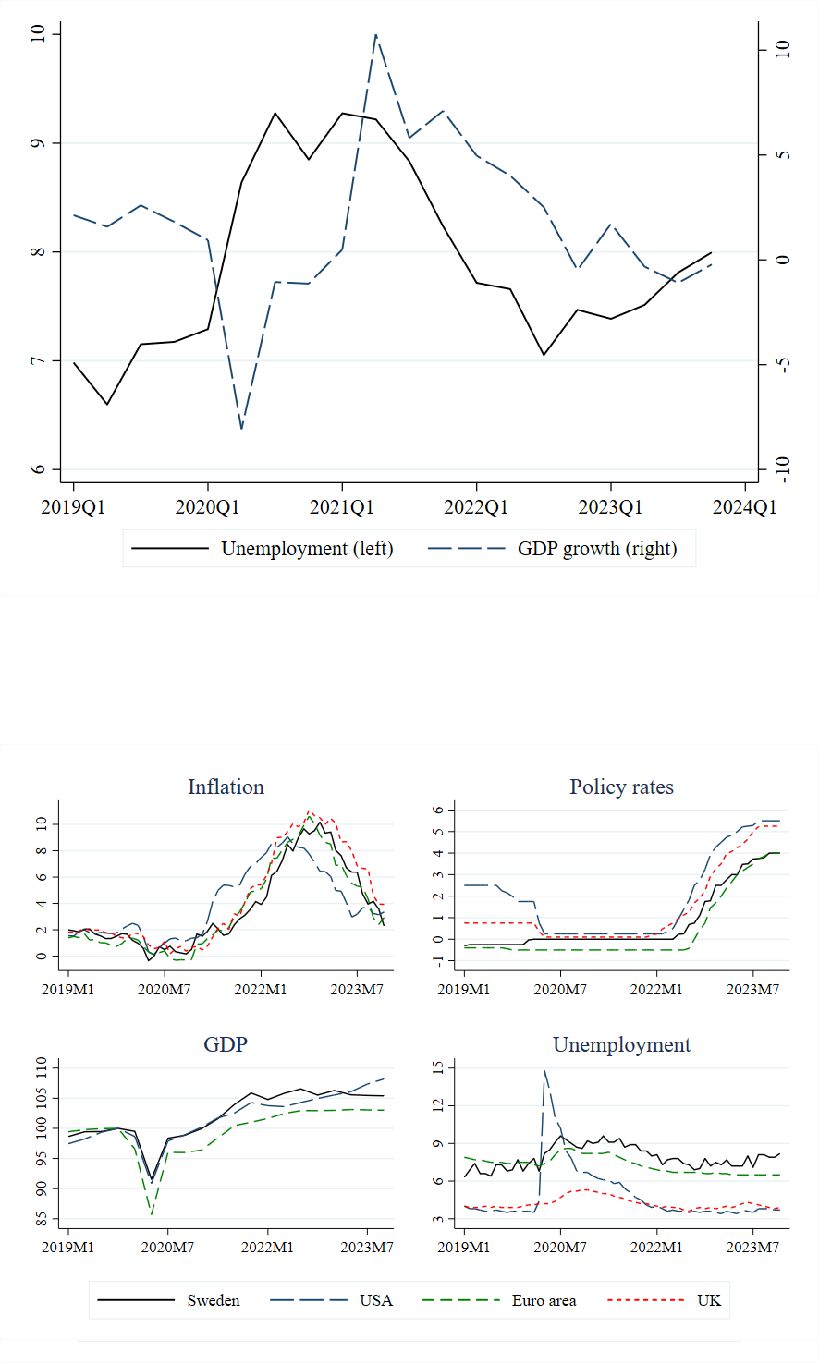
Since inflation increased and the central banks started to raise interest rates, growth has fallen. Figure 3.2 shows that recovery in the economy was great during the second half of the pandemic (from the second quarter of 2021), but that GDP has fallen since then. During the second and third quarters of 2023, there was negative growth, probably partly as a result of the central banks’ tightening of monetary policy. However, unemployment has increased less than many initially feared. At the end of 2023, it stood at 8.0 per cent, which is an increase of less than 1 percentage points since the lowest level in the third quarter of 2022. Overall, this gives a picture that the labour market has been very resilient to the central banks’ interest rate increases, and that those who believed that the economy would make a soft landing were right.14 Figure 3.3 shows that developments in Sweden, the USA and the euro area have been similar, even though the USA appears to be ahead in the monetary policy cycle.
14An important exception is housing investments, which fell heavily in 2023.
25
| 2023/24:RFR15 | 3 BACKGROUND – MACROECONOMIC DEVELOPMENTS IN 2023 |
| Figure 3.2 Unemployment and GDP growth in |
Notes: Per cent. Quarterly data.
Source: The Riksbank.
Figure 3.3 Economic developments in Sweden, the USA and the euro area
Notes: Inflation concerns CPIF for Sweden, HICP for the euro area and CPI for the USA and the UK. The GDP is
Source: The Riksbank.
26
| 3 BACKGROUND – MACROECONOMIC DEVELOPMENTS IN 2023 | 2023/24:RFR15 |
3.2 Major macroeconomic events in 2023
Two major events occurred in March 2023. The start of the month saw bank runs from banks in the USA (Silicon Valley Bank and two other banks) and from Credit Suisse. This led to general disquiet in the banking world. American bank shares fell by 20 per cent and Swedish bank shares by just under 20 per cent. Central banks and public authorities in the affected countries took immediate action, and these developments did not have any major, systematic effects. In the margins, it is however probable that higher risk premiums had a tightening effect for a period. At the end of the month, a new wage agreement was met for the industrial sector in Sweden, when the “mark” (i.e. the percentage increase for wages decided through collective agreements) was agreed on. The agreement spanned for two years, from 1 April 2023 to 31 March 2025, for a total of 7.4 per cent (4.1 for 2023 and 3.3 for 2024). On account of the “mark’s” normative status, this meant in practice that real wages will not recover until 2025 at the earliest, and the risk of a
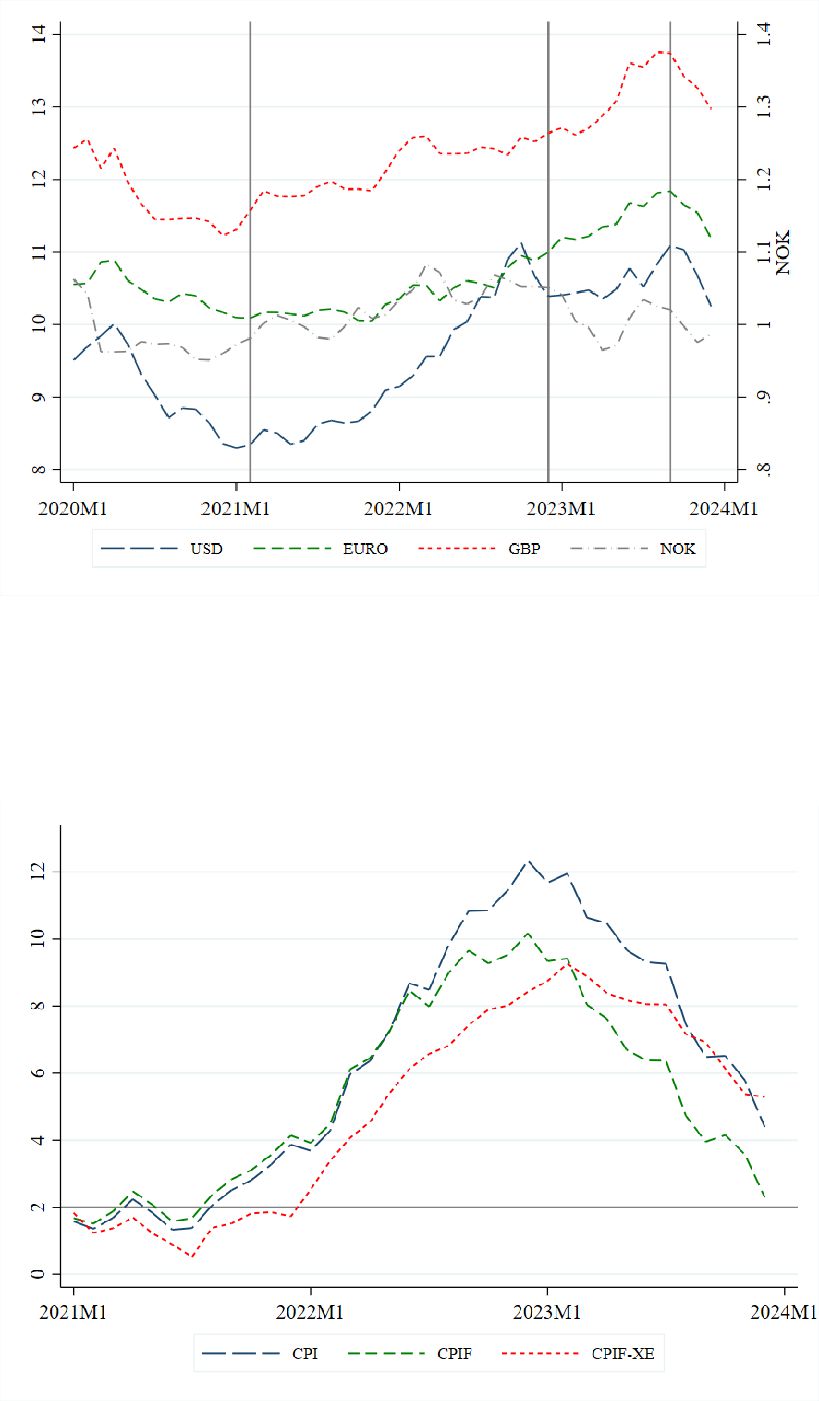
In early 2023, the krona continued to weaken against the most important currencies. Figure 3.4 shows that the krona was at its weakest in September, when it had lost 5.7 per cent against the euro since January, and 6.6 per cent against the dollar. After September, this development turned. In a
During 2023, the inflation rate turned downwards from the top levels reached for inflation measured according to a fixed interest rate (CPIF) in December 2022: 10.2 per cent) and CPI (12.3 per cent) and in February 2023 for inflation measured according to a fixed interest rate excluding energy prices
15The Riksbank’s annual report gives the dollar rates 10.0511 (31 December 2022) and
10.4177 (31 December 2023) and the euro rates 11.1185 (31 December 2022) and 11.145 (31 December 2023).
27
| 2023/24:RFR15 | 3 BACKGROUND – MACROECONOMIC DEVELOPMENTS IN 2023 |
| Figure 3.4 The Swedish krona compared with the US dollar, the euro, the | |
| British pound and the Norwegian krone in |
Notes: The scale of the exchange rate against the US dollar (USD), the euro (EURO) and the British pound (GBP) is given on the left axis and the scale for the Norwegian krone (NOK) is given on the right axis. The first two vertical lines indicate the start and end dates for the transition to a
Figure 3.5 Inflation according to different measures
Notes: Annual inflation according to the consumer price index (CPI), consumer price index with a fixed interest rate (CPIF) and consumer price index with a fixed interest rate excluding energy prices (CPIF_XE). Per cent. Monthly data. The vertical line illustrates the inflation target.
Source: The Riksbank.
28
2023/24:RFR15
4 Monetary policy 2023
In this section, we describe the Riksbank’s forecasts and the conducted monetary policy, and make certain comparisons with other central banks.
4.1The Riksbank’s forecasts
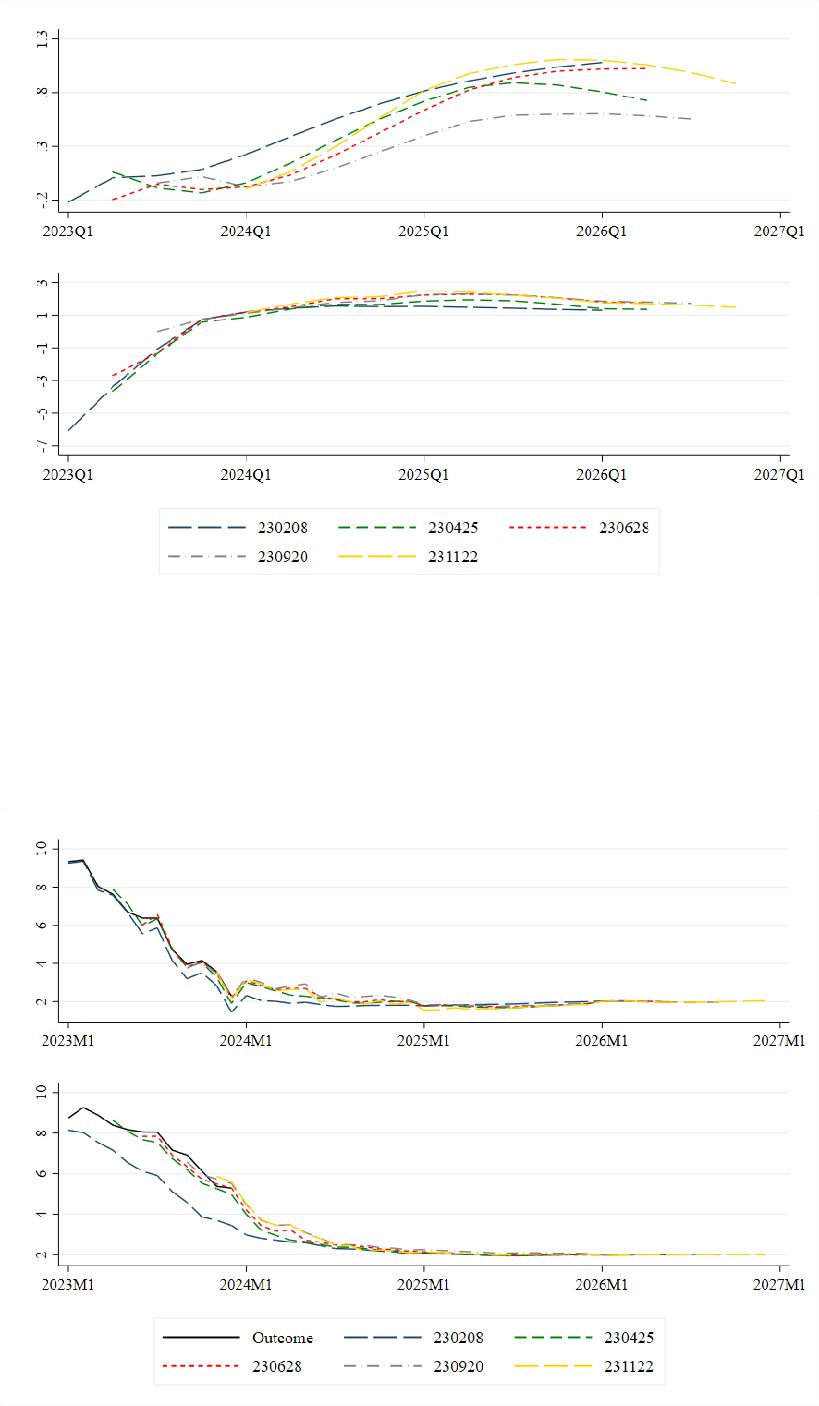
In the light of criticism voiced in last year’s report on the Riksbank’s forecasts, we now investigate the forecasts made during 2023. Figure 4.1 shows the Riksbank’s forecasts for inflation with a fixed interest rate (CPIF) and a fixed interest rate excluding energy prices
16The accuracy of the forecast is also good for inflation excluding energy prices. The first forecast trajectory (8 February 2023) is admittedly initially 1.4 percentage points below the outcome. The reason why the forecast for
29
| 2023/24:RFR15 | 4 MONETARY POLICY 2023 |
| Figure 4.1 Forecasts and outcomes for inflation in 2023 according to CPIF | |
| (above) and |
Notes: The solid line shows annual inflation (outcome). The dotted line shows forecasts at various dates), Consumer price index with a fixed interest rate (CPIF) above and excluding energy prices below (CPIF- XE). Per cent. Monthly data.
Source: The Riksbank.
In last year’s report, in addition to a discussion of inflation forecasts, there was also a discussion of forecasts for the GDP gap and unemployment, and for the interest rate path. The forecasts for the GDP gap and unemployment can be seen in figure 4.7, and these are also close to the actual outcome. We will discuss the interest rate paths in Section 4.4.
4.2The Riksbank’s decisions for measures
The Riksbank held five monetary policy meetings in 2023. The policy rate was raised by 1.5 percentage points, from 2.5 per cent to 4.0 per cent, between February and November. Other restrictive monetary policy decisions were also taken, mainly in the form of active selling of bonds, and that an increasingly restrictive interest rate path was communicated. These decisions are summarised in table A.1 in the appendix.17
The policy rate and balance sheet operations
At the meeting in February, the policy rate was raised by 0.5 percentage points to 3.0 per cent. A decision was also made to begin selling government bonds, corresponding to SEK 3.5 billion per month, from April onwards. Finally, it was decided that there would be an increase in the issue of Riksbank certificates maturing in one week, which would raise the effective policy rate
17Decisions taken in 2022, which were evaluated in last year’s report, are listed in table A.2.
30
| 4 MONETARY POLICY 2023 | 2023/24:RFR15 |
somewhat. The reason given for the decision was that
At the meeting in April, the Executive Board of the Riksbank decided to raise the policy rate by 0.5 percentage points to 3.5 per cent. Two board members recommended a rise of just 0.25 percentage points.18 However, the majority emphasised that the decrease in CPIF inflation depended mainly on dramatic falls in energy prices, while inflation according to CPIF XE (excluding energy prices) had fallen more than the forecast from February (see figure 4.1).
At the meeting in June, the Executive Board decided to raise the policy rate by 0.25 percentage points to 3.75 per cent. It also decided to increase the speed of sales of government bonds to SEK 5 billion per month from September onwards. The main reason was stated to be that inflation, cleaned up for energy prices, was falling slowly and that prices for services continued to rise quickly. The latter was seen as a sign that domestic demand was strong and further tightening was necessary.
At the meeting in September, the Executive Board decided to raise the policy rate by a further 0.25 percentage points to 4.0 per cent. Both at the meeting in June and in September, details relating to inflation developments were presented as deciding factors for the decisions. As mentioned above, inflation according to CPIF fell more quickly than inflation excluding energy prices, which would imply a high level of domestic demand. New outcomes were characterised by high volatility and a shift in how various partial indices of CPIF developed. The rate of inflation for goods and food had already fallen rapidly early in the year, while this was not the case for services that carry great weight in the index (approx. 46 per cent of transport is included). Figures
4.2and 4.3 illustrate this. Figure 4.2 shows that the weights for the index do play a role in this – with the 2023 weights applied to 2022, inflation is lower. The Riksbank (2023d) identifies travel abroad in particular as such a category. Figure 4.3 illustrates the increased significance of services for the rate of inflation during the year. In October, CPIF inflation was at 4.2 per cent, of which services accounted for 3.2 percentage points. On the whole, individual inflation outcomes from month to month were volatile, which make interpretation more difficult – we will return to this subject in Section 5.
The same day that the monetary policy decision was announced in September, there was also an official announcement that the Riksbank had decided to take measures to reduce the currency risk with a fourth of the foreign exchange reserve (USD 8 billion and EUR 2 billion). These amounts
18Martin Flodén stated three reasons in favour of a slight increase: (i) that domestic demand was weakening fast; (ii) that the wage agreement for industry would entail a weak development of real wages; and (iii) a general feeling of concern among the banks. Anna Breman gave the following reasons: (i) the policy rate is restrictive and it is desirable that it continues to be so for a long time and that there is room for manoeuvre to act on new information; (ii) domestic demand is falling and the forecast has been revised in a downward direction; and (iii) the speed of inflation is best pushed down by keeping interest rates restrictive for a long period of time.
31
| 2023/24:RFR15 | 4 MONETARY POLICY 2023 |
of dollars and euros were sold. They were obtained by the Riksbank at the same time as entering into a currency
Lastly, in November 2023 the Executive Board decided to leave the policy rate unchanged at 4.0 per cent. At that point in time, inflation on services had also fallen significantly and inflation according to CPIF for
Figure 4.2 CPIF excluding energy and
Notes: Inflation according to the consumer price index with a fixed interest rate and excluding energy prices
Source: The Riksbank’s monetary policy report in September 2023.
19Inflation at the turn of the year 2023/24 was 2.3 per cent according to CPIF and 5.3 per cent according to
32
| 4 MONETARY POLICY 2023 | 2023/24:RFR15 |
Figure 4.3 Contribution to CPIF inflation
Notes: Contribution to annual inflation according to consumer price index with a fixed interest rate (CPIF). Percentage points.
Source: The Riksbank (2024a).
Interest rate paths
In Section 2.4, we described how the Riksbank can control the formation of expectations by means of the interest rate path which is announced after each monetary policy meeting. Figure 4.4 shows the interest rate paths as communicated by the Riksbank in the upper graph and in the lower graph, the financial market’s expected path for the policy rate at each monetary policy meeting. The figure also shows the policy rate the Riksbank decided on,
The upper graph in figure 4.5 shows the difference between the Riksbank’s interest rate paths and the expectations of the market. For 2023, the difference is small, but from 2024 and onwards the difference grows gradually. For 2025
33
| 2023/24:RFR15 | 4 MONETARY POLICY 2023 |
the difference amounts to more than 1 percentage point. The graph below shows what the Riksbank’s published interest rate paths mean in terms of paths for
As we have described in Section 2.4, a lack of consensus between the interest rate path and the expectations of the market may depend on differences in assessments of macroeconomic developments. The Riksbank could be more pessimistic about inflation falling, believing that economic activity would continue to be too high to be consistent with falling inflation. This, however, does not appear to be the case. We illustrate this in Figures 4.6 and 4.7. Figure
4.6shows that according to the forecast, the inflation target will be reached in 2024. The GDP gap remains negative throughout the period of the forecast and unemployment only falls slowly, all according to the Riksbank’s own published forecasts. It is thus unclear what would justify such a restrictive interest rate path. One possibility is that the Riksbank wants to send a signal that it will be more “hawkish” than the market believes it will actually be.
Figure 4.4 The Riksbank’s interest rate path (above) and the market’s interest rate path (below) three years ahead on different dates in 2023
Note: The upper graph shows the Riksbank’s published interest rate paths and the policy rate as an average during each quarter. The lower graph shows the expectations of the market as an average during each quarter. Percentage points.
Source: The Riksbank and its own calculations.
34
| 4 MONETARY POLICY 2023 | 2023/24:RFR15 |
Figure 4.5 Difference between the Riksbank’s interest rate path and expectations of the market (above) and real interest rate paths (below)
Note: The upper graph shows the difference between the Riksbank’s published interest rate paths and the market’s estimated path. The lower graph shows the real interest rate which is calculated as the Riksbank’s policy rate path minus the Riksbank’s forecast for CPIF. The forecast for CPIF is based on the monthly average for each quarter. Percentage points.
Source: The Riksbank.
Figure 4.6 The Riksbank’s inflation forecasts three years ahead on different dates in 2023 (CPIF above,
Note: The Riksbank’s published forecasts on different dates for inflation according to CPIF (upper graph) and
Source: The Riksbank.
35
| 2023/24:RFR15 | 4 MONETARY POLICY 2023 |
| Figure 4.7 Forecasts and outcomes for the GDP gap (above) and | |
| unemployment (below) |
Note: The Riksbank’s published forecasts on different dates – for the GDP gap (upper graph) and unemployment (lower graph).
Source: The Riksbank.
4.3 Comparison with other countries
In Section 3, it was mentioned that the Riksbank’s monetary policy has followed the same path as that of the USA and the euro area, but with a slight delay. The development of inflation is also somewhat delayed in this respect. Inflation according to the main index of the euro area, HICP, peaked in October 2022, and the corresponding time in the USA was June 2022. For Sweden, the peak occurred in December 2022. Figure 3.3 shows that the ECB and Fe- deral Reserve Bank raised the policy rate in a way similar to that of the Riksbank, with the difference that the Federal Reserve Bank started to raise the interest rate in March 2022, while the ECB waited until July 2022. The Bank of England started the cycle of increases in December 2021.
As regards the development of the Rikbank’s balance sheet, it is similar to those of other major central banks. In June 2022, the Federal Reserve Bank decided to no longer reacquire matured government bonds. Figure 4.8 shows the development of the balance sheet relative to GDP for the Riksbank, Federal Reserve Bank, ECB and Bank of England. The peak for the first three occurred at the end of 2021, when the Riksbank’s balance sheet relative to GDP was
28.6per cent. At
As we see in the figure, the development for the Federal Reserve’s balance sheet is roughly parallel to that of the Riksbank. However, the ECB’s balance sheet has fallen more rapidly. Assuming that the effect of changes in the balance sheet are proportional to the change expressed in percentage points
36
| 4 MONETARY POLICY 2023 | 2023/24:RFR15 |
relative to GDP, the tightening in Sweden is roughly in line with that of the USA, but less than in the euro area.
Figure 4.8 Central bank balance sheets relative to GDP
Note: The Riksbank’s and other central banks’ balance sheets relative to GDP. Per cent. The Bank of England has not reported any values for 2023.
Source: The Riksbank.
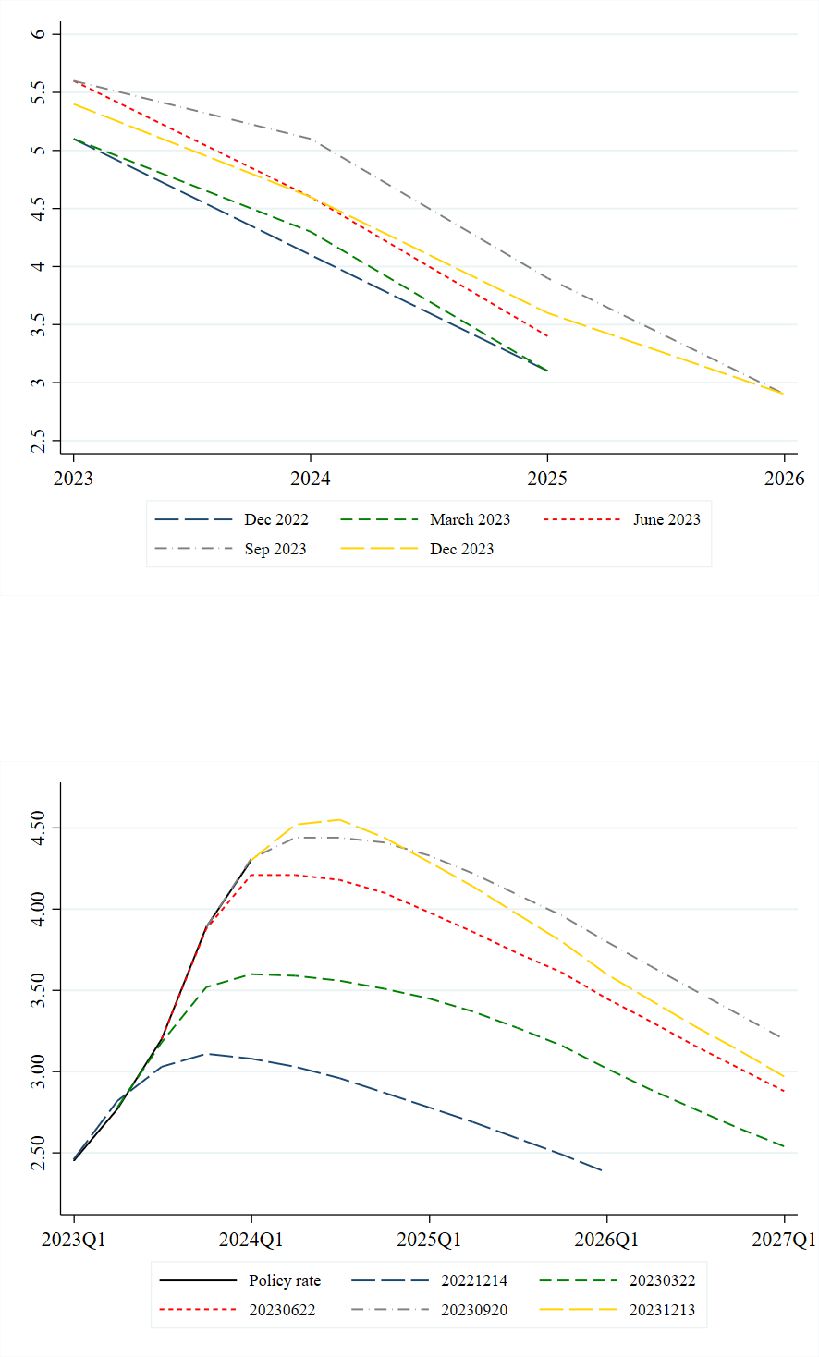
Lastly, we compared the Riksbank’s interest rate paths with the Federal Re- serve Bank’s dot plots and Norges Bank’s interest rate paths. The Federal Re- serve Bank’s dot plots are shown in Figure 4.9 at five different points in time between December 2022 and December 2023. At all of these points in time, the paths show a downward path. Norges Bank’s interest rate paths are shown in Figure 4.10. They show a clear bulge where the policy rate reaches its peak in 2023 for the earliest paths, and for the last path in the third quarter of 2024.
37
| 2023/24:RFR15 | 4 MONETARY POLICY 2023 |
Figure 4.9 The Federal Reserve Bank’s dot plots
Note: The Federal Reserve Bank’s dot plots, presented as the median rate projection among the members of the FOMC at five different points in time. The members’ view of the
Source: Federal Reserve Bank (Summary of Economic Projections).
Figure 4.10 Norges Bank’s policy rate paths
Note: Norges Bank’s published policy rate paths on five occasions. Per cent.
Source: Norges Bank (Monetary Policy Reports).
38
| 4 MONETARY POLICY 2023 | 2023/24:RFR15 |
4.4 Other communication from the Riksbank
The Riksbank’s communication plays a critical role. By explaining its monetary policy (or other) decisions clearly and presenting the probable effects in a correct manner, the Riksbank boosts its credibility. In addition to communication about interest rate paths, as presented in Section 4.2, we consider that communication about the fundamental value of the krona and measures to reduce the exchange rate risks of the foreign currency reserves warrant discussion.
On 21 September, the same day as the monetary policy decision, the Riksbank announced that it was hedging USD 8 billion and EUR 2 billion, corresponding to
20On 29 June, the Riksbank announced that this measure would be taken. See the memorandum: Managing the risks in the foreign exchange reserves (ref.no.
39
2023/24:RFR15
5Evaluation
We will begin by studying fulfilment of objectives, that is what happened as regards inflation and inflation expectations during the year, and following this we will discuss whether we consider the decisions on monetary policy to be appropriate. We then deal with other aspects of decisions and communication by the Riksbank by commenting on examples of criticisms of Riksbank decisions taken during the year.
5.1 Fulfilment of objectives
Has the Riksbank achieved its objective regarding price stability? We will first discuss what happened to inflation during the year and then the
As we established above, during the year inflation was above the
A possible objection is that an ever higher policy rate would probably have led to an even faster fall in inflation. More specifically, one could easily imagine that interest rates could have been raised more sharply and earlier on. However, sudden fluctuations in interest rates are problematic for market actors and the economy – dramatic and sudden increases should be avoided. In last year’s evaluation of monetary policy, it was argued that the implementation of the increases was excessively delayed during 2022. In line with this assessment, we would also like to point out that more rapid reactions during 2022 would have had a positive effect on developments during 2023; this year’s increases must therefore partly be seen in the light of the further
40
| 5 EVALUATION | 2023/24:RFR15 |
increases which were needed at the end of 2022 and which the Riksbank then realised were required (and planned for). During 2023, interest rates were raised successively, and even more that what had been planned at the end of 2022. One interpretation of this is that the threat of inflation was also underestimated at the end of 2022, in other words not only earlier in the year. During 2023, on the other hand, monetary policy was conducted rather with great sensitivity to signals heralding high or persistent inflation, a fact that we will soon return to. Finally, in the discussion on inflation during 2023, we would like to recall that the changes in the policy rate in 2023 were probably not so significant for the inflation outcome during the year. As we discussed in Section 2, there is normally a delay in the impact of this mechanism of one to two years.
However, an evaluation of monetary policy in 2023 cannot stop with an assertion that inflation continued to be above the target a larger part of the year, or for that matter that by the end of the year it had reached the right level. The most important task of the Riksbank, especially in times like those we have gone through, is rather to safeguard overall confidence in the inflation target. We will now discuss whether this target has been reached, taking into account the consequences for the real economy which may have been a result of the policy.
We would first like to recall the arguments concerning the value of wellanchored inflation targets in Section 2.3. History has taught us that without a sufficiently restrictive policy and expectations of such, inflation can entrench itself in the economy long after price shocks have disappeared. It is therefore of central importance that most of the actors in the economy have a picture of future inflationary developments that coincides with the
In summary, most evidence now indicates that the
3.1above), this is clearly the case, but also in a
2 per cent. The Riksbank’s monetary policy, combined with a similar policy in the world around us, has in our opinion been critical for this. How does this view affect our evaluation of monetary policy, particularly during 2023? We, and most other experts, are of the opinion that the high inflation levels we have seen in Sweden during the last two years or so did not come about as a result
41
| 2023/24:RFR15 | 5 EVALUATION |
| of excessively high demand pressure in Sweden. Instead, the reason was | |
| various supply shocks such as higher energy prices and a rise in other global | |
| market prices. In macroeconomic models with |
|
| expectations anchored at target, such inflationary impulses will not drive up | |
| inflation permanently as long as the central bank follows its usual | |
| recommendations.21 This is also a good description of reality, also for the | |
| extreme period we have gone through. Given that inflation expectations are | |
| so that the economy is forced into recession with increasing unemployment | |
| and a negative GDP gap. Once the supply disruptions had eased off, inflation | |
| would have returned to target after a while – not immediately, but at an | |
| acceptable rate. The problem with this analysis, however, is that it is a partial | |
| one: it is based on the assumption that inflation expectations are well- | |
| anchored. If the anchoring had dislodged, the return to target level would not | |
| have taken place. High interest rates, and communication indicating a | |
| continued situation with high interest rates, probably reduced the risk of | |
| inflation expectations losing their |
|
| strong and sound motive for a more restrictive monetary policy, even though | |
| this would entail real economic costs which are not negligible. But just when | |
| this is the objective, the models provide little guidance when it comes to how | |
| much further tightening is required. | |
| Inflation expectations have not lost their anchorage in the inflation target, | |
| as we noted earlier, but we would also like to point out that the quantitative | |
| contributions of Swedish interest rate increases to this – and whether the | |
| objective could have been achieved with lower rises in interest – are questions | |
| it is impossible to answer with any precision. Existing economic models are | |
| not, at least not yet, suited to giving such answers. It is even more difficult, of | |
| course, for the Riksbank to provide answers in real time as to what is required. | |
| However, our assessment is that the Riksbank contributed in a decisive way to | |
| ensuring that the inflation expectations did not lose their anchorage in 2023. | |
| We will discuss their various specific decisions in the next section. |
5.2 Has the policy been well considered?
During 2023, the policy rate, which is the Riksdag’s main monetary policy instrument, was raised from 2.5 to 4 per cent in four stages which are shown in figure 5.1. We have emphasised the importance of safeguarding the longterm inflation target above and drawn the conclusion that the policy as a whole has been successful. Is it also possible to claim that each of the individual decisions regarding interest rates were
21 These “usual recommendations” are usually described in a Taylor Rule in which interest rates are decided as an increasing function of interest and the GDP gap. If the economy is to be stable, the central bank must react sufficiently forcefully to inflationary shocks, according to the theory.
42
| 5 EVALUATION | 2023/24:RFR15 |
remained at 8 per cent with a certain, if marginal, increase. An initial impression is that the decisions regarding interest rates seem to be back to front. The weaker the economy is and the lower inflation is, the lower the policy rate should be, at least in accordance with current theory and the reasoning in Section 2. In more concrete terms, a high interest rate is used to curb demand, which affects the real economy negatively and lowers inflation. This reasoning would demand higher interest rates initially and lower interest rates as the economy is weakened. Why did the Riksbank make these apparently backward decisions?
Figure 5.1 Policy rate during 2023
Note: The Riksbank policy rate during 2023 Current data. Per cent.
Source: The Riksbank.
It would possibly have been reasonable to raise the policy rate more rapidly than was actually the case. In addition, there was a
43
| 2023/24:RFR15 | 5 EVALUATION |
| already at the end of 2023 indicated imminent falls in interest rates? In the | |
| media, several debaters suggested that this should have been done. The argu- | |
| ment was that the inflation outcomes during the last few months had been in | |
| line with the inflation target and that the economy was weak. | |
| In order to address this assertion, in Figure 5.2 we illustrate how inflation | |
| according to CPIF and |
|
| months of |
|
| at each point in time “how inflation has developed recently”. The figure shows | |
| that inflation in March 2023, measured according to CPIF during the last three | |
| months, was just 0.6 per cent. In September, it was 0.4 per cent. At the same | |
| time, the red dotted line in the upper graph in Figure 5.2 shows that the average | |
| for the last three months is so volatile that it provides poor guidance for the | |
| underlying trend. Between March and September, the |
|
| were all over 2 per cent. In December 2023, the |
|
| clearly above the inflation target (3.3 per cent). The retrospective average | |
| during six months did not reach the inflation target until December 2023. In | |
| the lower graph in Figure 5.2, we see that the underlying inflation, |
|
| shows a somewhat different development where a level of 2 per cent for the | |
| in November. | |
| We interpret the Riksbank’s decision, on the basis of its communication, | |
| as a result of a relatively strong concern for persistent inflation based on an | |
| unexpectedly strong domestic demand. The detailed figures for price increases | |
| that we reported in Figure 4.2 and 4.3 show that many underlying price incre- | |
| ases were set to continue, but lagging behind especially in the service sector, | |
| and these indicators seem to have made the feeling of concern more no- | |
| ticeable. The overall picture is thus that in 2023 the Riksbank has been much | |
| more sensitive to indicators of persistent inflation and has used increases in | |
| the policy rate and a communicated interest rate path as a counterbalance. Our | |
| opinion is that the Riksbank was right in its view. “The war on inflation” could | |
| not be regarded as won back in the summer or autumn of 2023 based on the | |
| shaky signals that were coming in. It would have possibly been acceptable to | |
| not to impose the last rise in interest rates and allow the policy rate to remain | |
| at 3.75 per cent instead of raising it to 4.0 per cent. However, we believe that | |
| this would have given some benefit in terms of increased economic activity, | |
| but at the same time it would have marginally increased the risk that inflation | |
| would have become entrenched. It is also likely that a somewhat faster | |
| increase in the policy rate during the spring would have made it more rea- | |
| sonable not to go the whole way to 4 per cent. But not even in retrospect is it | |
| possible with any certainty to determine whether this would have led to a better | |
| outcome. Therefore, our assessment is that there is no reason to criticise the | |
| Riksbank’s decisions. The fact that it is difficult to determine with any precis- | |
| ion what the correct assessment is, however, means that we would probably in | |
| any case not have criticised the Riksbank if the last rise in interest rates had | |
| not been implemented. |
44
| 5 EVALUATION | 2023/24:RFR15 |
Figure 5.2 Inflation on an annual basis over the last three, six and twelve months according to the CPIF (above) and the
Note: Inflationary developments during the last year (solid blue line), the last six months (green dotted line) and the last three months (red dotted line). Calculated on an annual basis.
Per cent.
Source: Statistics Sweden and our own calculations.
Inflation forecasts
We will also comment on the inflation forecasts that have been made, especially as criticism was levelled towards the forecasts that were then presented. In Section 4.1 above, it was noted that the forecasts appeared to be good during the year compared with outcomes. One possibility is that the Riksbank adjusted its view of inflation dynamics and thus identified the situation as being better than during 2022. Another possibility, however, is that it did not do this, but that data during 2023 behaved more favourably. During 2023, all forecasts appeared to be as they were in 2022, that is that the forecast path was quite simply falling inflation from the time that the forecast was made, which was wrong in 2022 but right in 2023. It is difficult to determine which of these interpretations is correct. First and foremost, we would like the Riksbank to explain how the forecasts (both for inflation and interest rates) are made. Many different models for forecasting are available: which of these are used or given the most importance? To what extent is “manual handling” done? Manual handling may of course be justifiable in many cases, especially during historically unusual episodes. A more transparent account of this would be valuable.
Last year’s report requested conditional forecasts, or alternative scenarios. We note that alternative scenarios occur in all monetary policy reports from April 2023 onwards. They have thus been given a much more pronounced role, which is positive. Flodén (2024) believes that the scenarios in November 2023
45
| 2023/24:RFR15 | 5 EVALUATION |
| were valuable in what was communicated, but also points out that meaningful | |
| scenarios require a work procedure in which the management involves itself | |
| in the process at an early stage. We will now discuss the inflation paths during | |
| 2023, which play a central part in such a scenario analysis. |
Interest rate paths
In 2023, the Riksbank’s interest rate paths were far from the expectations of the market and were considered to have low credibility. The greatest deviation was that the Riksbank signalled higher interest rates during a longer period of time than the market saw as reasonable. The Executive Board of the Riksbank needs to analyse the deviations between the published interest rate path and the
Our reading of the assessment of the Riksbank and the market of the future economic situation is that the assessments are quite similar. In particular they both have the same view that inflationary developments will be favourable. Given this, the market thus does not seem to believe that the Riksbank will keep interest rates at such a high level – as this will not be necessary. The conclusion is that the gap between the Riksbank’s interest rate path and the market’s expected interest rate path depends on the fact that the market does not really believe in the Riksbank’s patterns of behaviour as they are expressed in the interest rate paths. This can be seen as a potential problem of credibility, but provided that inflation will soon reach target, the problem is not urgent. This assessment is supported by the fact that inflation expectations seem to be
If the interest rate paths are all too often understood to be improbable, despite a shared view of economic developments, there is a certain risk that the Riksbank would find it difficult to influence expectations by means of adjustments in the interest rate path. In other words: if little importance has so far been attached to the path, how could it quickly have more importance in the formation of expectations? This risk should, however, not be exaggerated. It is possible that market actors attach a low level of trust to the interest rate path as it does not appear to be consistent with macroeconomic developments and what is a normal and reasonable level for interest rates to be set at in view of these developments. In a situation in which the macroeconomic development justifies a heavily restrictive or accommodative interest path, it would presumably be easier for the Riksbank to create credibility for such a path.
46
| 5 EVALUATION | 2023/24:RFR15 |
Even though an interest rate path during a normal monetary policy cycle plays little role, we believe that it is valuable to have established credibility surrounding the interest rate path prior to situations that require vigorous monetary policy measures.
An overall question is whether the Riksbank’s interest rate paths do actually coincide with the Riksbank’s forecasts or whether they signal something else, for example what the Riksbank is prepared to do during special scenarios.22 If the paths are forecasts, how are these forecasts made? As is the case with inflation forecasts, we are asking for more transparency. If the paths are not forecasts, what are they? These are the questions Flodén (2024) discusses. He thinks that the interest rate path can facilitate an intelligent discussion on monetary policy.
We see signs today that the Riksbank is in the process of reviewing the role of the interest balance and its way of communicating about this, which is particularly clear in the monetary policy report from March 2024. We refrain from commenting on specific changes during 2024, but our general assessment is that it would be sensible to continue to publish a long interest path and that this should reflect the Executive Board’s expectations concerning the future policy rate. It would also be suitable as far as is possible to clarify in what way these expectations are based on expected developments in the economy and the Riksbank’s reaction to this.
The exchange rate of the krona and communication on decisions pertaining to the foreign currency reserve’s foreign exchange exposure
As we described in Section 4, the Riksbank made a decision on foreign currency reserves in connection with its monetary policy meeting in September, that is to successively reduce the foreign exchange exposure for part of them. A
22In the minutes of the monetary policy meeting from June, the following argument by First Deputy Governor of the Riksbank is to be found. This illustrates a way of thinking about the interest rate path as a monetary policy instrument: “The second thing I would like to draw attention to regarding monetary policy considerations is that it is problematic that many households and companies seem to expect that the policy rate will soon be lowered. Let me explain why. We know that household savings were high during the pandemic. Pandemicrelated savings may have been used to maintain consumption, and may have counteracted the tightening of monetary policy. Available date now indicates that the influx of new money into savings accounts had fallen, though the total amount of funds in savings accounts is still at a very high level. With large buffers, expectations regarding the policy rate are important. For example, if households believe that the tightening is temporary and that the policy rate will soon be lowered, they can choose to use savings to even out consumption over time. Demand will be strengthened and there is a risk that inflation will become entrenched at a high level. Ultimately, this can result in our needing to make further increases in interest. Paradoxically enough, expectations of imminent cuts in interest rates can mean that we have to raise the policy rate more, and keep it at a high level during a longer period of time that what we would have needed otherwise.”
23The Governor of the Riksbank also announced this at the end of the press conference that followed the monetary policy decision.
47
| 2023/24:RFR15 | 5 EVALUATION |
| rates, a swap agreement. These measures included the fact that the currency | |
| would be exchanged back at a specified future point in time. Since the foreign | |
| currency is already sold, at the specified future point in time, foreign currency | |
| has to be obtained in another way, either by means of a new swap agreement | |
| being entered into or by means of selling parts of the foreign reserves. These | |
| measures mean that the value of the foreign currency reserves in Swedish kro- | |
| nor becomes somewhat less sensitive to variations in exchange rates. This has | |
| been called “hedging” the currency reserves, but this is an expression which | |
| in our opinion is not completely satisfactory. Admittedly, the foreign exchange | |
| exposure is reduced as a result of these measures, but they also lead to the fact | |
| that part of the currency reserve is bound up in the event of it being difficult | |
| to roll over the swap agreements when these expire. If a crisis should arise | |
| when Swedish banks quickly need foreign currency and the Riksbank also | |
| needs to pay back foreign currency, access to foreign currency will become | |
| more limited.24 | |
| The measures that were taken entailed a lower level of currency exposure, | |
| that is from the broader consolidated central government perspective a lower | |
| foreign exchange exposure for the state, measured in Swedish kronor, as well | |
| as a realisation of the profits that had been made as a result of the successive | |
| fall of the krona. In as far as currency reserves are just reserves in the sense | |
| that their principal purpose is to be used in extraordinary situations, |
|
| fluctuations in value are merely of limited |
|
| view here is, first and foremost, that the background to the decision could have | |
| been communicated much more clearly. If this was a decision that was mainly | |
| regarded as important from a consolidated central government perspective – | |
| to reduce the foreign exchange exposure of the overall central government | |
| portfolio – this should have been made clear. At the same time, this would then | |
| be at variance with the bank’s earlier decisions to expand the currency | |
| reserves. In this case, is this implicitly a change in attitude of what constitutes | |
| an optimal size for currency reserves? If you have currency reserves, you are | |
| by definition subject to foreign exchange exposure. However, it may be | |
| assumed that the decision was regarded as being relevant rather for the sake of | |
| the bank’s own balance sheet or result, in other words relevant when seen from | |
| a narrower perspective. The idea here could be to avoid a further deterioration | |
| of its equity.25 We will discuss this problem – that the Riksbank sees itself as | |
| being limited by having too weak a balance sheet – in Section 6 below. | |
| Another alternative motive is that the intervention was partly seen as a | |
| monetary policy measure. The idea was to bring about a strengthening of the | |
| 24 See the Riksbank (2023f) for a more detailed and more technical discussion, pp. |
|
| 25 This was the IMF’s interpretation (2024). It writes: “The Riksbank launched a programme | |
| to hedge the FX risk in its balance sheet in late September 2023, following losses of about | |
| 1.4 percent of GDP in 2022 (mostly explained by valuation losses of its bond holdings, which | |
| have since been partly recovered). The operation synthetically shielded about a quarter of FX | |
| reserves from potential krona appreciation, and was completed in 4 months. The operational | |
| details were published with a |
|
| the exchange rate. The krona appreciated some 4.5 percent against the USD, and 2 percent | |
| against the euro during the length of the program, while retaining its |
|
| is crucial to maintain the shock absorbing role of the exchange rate, absent disorderly market | |
| conditions, and thereby repeated use of the strategy should be avoided.” |
48
| 5 EVALUATION | 2023/24:RFR15 |
value of the krona. This strengthening could potentially be achieved through the purchase of kronor together with the Riksbank’s communication in this connection, thereby helping in the struggle against inflation.
During the year, there was a change in the view of the extent exchange rate changes impact domestic price levels. Recently, at least, the impact seems to have been great, which would mean a significant downward pressure on inflation if the krona is strengthened. It is unclear whether we should comment on the Riksbank’s decision regarding hedging, as it is unclear to what extent – if at all – this was a monetary policy decision. However, we would strongly urge for more clarity here. If one of the motives was related to monetary policy, it ought definitely to have been included as a point on the agenda of the Executive Board’s monetary policy meeting. Conducting monetary policy by means of an intervention on the currency market in addition to regular measures, and outside monetary policy meetings, would in fact be a distinct deviation from the way in which monetary policy has been conducted historically and would also be problematic from the perspective of transparency.
Another aspect of the Riksbank’s communication is that it has been made clear in various contexts that the krona has been considered to be undervalued. It is also unclear what the purpose of these signals has been. The arguments behind the view of the krona are to be found in an
5.3Restoration of the Riksbank’s equity
The Riksbank’s equity was negative at the end of 2023 – before the appropriation of profits it was minus 18 billion kronor and before the result of the year it was 16 billion kronor (see Figure 5.3). Different central banks deal with this type of situation in different ways (see Long and Fisher, 2024, for an international overview). Under the Riksbank Act, a submission to the Riksdag is therefore required for an equity injection, which is what happened in April 2024 (the Riksbank, 2024b). The proposal is that the equity should be restored to the target level, which would mean a capital injection of approx. 43 billion kronor. Whether or not the fact that the Riksbank needs to “ask for money” affects its independence is an important question, but it is difficult for us to assess. It is quite clear that an internal transaction inside the state does not have any significance for the overall central government balance sheet, but the national debt does increase, which is of course significant. Transfers between the various central government institutions may be significant, especially in
26Comments in the National Debt Office’s proposed guidelines for managing the national debt
49
| 2023/24:RFR15 | 5 EVALUATION |
times of crisis if the central government loan resources are limited. Our task here is not to evaluate the Riksbank Act – and whether it puts the Riksbank into too much of a state of dependency – but it is sufficient to say that we note that this dependency, in as far as it is understood as being so, can mean an undesired limitation of scope for action. We will deal with this question below in Section 6.
Figure 5.3 The Riksbank’s equity and results
Note: The red line indicates the target level for equity in accordance with the Riksbank Act of 60 billion. The yellow line indicates the minimum level of 20 billion kronor. Billions of kronor. The levels are indicative as they are gradually adjusted upwards. Observations from 31 December each year. Annual data. Source: The Riksbank.
5.4 Common criticisms of the Riksbank
We wish to comment briefly on some common criticisms directed at the Riksbank. Most of these comments are directly connected with our discussions earlier in the report.
1.The last increase in the policy rate to 4 per cent was unnecessary and is the cause of the recession.
We do not agree with this. In September 2023, there were a number of signs that inflation would not become entrenched in the economy. It would have been irresponsible to declare the “war against inflation” won with the information that was available. Nor is it possible – even after the event – to determine whether refraining from raising the interest rate to 4 per cent would have led to a development that would have on the whole been favourable. Economic developments would have been somewhat more favourable, inflation marginally higher and the risk of rising inflation expectations somewhat higher. The rough calculation we made in Section 2 indicates that the total effect of the tightening of 0.25 percentage units’
50
| 5 EVALUATION | 2023/24:RFR15 |
increase in interest rate is extremely limited. The total fall in demand is probably at most 5 billion kronor, that is less than 0.1 per cent of GDP.
2.Supply shocks cannot be solved with interest rate increases.
We do not agree. Of course, it is true that negative supply shocks cannot be neutralised with rises in interest rates. But regardless of the cause, the risk is that a period of high inflation may result in an erosion of confidence in the inflation target. Restoring this confidence can be very costly. It is therefore without a doubt in line with established theory and proven experience to meet supply shocks with rises in interest rates. Fiscal policy designed to stimulate supply can reduce the inflationary effect of supply shocks, but lies outside the Riksbank’s mandate and toolbox.
3.What does the Riksbank believe is a sufficient increase in the interest rate to ensure confidence in the inflation target – does it really have any idea?
The Riksbank has different economic models at its disposal to calculate the effect of changes in the policy rate. But all these models are based on the assumption that inflation is anchored, that is that confidence in the inflation target is one hundred per cent. However, to understand how much that is required to steer confidence back to the target when it has started to become fragile, there are no models to lean against today, at least not models that are quantitative and surrounding which there is a certain amount of consensus. Our interpretation of the decisions of the Executive Board during the year is that they tried their way by looking at market expectations and were sensitive to signs that inflation would turn upward again. We consider this to be a reasonable strategy under these circumstances.
51
2023/24:RFR155 EVALUATION
4. The Riksbank could have avoided the loss of its holdings of securities by holding on to them until they expired.
This is not correct. The Riksbank’s interest rate increases meant that the cost for financing securities, that is the interest on the commercial banks’ borrowing from the Riksbank, increased, while at the same time the interest income from the securities remained unchanged. This means that the market value of government bonds falls, but also that the net interest income for the Riksbank, the difference between interest income and the policy rate, is negative. If the Riksbank sells the bonds, the capital losses will be realised. These losses reflect the difference between interest income and the expected future policy rate. Such realised capital losses also have a negative effect of the result for the year. If the Riksbank instead holds on to the bonds until maturity, the final result will be the same, presumably. The negative net interest income also has a negative effect on the result for the year. If the policy rate falls back more quickly than expected, there will be a somewhat smaller loss resulting from holding on to the bonds until maturity compared with selling them before maturity, but the opposite applies if the policy rate rises unexpectedly much.27
5. The krona has depreciated in value and this constitutes a loss for Sweden: it erodes our prosperity. The Riksbank should have defended the krona during the year, either by means of greater increases in interest or by means of rescue purchases of currencies.
We do not agree. Prosperity in Sweden is founded upon our ability to produce goods and services, not upon the value of the krona. We have a great deal of exports and imports, and the fall in the krona can in the short term lower imports and benefit exports, but a little more in the long term these too are determined by real factors. In the short term, there are also distributional effects, for example households that spend a large amount of their budget on imported goods (such as travel abroad) are affected by a falling krona. Regardless of this, the value of the krona is not a target in itself for the Riksbank – its task is about safeguarding price stability. Controlling the value of the krona can of course be seen as part of monetary policy, but the Riksbank has for many years chosen to place a great deal of importance on this channel, which we also think is sensible.
27Here, we disregard how the result and the booked equity develops up until maturity. In the books, unrealised losses have a negative effect on the result of the year (and equity), but not unrealised profits, which are instead booked in the revaluation accounts.
52
| 5 EVALUATION | 2023/24:RFR15 |
6.The Riksbank’s interest rate increases have a very negative impact on households, especially those who are young and in debt.
We agree, It is true that interest rate increases negatively impact the scope households have for consumption. This cash flow channel is one of the ways in which monetary policy works. In an international perceptive, a relatively large proportion of Swedish households have variable interest rates. In other countries, for example the USA, it is usual to have interest rates that are fixed for a period of 30 years. This difference means that households in Sweden, especially young ones and those in debt, have to carry a greater burden in connection with the fight against inflation. De- aling with this can be commendable, but lies outside the mandate and toolbox of the Riksbank.
53
2023/24:RFR15
6 Further questions on monetary policy
This section provides a very brief description of a few questions that establish the framework for monetary policy and would therefore benefit from future analysis.
6.1The Riksbank’s financial status
We will now discuss a recurring theme in this report: the significance of the Riksbank’s financial status. The overall question is whether a “weak” financial status, defined in terms of low (or even negative) equity, impedes the Riksbank’s fundamental tasks. The Riksbank is a body under the Riksdag, and according to law, the Riksbank must make a submission to the Riksdag for a capital injection if its equity becomes too low. This requirement exists in Sweden, but is unusual in an international perspective. The Riksbank’s own earning opportunities, through the issue of banknotes and coins, are poor today. This fact also makes Sweden unusual in an international perspective. In most other countries, banknotes and coins are used to a much greater extent, which makes the volume of banknotes a more relevant source of financing, both for central banks and for central government as a whole.
Under the current legislation, submissions to the Riksdag for capital injections have become inevitable. Does this make it more difficult to conduct monetary policy? Does it erode the independence that the bank enjoys, and/or lead to monetary policy decisions that affect the consolidated central government sector, and thus the prosperity of society? The decision during the year on hedging of the foreign currency reserve is difficult to interpret and may indicate that the issue needs to be further illuminated. Any future decisions on quantitative easing (QE) may also be affected by the fact that the Executive Board perceives the bank’s financial status as weak, that is, that there is a risk of a need for recapitalisation. Our role is not to evaluate the decisions on QE that have been taken in the past. Our view is that such decisions should admittedly take into account the potential losses that may arise, but that focus should be directed more on the consolidated central government perspective, rather than the Riksbank’s own perspective. If the consolidated central government makes losses – be it through foreign currency holdings or holdings of Swedish
The Riksbank’s own earning ability has, as mentioned, weakened over time owing to the dramatic fall in the use of banknotes and coins in Sweden.
54
| 6 FURTHER QUESTIONS ON MONETARY POLICY | 2023/24:RFR15 |
Earnings can of course arise as a result of the composition of the financial portfolio – on account of the fact that the term to maturity of its assets does not correspond to the term to maturity of its liabilities or because of exchange rate changes – but the objective of asset management should not be to strengthen the bank’s own financial status. Central banks can, in principle, also increase their own earnings by introducing reserve requirements for banks, that is, not pay interest on all deposits. Such changes are discussed internationally.
On the whole, the relationship between the central bank’s financial and political independence is complex, and there are no obvious answers to the above questions.28
6.2The impact of monetary policy on distribution of income and wealth
During the period of very low interest rates, the question of monetary policy’s distribution policy aspects was more in focus than previously, and hypotheses were developed that monetary policy during this period affected inequality in society through, partly, new channels. In this section, we discuss a few of these channels, as we consider that they may need to be highlighted. However, the desirability of one or the other outcomes is a political matter.
One of the traditional objectives of monetary policy is, to the greatest possible extent, to stabilise the real economy, i.e., to maintain a high utilisation of resources. This objective is not just about
As regards the new channels, the period of low interest rates that followed the financial crisis in
Further, there is the question of how QE (and QT) affect the values of assets. If the Riksbank makes a loss by buying a government bond and later selling it when market rates rise, the counterparty (or a combination of counterparties) per definition makes a profit. A loss for central government means a cost, as central government is funded through taxes which normally distort and cause losses of efficiency. In addition, we can also note a redistribution from
28See, for example, Hall and Reis (2015), Kjellberg and Vestin (2019), and Long and Fisher (2024) for further reading.
55
| 2023/24:RFR15 | 6 FURTHER QUESTIONS ON MONETARY POLICY |
| central government, that is, all taxpayers collectively, to the individuals or | |
| companies, Swedish or foreign, who have gained from the transaction. | |
| Finally, large profits for banks, when interest rates have risen and the | |
| banks’ margins appear to have increased, have recently added further fuel to | |
| the debate on these issues. Is it, for example, the case that interest rate changes, | |
| both upwards and downwards, systematically give increased profits for the | |
| bank sector, and perhaps reflect incomplete competition, with the outcome that | |
| the distribution of society’s total resources is affected? | |
| The questions we are raising here are politically loaded. The point of | |
| asking them is that the answers can affect how we interpret and evaluate mo- | |
| netary policy: the consequences of these insights have a bearing both on the | |
| setting of interest rates and on the Riksbank’s issuing of digital currency | |
| (which would compete with or affect the value of other digital currency). The | |
| questions have so far only been the subject of limited research, but this research | |
| is very much alive, although it is possibly difficult to draw any conclusions as yet. |
56
2023/24:RFR15
7 Summary and concluding remarks
Last year’s evaluation of monetary policy in 2022 maintained that there was a certain tardiness in reacting to the rapidly rising inflation. In 2023, on the other hand, monetary policy was pursued with what we perceive as a clear concern that high inflation would become entrenched and threaten anchorage at the
With the benefit of hindsight, one can describe the Riksbank’s concern about inflation in 2023 to have been great. Inflation expectations appeared to be stable, around the
Our assessment is that the Riksbank’s communication was good, with a couple of exceptions. One such exception was the interest rate paths, where we see a gap between market expectations and the Riksbank’s own path, which needs to be explained in greater detail. The Riksbank should have communicated more clearly the extent to which the interest rate path is a forecast (and if so, what forecast it is based on) and the extent to which it is more about signalling tightening if inflation starts to rise again. It would also be wise, more
57
| 2023/24:RFR15 | 7 SUMMARY AND CONCLUDING REMARKS |
| generally, to clarify how forecasts (for interest rates, development in the eco- | |
| nomy and inflation) are made. | |
| We see a further problem regarding communication about the measures to | |
| reduce the foreign currency reserve’s exchange exposure in September. We | |
| have chosen not to evaluate these decisions per se as, with the information | |
| available to us, they are not an obvious part of monetary policy. However, it | |
| is difficult for us to gain a clear picture of whether this decision was fully or | |
| in part a monetary policy measure. If it was, it should have been dealt with at | |
| the monetary policy meeting. If the decision did not have monetary policy | |
| grounds, more could have been done to clarify this. A possibility is that the | |
| hedging of the foreign currency reserve improved the Riksbank’s financial sta- | |
| tus and the grounds could thus be a perceived increased independence. | |
| It has, in summary, been an eventful year with good final results from a | |
| monetary policy perspective. |
58
2023/24:RFR15
References
Amberg, N., Jansson, T., Klein, M. and Rogantini Picco, A. (2022), “Five Facts about the Distributional Income Effects of Monetary Policy Shocks”, American Economic Review: Insights, 4(3):
Blix Grimaldi, M., Crosta, A. and Zhang D. (2021), “The Liquidity of the Go- vernment Bond Market – What Impact Does Quantitative Easing Have? Evidence from Sweden”, Sveriges Riksbank Working Paper Series No. 402.
Bylund, E., Iversen, J. and Vredin, A. (2023) “Monetary policy in Sweden after the end of Bretton Woods”, Sveriges Riksbank Working Paper Series No. 429.
Calmfors, L. (2023) “Riksbanken förlorar miljarder – på grund av sina egna räntehöjningar”, Dagens Nyheter,
Claussen, C. A. (2017) “Central Bank of Chile’s Monetary policy decisionmaking process, communication and transparency – Review and recommendations”.
Cranston, M. (2023) “Shifting inflation target a slippery slope: Summers”, Fi- nancial Review, March 8,
Flodén, M. (2024) “Att kommunicera om framtida penningpolitik – reflektioner efter elva år som ledamot i Riksbankens direktion”, speech at Nordea on 17 April.
Hall, R. and Reis, R. (2015) “Maintaining
Hassler, J, Krusell, P. and Seim, A. (2023), “Evaluation of monetary policy 2022”, Report from the Riksdag 2022/23:RFR5.
IMF (2024) “Sweden”, Article IV Consultation, IMF Country Report No. 24/ 70.
Kjellberg, D. and Vestin, D. (2019) “The Riksbank’s balance sheet and financial independence”, Sveriges Riksbank Economic Review 2019:2,
Long, J. and Fisher, P. (2024), “Central bank profit distribution and recapitalisation”, Bank of England Staff Working Paper No. 1.069. April.
The Riksbank (2021), “Valutareservens finansiering – konsekvenser för Riksbankens balansräkning och finansiella risker”, file no.
The Riksbank (2022a), Minutes of the Monetary Policy Meeting held on 9 February 2022.
The Riksbank (2022b), Minutes of the Monetary Policy Meeting held on 27 April 2022.
59
2023/24:RFR15REFERENCES
The Riksbank (2022c), Minutes of the Monetary Policy Meeting held on 29 June 2022.
The Riksbank (2022d), Minutes of the Monetary Policy Meeting held on 19 September 2022.
The Riksbank (2022e), Minutes of the Monetary Policy Meeting held on 23 November 2022.
The Riksbank (2023a), Minutes of the Monetary Policy Meeting held in February 2023.
The Riksbank (2023b), Minutes of the Monetary Policy Meeting held on 25 April 2023.
The Riksbank (2023c), Minutes of the Monetary Policy Meeting held on 28 June 2023.
The Riksbank (2023d), Minutes of the Monetary Policy Meeting held on 20 September 2023.
The Riksbank (2023e), Minutes of the Monetary Policy Meeting held on 22 November 2023.
The Riksbank (2023f), “Inquiry into how currency risk can be reduced”, file no.
The Riksbank (2024a), “Account of monetary policy 2023”.
The Riksbank (2024b), “Restoration of equity”. Submission to the Riksdag 2023/24:RB4.
The Riksbank Committee (2019), “A New Sveriges Riksbank Act”, SOU 2019:46.
The Swedish National Debt Office (2018), Statsupplåning – prognos och analys, 2018:2, Riksgäldskontoret.
Svensson, L. E O (2015), “Forward Guidance”, International Journal of Central Banking, 11 September 2015, Supplement 1,
60
2023/24:RFR15
Appendix
Table A1 Monetary policy decisions 2023
| Date of meeting | Policy rate | Grounds for the decision* | ||
| Change | New level | |||
| 8 February | +0.5 | 3.0 | Inflation is far too high and has continued to | |
| rise. For inflation to fall and stabilise around | ||||
| the target within a reasonable time, the | ||||
| Executive Board has decided to raise the | ||||
| Riksbank's policy rate by 0.5 percentage points | ||||
| to 3.0 per cent. The Executive Board has also | ||||
| decided that as from April, the Riksbank shall | ||||
| sell government bonds in order to reduce its | ||||
| asset holdings at a faster rate and to offer an | ||||
| increased volume of Riksbank Certificates in | ||||
| its weekly monetary policy operations. | ||||
| 25 April | +0.5 | 3.5 | For inflation to be reduced and stabilise at tar- | |
| get within a reasonable time, the Executive | ||||
| Board decided to raise the Riksbank’s policy | ||||
| rate by 0.5 percentage points to 3.5 per cent. | ||||
| The forecast for the policy rate shows that it | ||||
| will probably be raised by a further 0.25 per- | ||||
| centage points in June or September. | ||||
| 28 June | +0.25 | 3.75 | For inflation to return to the target of 2 per cent | |
| within a reasonable time, the Executive Board | ||||
| decided to raise the Riksbank’s policy rate by | ||||
| 0.25 percentage points to 3.75 per cent. The | ||||
| forecast for the policy rate is that it will be | ||||
| raised at least once more this year. The | ||||
| Executive Board also decided to increase the | ||||
| rate of the Riksbank’s sales of government | ||||
| bonds from SEK 3.5 billion to SEK 5 billion per | ||||
| month as from September this year. | ||||
| 20 September | +0.25 | 4.0 | For inflation to fall back and stabilise around | |
| the target of 2 per cent within a reasonable | ||||
| period of time, the Executive Board has | ||||
| decided to raise the policy rate by 0.25 | ||||
| percentage points to 4 per cent. The forecast | ||||
| for the policy rate indicates that it could be | ||||
| raised further. | ||||
| 22 November | 0 | 4.0 | Monetary policy has reduced demand in the | |
| Swedish economy and contributed to an easing | ||||
| of inflationary pressures. The Executive Board | ||||
| assesses that monetary policy needs to remain | ||||
| contractionary. However, it is now appropriate | ||||
| to leave the policy rate unchanged. At its mo- | ||||
| netary policy meeting on 22 November, the | ||||
| Executive Board decided to keep the policy rate | ||||
| at 4 per cent. The Executive Board is prepared | ||||
| to increase the policy rate further if the outlook | ||||
| for inflation deteriorates. |
Note: * Quotes from the summaries of the monetary policy minutes. (The Riksbank 2023a, 2023b, 2023c, 2023d and 2023e).
61
2023/24:RFR15APPENDIX
Table A2 Monetary policy decisions 2022
| Date of meeting | Policy rate | Grounds for the decision* | ||
| Change | New level | |||
| 9 February | 0 | 0 | Monetary policy needs to give continued | |
| support for inflation to be close to the inflation | ||||
| target in the medium term. At its monetary | ||||
| policy meeting on 9 February, the Executive | ||||
| Board of the Riksbank therefore decided to | ||||
| keep the repo rate unchanged at zero per cent, | ||||
| and to purchase bonds for SEK 37 billion | ||||
| during the second quarter of 2022 to | ||||
| compensate for maturing assets in the | ||||
| Riksbank’s holdings. | ||||
| 27 April | +0.25 | 0.25 | The Riksbank needs to conduct monetary po- | |
| licy to counteract the high inflation becoming | ||||
| entrenched in priceand |
||||
| sure that inflation returns to the target after a | ||||
| time. At its monetary policy meeting on 27 | ||||
| April, the Executive Board of the Riksbank | ||||
| therefore decided to raise the repo rate from | ||||
| zero to 0.25 per cent and to reduce the pace of | ||||
| the Riksbank’s asset purchases during the se- | ||||
| cond half of this year so that the holdings | ||||
| decline. | ||||
| 29 June | +0.5 | 0.75 | The Riksbank needs to prevent high inflation | |
| becoming entrenched in priceand |
||||
| ting, and to ensure that inflation returns to the | ||||
| target. The Executive Board therefore decided | ||||
| at its monetary policy meeting on 29 June to | ||||
| increase the policy rate by 0.5 percentage | ||||
| points to 0.75 per cent and to reduce the Riks- | ||||
| bank’s asset holdings faster during the second | ||||
| half of the year than what was decided in | ||||
| April. | ||||
| 19 September | +1.0 | 1.75 | Inflation is too high. It is undermining house- | |
| holds’ purchasing power and making it more | ||||
| difficult for households and companies to plan | ||||
| their finances. It is very important that mone- | ||||
| tary policy continues to act for inflation to fall | ||||
| back and stabilise at the target of 2 per cent | ||||
| within a reasonable time perspective. At its | ||||
| monetary policy meeting on 19 September, the | ||||
| Executive Board of the Riksbank decided to | ||||
| raise the policy rate by 1 percentage point to | ||||
| 1.75 per cent. | ||||
| 23 November | +0.75 | 2.50 | To bring down inflation and safeguard the in- | |
| flation target, the Executive Board decided to | ||||
| raise the policy rate by 0.75 percentage points | ||||
| to 2.50 per cent at the monetary policy meeting | ||||
| on 23 November. Inflation is still far too high | ||||
| and compared with September the Executive | ||||
| Board assesses that monetary policy needs to | ||||
| be tightened further to bring it back to the tar- | ||||
| get within a reasonable time. | ||||
| Note: * Quotes from the summaries of the monetary policy minutes. (The Riksbank 2022a, 2022b, | ||||
| 2022c, 2022d and 2022e). | ||||
62
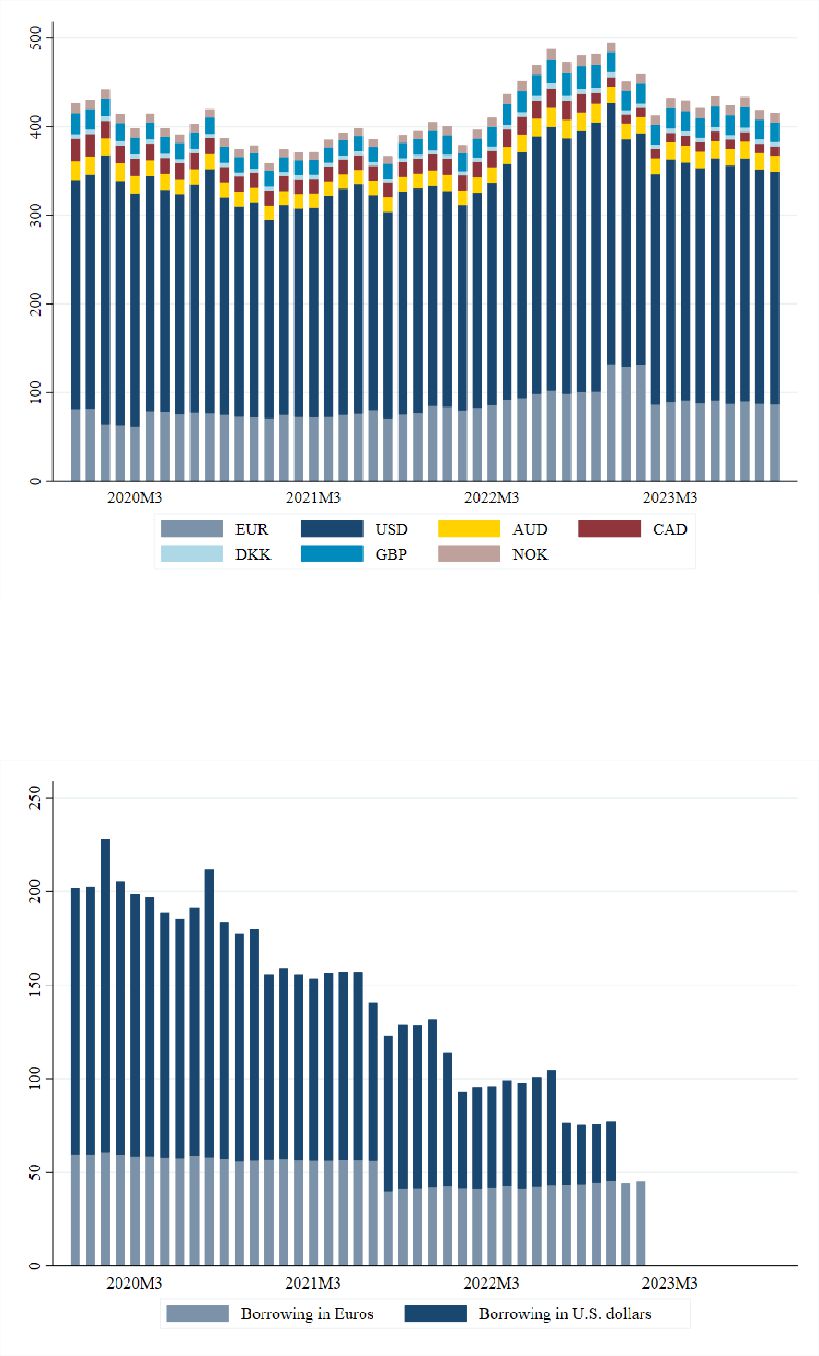
APPENDIX2023/24:RFR15
Figure A.1 Composition of the foreign currency reserve
Note: Composition of the foreign currency reserve: euro (EUR), American dollars (USD), Australian dollars (AUD), Canadian dollars (CAD), Danish kroner (DKK), British pounds (GBP) and Norwegian kroner (NOK). SEK billion. Monthly data.
Source: The Riksbank.
Figure A.2 Currency loans via the Swedish National Debt Office
Note: Currency loans in euro (EUR) and American dollars (USD) via the Swedish National Debt Office. SEK billion. Monthly data.
63
Beställningar: Riksdagens tryckeriexpedition, 100 12 Stockholm
telefon:
Tidigare utgivna rapporter: www.riksdagen.se under Dokument & lagar