
Ds 2012:18
Convention on nuclear safety 2012 extra ordinary meeting
The Swedish National Report
Ministry of the Environment
Ds 2012:18
Convention on nuclear safety 2012 extra ordinary meeting
The Swedish National Report
Ministry of the Environment
This report is on sale in Stockholm at Fritzes Customer Service,
which sells reports in the series Swedish Government Official Reports (SOU) and in the Ministry Publications Series (Ds).
Address: Fritzes, Customer Service
Sweden
Fax: 08 598 191 91 (national) +46 8 598 191 91 (international)
Telephone: 08 598 191 90 (national) +46 8 598 191 90 (international)
Printed by Elanders Sverige AB
Stockholm 2012
ISBN
ISSN
Table of Contents
4.2Activities performed by the operators or other national organizations involved in
5.Topic 5: Emergency preparedness and response and
| site)........................................................................................................................................ | 64 |
5.1Overview of performed analyses/activities within emergency preparedness and
Page 3(87)
Page 4(87)
Foreword
During the 5th Review Meeting of the Convention on Nuclear Safety (CNS), the Contracting Parties in attendance agreed to hold an Extraordinary Meeting in August 2012 with the aim to enhance safety through reviewing and sharing lessons learned and actions taken by Contracting Parties in response to events at TEPCO Fukushima
It was agreed that a brief and concise National Report should be developed by each Contracting Party to support the Extraordinary Meeting. This report should be submitted three months prior to the meeting to the Secretariat via the
It was also agreed that the Contracting Parties should organize their reports by topics that cross the boundaries of multiple CNS Articles. Each National Report should provide specific information on these topics to address the lessons learned and activities undertaken by each Contracting Party. The National Report should include a description of the activities the Contracting Party has completed and any activities it intends to complete along with scheduled completion dates.
The present report is therefore structured in accordance with the guidance given by the General Committee for CNS. In Chapter 0, a brief description of Swedish nuclear power plants is given with an emphasis on measures that have been taken gradually as a result of new knowledge and experience. The following chapters deal with the six topics, which are: 1) External events, 2) Design issues, 3) Severe accident management and recovery, 4) National organizations, 5) Emergency preparedness and response and
The Swedish report has been produced by a working group including representatives from both the Swedish regulatory body and reactor utilities. The regulator has coordinated this work.
Page 5(87)
Page 6(87)
I. Introduction
I.1 Brief description of the Swedish nuclear power plants
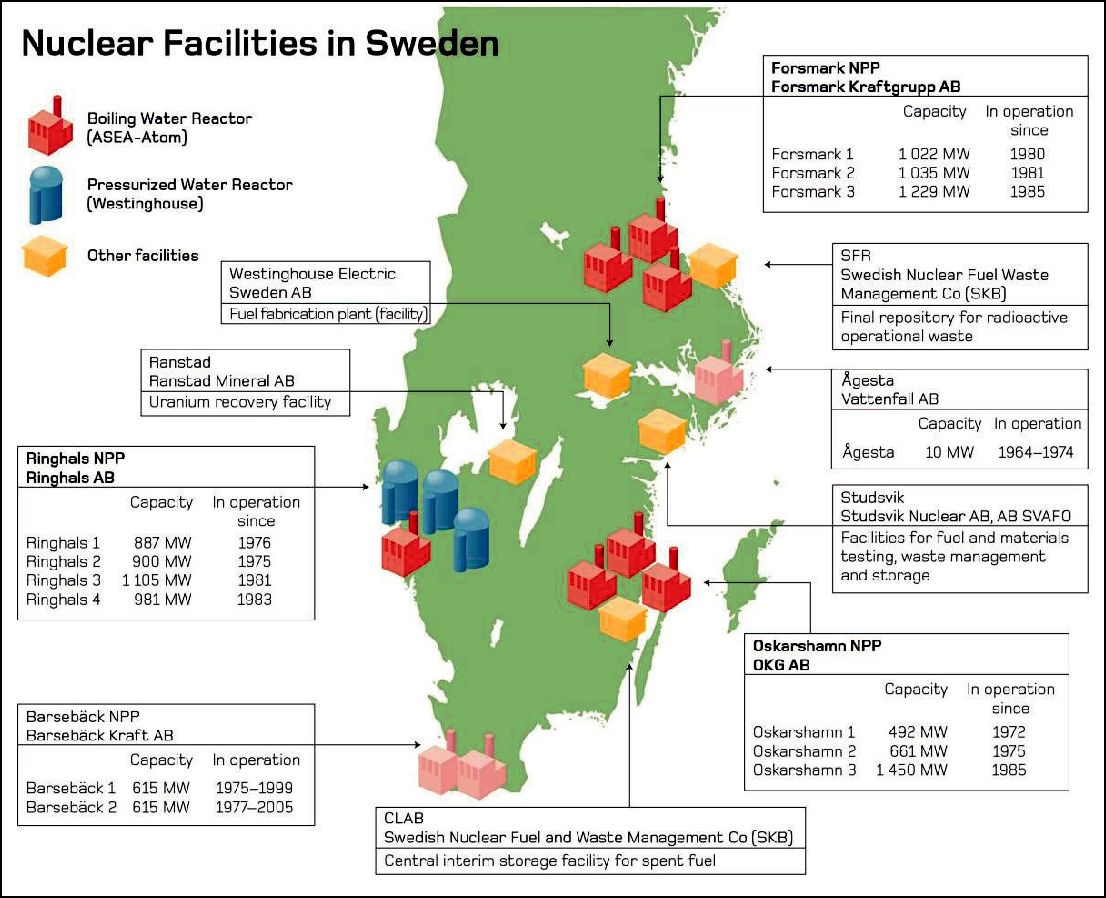
There are 10 nuclear power reactors in operation in Sweden; seven Boiling Water Reactors (BWRs) and three Pressurized Water Reactors (PWRs), see Figure 1. All the BWRs were designed by the domestic vendor
The three oldest BWRs have external main recirculation loops while the other four units have internal recirculation pumps with no large pipes connected to the reactor pressure vessel below core level. The BWR containments are all of the pressure suppression (PS) type of MARK 2 design and various layouts of the vent pipe configuration and pressure suppression pools.
Figure 1 - Swedish nuclear facilities.
Measures to increase the level of safety at Swedish nuclear power facilities have gradually been taken in accordance with new knowledge and experience. New knowledge and experience have emerged from lessons learned from incidents and accidents, from research, from safety analyses and from new reactor designs. International accidents/incidents such as the Three Mile Island (TMI) nuclear accident in 1979 as well as domestic incidents such as the ‘strainer event’ in Barsebäck 2 in 1992 and the Forsmark 1 event in 2006, have had a major influence on these measures. For example periodic safety reviews started in Sweden in the early 1980s as a result of the TMI nuclear accident and the requirements regarding the reviews have developed over the years and are now quite
Page 7(87)
similar to those recommended in the IAEA Safety Standards. Another example are the Swedish regulations on design and construction of nuclear power reactors which were issued in 2005 and have resulted in extensive
I.2 Description of severe accident mitigating measures
After the TMI accident in the United States in 1979, a major investigation, decided by the Swedish Government, was launched and conducted by a group of experts and resulted in a number of recommendations concerning:
strengthening of the regulatory body,
strengthening of the emergency preparedness and response organizations on the regional level,
an increased focus on
enhanced training of plant operators,
strengthening of the experience feedback, both at the licensees and at the regulatory body,
improved severe accident management (SAM), and
implementation of filtered containment venting system.
Based on these recommendations, the Swedish Government decided that all Swedish nuclear power reactors should be capable of withstanding a core melt accident without any casualties or ground contamination of significance to the population. In the decision it was stated that these requirements can be considered met if a release is limited to a maximum of 0.1 % of the reactor core content of
filtered containment venting through an inert
unfiltered pressure relief in BWRs in the case of large LOCA and degraded pressure suppression function to protect the containment from early overpressurization,
independent containment spray,
all mitigating systems designed to withstand an earthquake1, and
a comprehensive set of severe accident management procedures and guidelines.
It was assumed during
1 The mitigation systems were designed according to US NRC Regulatory Guide 1.60 scaled to peak ground acceleration (PGA) values of 0.15 g horizontal and 0.1 g vertical.
Page 8(87)
scenarios) and that the releases and leakage from the containment can be controlled and limited.
Several potential threats to containment integrity occur during a core melt process. In brief, these can be categorized into the following groups: pressure loads due to gas and steam generation, temperature loads due to the high temperature of the molten core, impulse loads due to hydrogen combustion and the interaction between the molten core and water, concrete removal due to contact between the corium and concrete as well as high temperatures and aggressive materials.
Two postulated events (special events) were chosen as design basis events for the severe accident mitigating systems:
Loss of all AC power and
Large LOCA in combination with degraded pressure suppression function (for only BWRs). This is the design basis event with respect to early containment overpressurization in the BWRs. The large LOCA causes a rapid pressure
During these events, no manual actions within the first 8 hours shall be assumed. This means that after 8 hours, prepared manual actions can be credited and the independent containment spray is assumed to be available, which will temporarily reduce the containment pressure and also reduce the filtered release (or delay the initiation).
In the scenario with loss of all AC power in both BWRs and PWRs, reactor pressure vessel
For the postulated event with loss of all AC power in BWRs, the pressure in the containment will not reach the design limit pressure and therefore the actuation of independent containment spray at this time will significantly delay the overpressurization of the containment. At a certain level of pressure, due to compression of
In the design scenario for PWRs, pressure in the containment will reach the design limit pressure typically after
Page 9(87)
After 8 hours the independent containment spray is available which will reduce the containment pressure and also reduce the current containment filtered venting release.
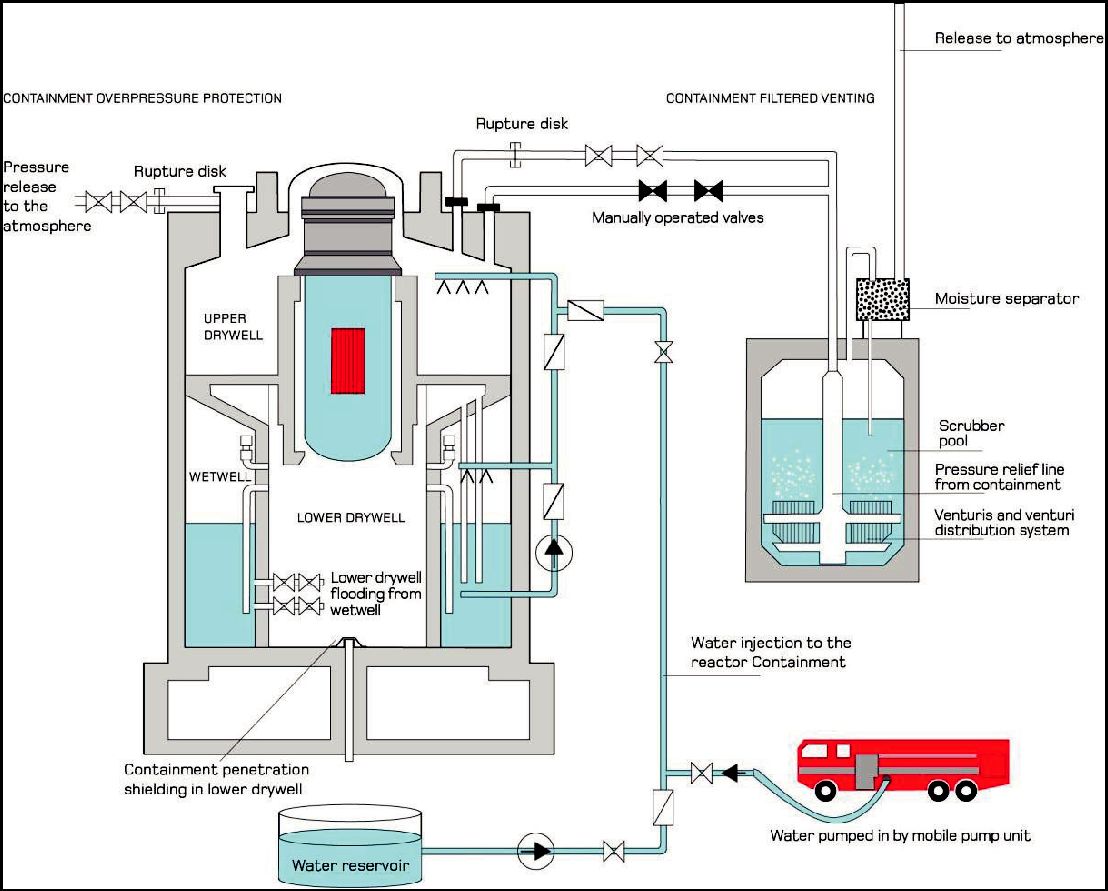
All of the currently operating plants in operation have chosen the MVSS concept to fulfil the requirements of filtered venting, and a conceptual illustration of the overall severe accident mitigation concept for the BWRs and PWRs is presented in Figure 2 and Figure 3, respectively. The major component is the scrubber system comprising a large number of small venturi scrubbers submerged in a pool of water. The water contains chemicals for adequate retention of iodine. A venturi scrubber is a gas cleaning device that relies on the passage of the gas through a fine mist of water droplets. The design of the venturis is based upon the suppliers’ broad experience in this area, gained when designing venturis for cleaning polluted gases from various industrial plants.
Figure 2 - Schematic view of the severe accident mitigation features installed in Swedish BWRs.
The Multi Venturi Scrubber System (MVSS) can be activated automatically, via a rupture disc, or manually. There are two separate venting lines from the containment for these two modes of operations. The venting line with the rupture disc is always open so that no operator actions are needed to vent this way. The design principle of the system is the same for BWRs and PWRs. The system is made inert to avoid hydrogen combustion.
Page 10(87)

Figure 3 - Schematic view of the severe accident mitigation features installed in Swedish PWRs.
The Swedish strategy for dealing with a core melt in BWRs is to let the core debris fall into a large volume of water in the lower regions of the containment. This is a quite uncommon approach and only a few reactors in the world apply this strategy. Since the strategy is somewhat unique, the international research related to the special phenomena associated with this strategy is fairly limited, even if a wide range of international research has been conducted on phenomena that are also applicable to Swedish plants. An extensive national research programme was set up in the 1980s to highlight all important aspects needing to be addressed and this programme is still progressing. There are uncertainties connected with the Swedish strategy which need to be addressed. Through the Swedish strategy, a major initiating interaction between concrete and core melt will most likely be avoided. However, there are still some open issues identified related to steam explosions which could occur when the core melt interacts with the water and the coolability of the core debris in the containment. The severe accident research is now targeted to confirm that the uncertainties connected to the chosen solution are acceptable. Since the governmental decision in the 1980s, the Swedish utilities and the regulator have collaborated to conduct further research on severe accidents and to monitor international research within the area of severe accidents.
I.3 Description of modernization and safety upgrading of all Swedish nuclear power reactors
Safety improvements of Swedish nuclear power reactors have traditionally been conducted through consecutive plant modifications and specific projects as a result of experience from events and problems identified in the plants. These successive modifications have to a large extent been based on new insights gained through safety analyses and research, but also from newer reactor designs, which have indicated possible safety improvements. This process has to a large extent been driven and confirmed by the periodic safety reviews.
Page 11(87)
Examples of events that have led to facility modification include the ‘strainer incident’ at Barsebäck in 1992. Experience from this event showed that the emergency core cooling systems in the BWRs with external reactor recirculation pumps did not perform as postulated in the safety analysis reports. The event led to
Due to the background of these events, the Swedish regulator decided to issue general regulations on the design and construction of nuclear power reactors. These regulations (previously SKIFS 2004:2, currently SSMFS 2008:17) and the general advice on their interpretations entered into force on 1 January 2005 with transitional provisions. When they entered into force, the regulations contained transitional provisions providing the basis for the regulator’s decision concerning
The regulations (SSMFS 2008:17) are based on Swedish and international operating experience, recent safety analyses, results from research and development projects and the development of IAEA Safety Standards and industrial standards that were applied in the construction of the facilities. The regulations contain specific requirements for nuclear power reactors on design principles and the implementation of the
The regulations also contain requirements on the facilities’ resistance against natural phenomena and other events, such as earthquakes, flooding, extreme winds, extreme temperatures and extreme ice formation. Requirements are also imposed on the main and emergency control rooms, safety classification, event classification and the design and operation of the reactor.
The requirement on diversification which is aimed to protect against the effects of common cause failures (CCF) has meant that additional events (called complex sequences or special events) need to be analysed. The events, together with the events which are the basis for severe accident mitigating systems, form the event class of design extension conditions. The requirement has also meant that the function for reactivity control in the event of ATWS/ATWC (ATWS = Anticipated Transient Without Scram, ATWC = An- ticipated Transient Without all Control rods) must be diversified using for example automatic injection of boron.
Since the 10 power reactors operating in Sweden represent seven somewhat unique designs owing to their respective age and vendor, and have different prerequisites for complying with general regulations on design and construction, an impact assessment was conducted for each reactor. These assessments identified whether further analyses and/or
improvement of physical and functional separation
diversification of safety functions
accident management measures
robustness to local dynamic effects from pipe breaks
resistance to external events
improvement of operational aids
Page 12(87)
environmental qualification and surveillance
The most resource intensive measures were associated with improving the physical and functional separation and diversification. At the present time, a significant share of identified measures has been implemented, but some measures remain to be performed. For instance, the major modernization of Oskarshamn 2 is planned to be completed in spring 2013 and important measures remain to be taken on the part of Swedish PWRs until 2015.
In parallel with modernization programmes, power uprates have been conducted at eight of the ten Swedish nuclear power reactors in operation. By the end of the 1980s, nine of the twelve original nuclear power reactors in Sweden had been uprated; this took place between 1982 and1989 with power increases between 6% and 10% from the originally licensed thermal power levels. These power uprates were possible due to better utilization of existing margins, better methods for analyses and improved fuel design, but extensive modifications were not necessary. The current programmes, planned to be implemented during the period
In addition to the plant modifications listed above, the licensees need to implement measures to comply with the regulator’s new regulations on security and physical protection (SSMFS 2008:12). These measures are not described in this report. For more details, see reference [1].
I.4 Description of ongoing work with the European stress tests
The nuclear accident at the TEPCO Fukushima
Union by means of a comprehensive assessment of risk and safety (‘stress testing’). For
Sweden, this work was carried out by the Swedish licensees and reviewed by the Swedish Radiation Safety Authority (SSM) in 2011. The results were published in a national report submitted to the European Commission at the end of December 2011, see ref. [2].
Based on information on the root cause of the nuclear accident at the Fukushima
On 22 March 2011, SSM stated in a written communication to the licensees the importance of immediately launching work to identify lessons learned from the situation with the aim of assessing any further radiation safety measures that might be necessary at Swedish nuclear power reactors as well as at the facility for storage of spent nuclear fuel.
On 25 May 2011, SSM ordered the licensees of the nuclear power reactors, as well as the interim storage facility for spent nuclear fuel (CLAB), to conduct renewed analyses of the facilities’ resistance against different kinds of natural phenomena. They should also analyse how the facilities would be capable of dealing with a prolonged loss of electrical power, regardless of cause. It was stated in the motivation for the decision that the specific details concerning the scope and performance of these renewed analyses and safety
Page 13(87)
evaluations were stipulated by the specifications for the ‘stress tests’ as agreed between European nuclear safety regulatory authorities and the European Commission.
On 29 December 2011, SSM reported the results of the licensees’ stress tests and the Authority’s assessment. The results were published in a national report which was submitted to the European Commission, see ref. [2]. One of the conclusions was that the work was largely performed in accordance with the specifications resolved within the European Union, see ref. [3].
The results from the stress tests have shown that Swedish nuclear facilities are robust, but have also identified a number of areas of improvement to further strengthen the nuclear facilities’ robustness. The stress tests have shown that the severe accident mitigation systems, including filtered venting of the containment, implemented after the TMI nuclear accident, are of great importance for limiting the
Many of the areas of improvement identified by the licensees and by SSM imply that analyses conducted earlier need to be
The areas of improvement identified from the stress tests performed will be managed in different ways depending on their importance from the perspective of safety and the urgency of implementing the measures.
During the spring of 2012, SSM has required all licensees to present action plans for dealing with the deficiencies identified during the European stress tests. The licensees should consider the safety significance of each measure and provide
In parallel with the work described above, SSM is currently conducting investigations and preparing reports in accordance with a government assignment. These reports will include evaluations of the issues identified in the stress tests and other lessons learned
Page 14(87)
from the nuclear accident in Fukushima in addition to conclusions drawn. The reports will also contain the regulator’s view on any further measures that should be taken at
Swedish nuclear facilities and the need for any further requirements imposed on safety improvements. This work will be reported to the government by 31 October 2012.
The above implies that SSM so far has required no physical plant changes at nuclear power reactors in Sweden as a result of the Fukushima
I.5 Description of work related to WANO recommendations
The industry organization WANO (World Association of Nuclear Operators) has addressed the Fukushima events in various ways.
A WANO Fukushima commission was formed soon after the events. In August 2011, the commission issued a number of recommendations for a more efficient WANO including increasing the frequency and scope of WANO peer reviews.
Three SOERs (Significant Operating Experience Reports) were issued in 2011 on various aspects of experience from the nuclear accident. These reports are for the internal use of the licensees. The SOERs include recommendations for action by the operators.
The first SOER report (WANO SOER
The second SOER report (WANO SOER
The third SOER report (WANO SOER
These SOERs have been an important part of the industry programmes to learn from experience at Fukushima events. The Swedish nuclear industry’s responses to the WANO SOERs are included in the summary tables in chapters 1, 2 & 3.
Page 15(87)
1. Topic 1: External events
The combined effects of the March 2011 earthquake and tsunami in Japan presented significant challenges to the NPPs. It is important to establish appropriate protection from natural phenomena. Events such as earthquakes, flooding, extreme weather conditions (hurricanes, tornadoes, snow loads, etc.), and external fires should be considered.
Under this topic, Contracting Parties are expected to report on analysis undertaken to reevaluate the safety of existing or proposed NPPs, taking into consideration the hazards of catastrophic external events. To the extent possible, the Contracting Parties should include information on models and
1.1 Overview of performed analyses/activities within external events
External events were one of the areas assessed in the framework of the European stress tests. In the Swedish national report for stress tests, external events have been described for different types of accidents, starting from design basis where the plants can be brought to safe shutdown without any significant nuclear fuel damage and up to severe accidents involving core meltdown or damage of fuel in the spent fuel pool. It should be noted that the severe accidents involving core melt and
Results presented in this chapter are mainly based on conclusions drawn in the framework of the stress tests or in the framework of licensee respond to WANO recommendations. This is also the case for the recommendations for further analyses which should be considered as potential measures to increase the robustness of the plants presented in the summary table in Section 1.4. As a result of the stress test assessments, some areas of improvement for the Swedish NPPs have been identified by the licensees while others have been identified by the regulator when reviewing licensee reports. As mentioned in Section 0.3 of this report, the potential improvements identified in the stress test assessments will be managed in different ways depending on their importance from the perspective of safety and the urgency of implementing the measures.
1.2 Activities performed by the operators
1.2.a. Overview of the actions taken or planned by the operators to address external events
Examples of issues addressed by WANO
The first WANO SOER, see Section 0.4, was issued in March 2011. The report briefly describes the events and includes recommendations to provide
Verification of capability to mitigate conditions that result from beyond design basis events which includes the following: that equipment designed for severe accident mitigation is available and functional, that procedures for severe accident mitigation strat-
Page 16(87)
egies are in place and are executable, that qualifications of operators to implement procedures and instructions are verified, etc.
Verification of capability to mitigate station blackout (SBO) conditions required by station design. This includes ensuring that the capability to mitigate SBO conditions is verified and that required materials are adequate and properly set up.
Verification of capability to mitigate internal and external flooding events required by station design. This includes ensuring that the capability to mitigate internal and external flooding events required by station design is verified and that required materials and equipment are adequate and properly staged. It also includes performance of walkdowns and inspections of important equipment needed to mitigate fire and flooding events to identify the potential for the loss of equipment function during seismic events relevant for the site. Furthermore, it includes development of mitigating strategies for identified vulnerabilities. As a minimum, one must perform walkdowns and inspection of important equipment (permanent and temporary); also develop mitigating strategies to cope with the loss of such important functions.
The second SOER was issued in August 2011 and contains recommendations to provide assurance that each station will increase the sensitivity to spent fuel storage event response and that a high state of readiness is maintained to respond to events that challenge spent fuel pool cooling or coolant inventory control. The recommendations include:
Establishment of the time for the Spent Fuel Pool (SFP) maximum bulk temperature to reach 100 degrees Celsius in the event that normal cooling is lost. This information should be readily available in the control room and emergency response facilities.
Verification of the adequacy of abnormal/emergency operating procedures for responding to a loss of SFP cooling and/or coolant inventory. Verify that the guidance in the abnormal/emergency operating procedures can be implemented during and following severe weather, seismic events, loss of control room, and flooding conditions.
Verification of an existing programme for regularly checking/testing the functionality of vacuum/siphon breakers associated with SFP cooling or coolant inventory systems.
The third SOER was issued in December 2011 and calls for the development of preplanned contingencies for protection from extended loss of AC power and beyond station blackout (SBO) events similar to those experienced at Fukushima
Implementation of actions to address loss of AC power events simultaneously at each unit of
Providing power to essential instrumentation; and fuel and other consumables to power emergency response equipment.
Securing communications equipment during an extended loss of AC power, etc.
Earthquakes
In Sweden, only the two newest reactors, Oskarshamn 3 and Forsmark 3, were originally designed to withstand earthquakes. The other Swedish reactors became subject to general requirements imposed on resistance against earthquakes when the Swedish Nuclear Power Inspectorate’s regulations concerning the design and construction of nuclear power reactors, SKIFS 2004:2, entered into force in 2005. In order to allow licensees sufficient time to take measures and fulfil the requirements, separate decisions were taken giving
Page 17(87)
the licensees a certain period of time to take the requisite measures to fully comply with the regulations, now designated as SSMFS 2008:17.
Scandinavia is considered to have seismically stable bedrock, so the risk of an earthquake causing damage to buildings has traditionally been considered negligible. Since the early 1990s, the Swedish earthquake probability level of
In the design and other analyses, the licensees apply a dimensioning earthquake within a radius of twenty kilometres of a strength corresponding to a strength of approximately 6.0 on the Richter scale and with a probability of once per 100,000 years
According to the licensees, the Swedish plants are able to achieve a safe shutdown condition in case of a DBE, provided that the deficiencies identified in some plants have been remedied. The most important measure for Forsmark 1 and 2 and Ringhals
The use of the Swedish earthquake probability level of
Flooding
The source of the flooding considered is high seawater level. No Swedish units are located in close proximity to any body of water other than the sea. Waves are not included in the design basis flooding and are not believed to affect any unit, since no units are located in direct contact with the sea.
The phenomenon of a tsunami is not relevant because Sweden is seismically stable and the surrounding sea is too shallow to generate a significant tsunami. Tsunamis, seiches, tides and other phenomena are considered to be covered by high sea water levels.
Page 18(87)
The design basis sea water level is +2.02 m above normal sea water level for Oskarshamn NPPs, +2.65 m for Ringhals NPPs and +3.0 m for Forsmark NPPs. The frequency of a rise in the sea water level above the design basis flooding is estimated to be
All Swedish NPPs can withstand an external sea water level up to 3.0 m above normal sea water level without fuel damage. External flooding above this level has not been analyzed for Forsmark and Oskarshamn NPPs and has therefore been assumed to result in fuel damage. Ringhals has been analyzed further, showing that an external water level of +3.3 m is not expected to cause core damage at any Ringhals unit.
All units are designed to handle flooding due to high ground water level and all units are equipped with drainage systems to remove ground water from the area between the rock and the buildings. As long as the drainage systems are functioning, no flooding due to high ground water level is likely to occur. In case of failure of the drainage function, it is assumed that flooding will take many hours before any severe damage will occur to the plants, which is why manual action is likely to be successfully performed. Only the Os- karshamn units have drainage systems with emergency backup power.
The stress testing has identified many procedural improvements that can strengthen the ability to withstand high water levels. A planned shutdown in the event the sea water reaches certain levels is one identified procedure. A review should be conducted in Forsmark and Ringhals to check for gates and other forms of exterior doors to see how well they withstand external water levels above +3.0 m and then make reinforcements if needed. An evaluation will also be performed of how the water is distributed inside the plants during external flooding.
Spent fuel pools will be affected by flooding at the same water level as the corresponding reactor. The filtered containment venting system is unlikely to be affected by flooding.
Extreme weather conditions
The extreme weather conditions are based on statistics from the past 100 years. An estimation of more improbable extreme weather events is done by the licence holders with the assistance of SMHI (Swedish Meteorological and Hydrological Institute). The design basis events for extreme weather include rain, wind, sea water level, outdoor temperature and lightning.
Extreme air temperatures are considered to be a slow event in which there is time for taking manual measures.
At low air temperature, the concerns for the nuclear power plants are that some essential process measurement piping could run the risk of freezing and thereby indicate inaccurate values to the reactor protection system. In the case of low temperature alarm in the ventilation system, manual measures shall be performed in accordance with the procedure to ensure that freezing of the components concerned are avoided.
In the case of a prolonged high outside air temperature exceeding dimensional values, the ambient temperature may be assumed to exceed the allowable ambient temperatures in the same range as the air temperature that has been exceeded. The engineering judgment is that this can only cause accelerated ageing of the equipment concerned and not instant malfunctioning.
Page 19(87)
Extreme rainfall and snowfall are considered as slow events where there is time to take manual steps if the ordinary equipment fails to operate as designed.
The main identified risk connected to rainfall is the load of roofs because many roofs are flat or slightly inclined with surrounding ledges. The load can become too heavy if the drainpipes fail to drain the roof. In the assessment of some license holders, proactive actions must be taken within 12 – 24 hours for some buildings in case the drainage pipes are clogged during a heavy rainfall.
Leakage of a roof is not considered to be a significant risk since there is good separation between redundant safety trains.
Administrative measures (instructions/guidelines) to cope with low/high temperature conditions, snow removal and severe rainfall on the part of the roofs identified will be improved.
Another identified risk is if rainwater from the buildings and from the ground leaks into the rock shaft. The drainage pumps in the rock shaft have a good margin in their capacity to prevent flooding of the rock shaft.
In the event of intensive snowfall, the roofs can be overloaded with snow, and if some buildings collapse, there is a risk that the collapsed roofs can destroy safety systems or fuel in the pool for storage of spent fuel. A majority of the buildings are dimensioned to withstand a very intensive snowfall during
All the licensees have reported that the sites are designed to withstand strong wind. At much stronger winds, there are some shortfalls reported for older plants, such as a risk that beams and parts of the walls can fall down and some roofs may be affected.
For tornado missiles, all the licensees have applied the missiles defined in the NRC Regulatory Guide 1.76. There are some buildings where shortfalls have been reported for the missiles described. Procedures will be completed for the deficiencies found during the stress test; in particular, drawing up a procedure for external impact on the Forsmark 3 unit.
High seawater temperature is considered as a slow event where all licensees have procedures to reduce the reactor power and to shut down the reactor at sea water temperatures around +25°C. After shutdown, no shortfalls for the reactor are expected.
Frazil ice formation in the intake is a fast event. It is caused by low seawater temperatures creating ice crystals that accumulate on equipment below the surface. This is prevented by a recirculation flow in the cooling water canals. The evaluations show that frazil ice formation is not expected because of the recirculation flow.
The plant may be affected thermally, mechanically and electrically if struck by lightning. All licence holders have analysed Boiling Water Reactors in terms of the consequences of a severe lightning strike. The consequences are deemed to be limited. Ringhals
Page 20(87)
External fire
All Swedish NPP sites are surrounded with naturally occurring and/or
Due to existing firebreaks, and location of the sites, external fires are not assumed to pose any direct threat to the safety of the Swedish NPPs. However, external fire could lead to a loss of
1.2.b. Schedules and milestones to complete the operators’ planned activities
The evaluation and response to WANO SOER
The Swedish utilities have cooperated and have also had a good dialogue with the regulator regarding stress tests and other aspects originating from the Fukushima events. Urgent actions have already been taken. At the moment, further analyses are ongoing that will provide the basis for final decisions on more
Many of the areas of improvement already identified imply that analyses conducted earlier need to be
The areas of improvement identified from the stress tests performed will be managed in different ways depending on their importance from the perspective of safety and the urgency of implementing the measures.
The Swedish nuclear industry has initiated a joint effort for stress test results harmonization. The goal is to share information, best practices and coordinate further evaluations of stress test findings in the Swedish NPP units. The work is planned to be completed within the year 2012. The preliminary schedule for further work is as follows:
A first version of a common vision, strategy and targets (called the Industry Position Paper) for the
An early estimation of the time schedule of the needed measures to fulfill the defined targets will be assessed during the second half of 2012.
Investment decisions will be taken according to the general process for such decision making and decided measures will be incorporated in the plant safety upgrading programmes.
Page 21(87)
1.2.c. Preliminary or final results of the activities including proposals for further actions
As stated in 1.2.b above,
1.3 Activities performed by the regulator
1.3.a. Overview of the actions taken or planned by the regulator to address external events
Regulatory action as a result of the accident at the Fukushima
As a result of the accident at the Fukushima
In addition to the national actions taken, the Council of the European Union declared that Member States of the European Union should review safety at all NPPs by means of a comprehensive assessment of risk and safety (‘stress testing’). On 25 May 2011, SSM ordered licensees of all Swedish NPPs, as well as the licensee for the interim storage facility for spent nuclear fuel (CLAB), to conduct renewed analyses of the facilities’ resistance against different kinds of natural phenomena, prolonged loss of electrical power and ultimate heat sink regardless of cause, and also severe accidents, in accordance with the European Commission’s ‘Stress Tests’ specifications. It was stated in the motivation for the decision that the specific details concerning the scope and performance of these renewed analyses and safety evaluations were stipulated by the specifications for the
‘stress tests’ as agreed between European nuclear safety regulatory authorities and the
European Commission.
In the autumn of 2011, SSM reviewed the licensees’ stress tests.
On 29 December 2011, SSM presented the results of the licensees’ stress tests and the Authority’s assessment. The results were published in a national report and submitted to the European Commission.
During the spring of 2012, SSM has required all licensees to present action plans for dealing with the deficiencies identified during the European stress tests. The licensees should consider the safety significance of each measure and provide
In parallel with the European stress tests, SSM is conducting investigations and preparing reports for the Swedish Government. These reports will include evaluations of the issues identified in the stress tests and other lessons learned from the accident in Fukushima. The reports will also contain the regulatory view on any need for supplementary measures to be applied at Swedish nuclear facilities in addition to the measures identified from the stress tests as well as the need for any further requirements or updates to existing regulations.
Page 22(87)
Swedish regulations related to external events
The Swedish Radiation Safety Authority issued general regulations on the design and construction of nuclear power reactors (regulation SSMFS 2008:17) as described in Section 0.2 of this report. The regulations contain specific requirements on resistance against natural phenomena and other events that may arise outside or inside a facility and which can lead to a radiological accident, including extreme winds, extreme precipitation, extreme ice formation, extreme temperatures, extreme sea waves, extreme seaweed/algae growth or other biological conditions that can affect the cooling water intake, extreme water levels, earthquakes, fire, explosions, flooding, aeroplane crashes and disturbances to or loss of the offsite grid. The regulation states that for each type of natural phenomenon that can lead to a radiological accident, an established action plan shall be available for the situations where the dimensioning values run the risk of being exceeded. When the regulations entered into force, they were accompanied by transitional provisions providing the basis for the regulator’s decision concerning
Within the assignment given by the Swedish Government, it is stated that SSM should provide the Swedish Government with the Authority’s view on any need for supplementary requirements or updates to existing regulations.
Other activities related to the area of external events
Since the
The comprehensive work to develop the envelope ground response spectra for Sweden was performed in the late 1980s and early 1990s in a joint venture project with the Swedish authority and the nuclear power industry. The envelope ground response spectra are valid for a typical Swedish hard rock site. The seismicity is defined by the average Fennoscandian seismicity function. The transmission of seismic waves from the source to the surface of the ground is through hard rock having the average properties of Swedish bedrock in respect of its effects on the wave propagation. The ‘Swedish earthquake’ was presented in ref. [4] as envelope ground motion spectra with a yearly exceedance probability of
The mitigation systems, installed during the 1980s in accordance with a Government decision, were designed according to U.S. NRC Regulatory Guide 1.60 scaled to peak ground acceleration (PGA) values of 0.15 g horizontal and 0.1 g vertical. These are the same response spectra as the original design response spectra for Oskarshamn 3 and Forsmark 3.
In February 2003, a research report entitled Guidance for Analyses of External Events, see ref.[5], was published by the Swedish authority under a contract with the Nordic PSA
Page 23(87)
Group. The goal was to create a common approach to the analysis of external events within the probabilistic safety assessments for the Swedish NPPs.
At the time, the requirements stated that the safety analyses should be based on a systematic identification and evaluation of such events, sequences and other conditions that may lead to a radiological accident. The report Guidance for Analyses of External Events was drawn up as a supporting document for the authority’s reviews. The report was also expected to give guidance for the performance of the analysis by addressing project planning, identification of external events, screening of events and probabilistic analysis.
The word ‘guidance’ in the report’s title was used in order to indicate a common methodological guidance based on current state of the art concerning the analysis of external events and adapted to conditions relevant for Nordic sites. In addition, the report itself was meant to clarify the scope of the analysis of external events within the probabilistic safety analysis.
1.3.b. Schedules and milestones to complete the regulatory body’s planned activities
During the spring of 2012, SSM has required all licensees to present action plans for dealing with the deficiencies identified during the European stress tests. SSM will review the action plans and will request additional details or revision if needed. When the action plans are approved, the Authority will require all licensees to meet these schedules.
The SSM report on lessons learned from the accident at the Fukushima
The current schedules for completion of the ongoing modernisation and
1.3.c. Conclusions of the regulatory body regarding the outcome of the operators’ activities
At this time, and apart from the European stress tests for Swedish NPPs, SSM has not reviewed any additional operator activities addressing experience and lessons learned from the accident at Fukushima
SSM’s overall conclusion when considering external events in accordance with the European stress tests is that the Swedish NPPs are robust. However, the assessments included in the European stress tests of Swedish NPPs have identified a number of areas of improvement to further strengthen the robustness of the plants. SSM’s assessment is that these areas of improvement are of such a nature that the continued operation of the facilities does not need to be questioned. However, it is important that all deficiencies identified and suggested measures are considered and will be managed appropriately depending on their importance from the perspective of safety and the urgency of implementing the measures.
The results from the European stress tests of Swedish NPPs have shown that the severe accident mitigation systems, including filtered venting of the containment, implemented
Page 24(87)
in the Swedish NPPs after the Three Mile Island accident in 1979, are of great importance for limiting the
For severe accident scenarios where pressure is building up in the containment (similar to the situation that arose in the Fukushima
The filtered venting function was originally only intended to be used in severe accident conditions when core debris would be present in the lower regions of the containments. However, the stress test results have shown that it might be possible to use these systems for other purposes. For example, the results indicate that it might be possible during situations that could arise due to natural phenomena and other external events to use the filtered venting system to transfer heat from the reactor core to the atmosphere and prevent core melt in scenarios where the ordinary core cooling function has failed and extraordinary procedures are in place.
As far as concerns earthquakes, the stress test assessments indicate that data is somewhat lacking for demonstrating that the functions needed to bring some of the reactors to a safe state will perform as intended during and after an earthquake as stipulated by the dimensioning requirements. Also, these assessments indicate that further analyses are needed to achieve a more accurate estimation of the margin for safe shutdown, as well as analysis to demonstrate the impact of
For flooding, the stress test assessments show that all Swedish NPPs can withstand a sea water level of 3.0 meters above the average water level without resulting in core damage. According to licensee assessments, this level corresponds to a probability of
As far as concerns extreme weather conditions, the stress test assessments have shown that the Swedish NPPs can withstand impact from several kinds of extreme weather conditions. However, all extreme weather conditions and situations that can arise in the plants due to impact from extreme weather have not been fully evaluated nor considered and therefore further evaluations will be needed to address all issues related to this topic. Such evaluations should furthermore include combinations of extreme weather conditions and combined extreme weather conditions and consequential events.
1.4 Summary table for items related to external events
Table 1 shows a
Page 25(87)
Table 1: Summary of items related to the topic of external events.
| Activities by the Operators | Activities by the Regulator | ||||||
| (Item 1.2.a) | (Item 1.2.b) | (Item 1.2.c) | (Item 1.3.a) | (Item 1.3.b) | (Item 1.3.c) | ||
| Results | Conclusion | ||||||
| Activity | Activity | Activity | |||||
| Schedule | Available | Schedule | Available | ||||
| - Taken? | Or Milestones | - Taken? | Or Milestones | ||||
| for Planned | - Yes? | for Planned | - Yes? | ||||
| - Ongoing? | - Ongoing? | ||||||
| Activities | - No? | Activities | - No? | ||||
| - Planned? | - Planned? | ||||||
| Topic 1 – External events | |||||||
| Operators | |||||||
| Only minor | |||||||
| deficien- | |||||||
| cies/gaps | |||||||
| Verification of capability to | have been | ||||||
| identified. | |||||||
| mitigate conditions that result | |||||||
| Taken | Not applicable | However, | |||||
| from beyond design basis | |||||||
| the work has | |||||||
| events | |||||||
| resulted in | |||||||
| identified | |||||||
| areas for | |||||||
| improvement | |||||||
| Verification that the capability | |||||||
| to mitigate station blackout | |||||||
| (SBO) conditions required by | Taken | Not applicable | |||||
| station design is functional | |||||||
| and valid | |||||||
| Verification of capability to | |||||||
| mitigate internal and external | |||||||
| flooding events required by | Taken | Not applicable | |||||
| station design | |||||||
| Assure increased sensitivity | |||||||
| to spent fuel storage event | Taken | Not applicable | |||||
| response | |||||||
| Implementation of actions to | |||||||
| address extended loss of AC | |||||||
| power events simultaneously | |||||||
| (e.g. seawater pumps and | Planned | Not decided | No | ||||
| hoses) at each unit of multi- | |||||||
| unit sites | |||||||
| Providing power to essential | |||||||
| instrumentation and fuel and | |||||||
| other consumables during an | Planned | Not decided | No | ||||
| extended loss of AC power | |||||||
| Securing communications | |||||||
| equipment during an extend- | Planned | Not decided | No | ||||
| ed loss of AC power | |||||||
| The most important measure | |||||||
| for some reactors to | |||||||
| strengthen their robustness | |||||||
| is to remedy the shortcom- | Planned | Not decided | No | ||||
| ings identified in SMA valida- | |||||||
| tion. | |||||||
Page 26(87)
| Further analysis of structural | ||||||
| integrity of roofs of reactor | ||||||
| buildings and control rooms | Planned | Not decided | No | |||
| of some reactors should be | ||||||
| performed. | ||||||
| Further analysis and calcula- | ||||||
| tions regarding |
||||||
| quakes may be performed to | ||||||
| evaluate margins and identify | Planned | Not decided | No | |||
| measures against threshold | ||||||
| effects for some reactors. | ||||||
| Further analysis of aspects of | ||||||
| seismically induced fire for | Planned | Not decided | No | |||
| some reactors. | ||||||
| Deeper analysis for some | ||||||
| units regarding integrity | ||||||
| assessment of the reactor | ||||||
| containment, scrubber build- | Planned | Not decided | No | |||
| ing and spent fuel pools | ||||||
| should be performed for | ||||||
| some reactors. | ||||||
| Further investigation of pro- | ||||||
| cedure improvements that | ||||||
| can increase the capability to | ||||||
| withstand flooding above | ||||||
| +3m. One aspect of interest | Planned | Not decided | No | |||
| is how the water is distribut- | ||||||
| ed inside the plants during | ||||||
| such an event. | ||||||
| Administrative measures | ||||||
| (instructions/guidelines) to | ||||||
| cope with low/high tempera- | Planned | Not decided | No | |||
| ture conditions should be | ||||||
| investigated further. | ||||||
| Review and completion of | ||||||
| operational and maintenance | ||||||
| procedures to prohibit unal- | ||||||
| lowable accumulation of | Planned | Not decided | No | |||
| water and snow on some | ||||||
| identified roofs. | ||||||
| Some reactors should inves- | ||||||
| tigate their capability to | ||||||
| handle events involving | Planned | Not decided | No | |||
| lightning as design basis | ||||||
| accidents. | ||||||
| Regulator | ||||||
| A written communication to | ||||||
| the licensees about immedi- | Not applicable, | |||||
| ately launching work to iden- | ||||||
| Taken | completed in | No | ||||
| tify lessons learned from the | ||||||
| spring 2011 | ||||||
| Fukushima accident. | ||||||
| Ordered licensees to conduct | ||||||
| renewed analyses in accord- | Not applicable, | |||||
| ance with the European | ||||||
| Taken | completed in | No | ||||
| Commission’s ‘Stress Tests’ | ||||||
| May 2011 | ||||||
| specifications. | ||||||
| Review the licensees’ stress | Not applicable, | |||||
| Taken | completed in | Yes | ||||
| tests. | ||||||
| Dec 2011 | ||||||
Page 27(87)
| Presented the results of the | Not applicable, | |||||
| licensees’ stress tests and | ||||||
| Taken | completed in | Yes | ||||
| the Authority’s assessment. | ||||||
| Dec 2011 | ||||||
| Submit the Swedish national | Not applicable, | |||||
| report to the European | ||||||
| Taken | completed in | Yes | ||||
| Commission. | ||||||
| Jan 2012 | ||||||
| Require licensees to conduct | ||||||
| action plans for dealing with | Not applicable, | |||||
| the deficiencies identified | ||||||
| Taken | completed in | Yes | ||||
| during the European stress | ||||||
| April 2012 | ||||||
| tests. | ||||||
| Review the action plans and | ||||||
| request additional details or | Planned | No | ||||
| revision if needed. | ||||||
| Require all licensees to fulfil | ||||||
| action plans | Planned | 2013 | No | |||
| Conducting investigations | ||||||
| and preparing reports for the | Ongoing | Oct 2012 and | No | |||
| Swedish Government. | Jun 2013 | |||||
| Provide the Swedish Gov- | ||||||
| ernment with the Authority’s | ||||||
| view on any need for sup- | Oct 2012 and | |||||
| plementary requirements or | Planned | No | ||||
| Jun 2013 | ||||||
| updates to existing regula- | ||||||
| tions. | ||||||
| Issue requirements which | ||||||
| include protection against | ||||||
| loss of electrical power and | ||||||
| loss of ultimate heat sink and | ||||||
| require all Swedish licensees | Taken | 2005 | No | |||
| to implement modernisation | ||||||
| and |
||||||
| ance with transitional deci- | ||||||
| sions. | ||||||
| Review implemented mod- | ||||||
| ernisation and |
Ongoing | No | ||||
| Swedish NPPs. | ||||||
| Develop the envelope ground | Not applicable, | |||||
| response spectra for Swe- | ||||||
| Taken | completed in | No | ||||
| den. | ||||||
| 1992 | ||||||
| Issue requirements on re- | ||||||
| sistance against natural | ||||||
| phenomena and other events | Not applicable, | |||||
| that arise outside or inside | ||||||
| Taken | completed in | No | ||||
| the facility and which can | ||||||
| Jan 2005 | ||||||
| lead to a radiological acci- | ||||||
| dent. | ||||||
| Support a research report on | Not applicable, | |||||
| Guidance for External Events | ||||||
| Taken | completed in | No | ||||
| Analysis. | ||||||
| Feb 2003 | ||||||
Page 28(87)
2. Topic 2: Design issues
The Fukushima accident demonstrated that the ability of the NPP’s prevention and mitigation systems to respond and operate under extreme scenarios needs to be
This chapter should focus on actions to prevent severe damage to the reactor and the spent fuel pool, including any last resort means, as well as an evaluation of the time available to prevent severe damage.
For example:
Alternating current (AC) electrical power is critically important to the safety of the NPPs. Many of the systems, structures and components (SSCs) used to cool the fuel in the reactor depend on AC power. The loss of cooling, and the loss of all AC power, both
The design pressure for containments can be exceeded during prolonged station blackout (SBO) events. The design of the containment structures needs to be
Prolonged SBO events may inhibit the ability to provide water inventory or cooling to the spent fuel pools and could damage instrumentation needed for understanding the condition of the pool and the fuel. The reliability and availability of the spent fuel pool makeup systems may also need to be
Methods to prevent or mitigate a loss of ultimate heat sink may also need to be reexamined.
Contracting Parties are expected to report on the analysis of such design issues. The scenarios mentioned above, among others, need to be evaluated and analysed considering
2.1 Overview of performed analyses/activities within design issues
Design issues, such as prolonged loss of electrical power and ultimate heat sink regardless of cause, were included in the framework of the European stress tests and in the Swedish national report for the stress tests. These design issues have been highlighted for all NPPs. Different situations and the impact on the NPPs due to loss of electrical power and loss of ultimate heat sink for both the reactor and spent fuel pools have been considered and assessed starting from design basis events where the plants can be brought to safe shutdown without any significant nuclear fuel damage up to severe accidents involving core meltdown or damage to the spent nuclear fuel in the storage pool. It should be noted that the severe accidents involving core melt and
Results presented in this chapter are mainly based on conclusions drawn in the framework of the stress tests or in the framework of licensee responses to WANO recommendations. This is also the case for the recommendations for further analyses which should be considered as potential measures to increase the robustness of the plants presented in the summary table in Section 2.4 of this report. As a result of the stress test assessments, some areas of improvement for the Swedish NPPs have been identified by the licensees, while others have been identified by the regulator when reviewing licensee
Page 29(87)
reports. As mentioned in Section 0.3 of this report, the potential improvements identified in the stress test assessments will be managed in different ways depending on their importance from the perspective of safety and the urgency of implementing the measures.
2.2 Activities performed by the operators
2.2.a. Overview of the actions taken or planned by the operators to address design issues
Examples of issues addressed by WANO
The first WANO SOER, see Section 0.4, was issued in March 2011. The report briefly describes the events and includes recommendations to provide
Verification of capability to mitigate conditions that result from beyond design basis events which includes the following: that equipment designed for severe accident mitigation is available and functional, that procedures for severe accident mitigation strategies are in place and are executable, that qualifications of operators to implement procedures and instructions are verified, etc.
Verification of capability to mitigate station blackout (SBO) conditions required by station design. This includes ensuring that the capability to mitigate station blackout (SBO) conditions is verified and that required materials are adequate and properly set up.
Verification of capability to mitigate internal and external flooding events required by station design. This includes ensuring that the capability to mitigate internal and external flooding events required by station design is verified and that required materials and equipment are adequate and properly staged. It also includes performance of walkdowns and inspections of important equipment needed to mitigate fire and flooding events to identify the potential for the loss of equipment function during seismic events relevant for the site. Furthermore, it includes development of mitigating strategies for identified vulnerabilities. As a minimum, one must perform walkdowns and an inspection of important equipment (permanent and temporary); also develop mitigating strategies to cope with the loss of such important functions.
The second SOER was issued in August 2011 and contains recommendations to provide assurance that each station will increase its sensitivity to spent fuel storage event response and that a high state of readiness is maintained to respond to events that challenge spent fuel pool cooling or coolant inventory control. The recommendations include:
Establishment of the time for the Spent Fuel Pool (SFP) maximum bulk temperature to reach 100 degrees Celsius in the event that normal cooling is lost. This information should be readily available in the control room and emergency response facilities.
Verification of the adequacy of abnormal/emergency operating procedures for responding to a loss of SFP cooling and/or coolant inventory. Verify that the guidance in the abnormal/emergency operating procedures can be implemented during and following severe weather, seismic events, loss of control room, and flooding conditions.
Verification of an existing programme for regularly checking/testing the functionality of vacuum/siphon breakers associated with SFP cooling or coolant inventory systems.
The third SOER was issued in December 2011 and calls for the development of preplanned contingencies for protection from extended loss of AC power and beyond station
Page 30(87)
blackout (SBO) events similar to those experienced at Fukushima
Implementing actions to address loss of AC power events simultaneously at each unit of
Providing power to essential instrumentation; and fuel and other consumables to power emergency response equipment.
Securing communications equipment during an extended loss of AC power, etc.
Other issues
In the stress tests, the licensees have identified the following recommendations for further evaluations and reassessments. All recommendations have not been identified by all licensees and are not relevant to all units.
The ordinary auxiliary power systems are, as far as concerns all Swedish nuclear power plants, dimensioned to manage a
Alternative auxiliary power systems in the form of gas turbines are also available within or close to the facilities. However, these auxiliary power systems have not been safety classified. The licensees’ investigations indicate that these alternative auxiliary power systems could be crucial during a sequence of emergency events; also, the need for auxiliary power systems should be investigated further, particularly when considering situations where several reactors are affected simultaneously.
In the event of a loss of offsite power, failed house load operation in addition to loss of ordinary and alternative auxiliary power, what remains operational then is a batterybacked uninterruptible power supply for instrumentation and maneuvering of components. These batteries are for most units designed for one to two hours of operation, although they are deemed capable of functioning for a longer period of time. An analysis of battery capacity needs to be conducted in order to further improve the level of robustness.
In the event of a loss of offsite power, failed house load operation in addition to loss of ordinary and alternative auxiliary power, various mobile units can be used, such as
All Swedish nuclear power plants are designed to be brought to a safe state if the salt water intake is blocked and to keep the facility in this state. However, some reactors have not been fully verified as to whether this requirement is fulfilled. An update of design basis events and verifying analyses needs to be conducted.
Simultaneous blockage of both intake and outlet would involve significantly more difficult situations than the
Page 31(87)
Analyses of beyond design basis accidents also demonstrate the major significance of independent core cooling, where both permanent and alternative systems as well as mobile units strengthen the facilities’ safety and robustness. Evaluations of independent core cooling should be conducted and any need for further enhancements should be investigated.
The analyses also illustrate the importance of available water volumes for the purpose of extending the period of time before serious core damage is unavoidable in connection with severe accidents. A survey of water volumes in various storage tanks and set minimum levels in them needs to be performed. Also, a survey of available water volumes at and in connection with the various sites should be performed and the possible need for reinforcement should be evaluated.
Manual intervention is required to maintain cooling of spent fuel pools during a situation where both the water intake and outlet are blocked. Further investigations are also required of the need for additional cooling, both by means of permanent installations and mobile units. A key prerequisite in connection with these investigations is that the environment surrounding the ponds allows the personnel access for manual action.
2.2.b. Schedules and milestones for completing the operators’ planned activities
The evaluation for and response to WANO SOER
The Swedish utilities have cooperated and have also had a good dialogue with the regulator regarding stress tests and other aspects originating from the Fukushima events. Urgent actions have already been taken. At the moment, further analyses are ongoing that will provide the basis for final decisions on more
Many of the areas of improvement already identified imply that analyses conducted earlier need to be
The areas of improvement identified from the stress tests performed will be managed in different ways depending on their importance from the perspective of safety and the urgency of implementing the measures.
The Swedish nuclear industry has initiated a joint effort to achieve harmonization of the stress test results. The goal is to share information and best practices and to coordinate further evaluations of stress test findings in the Swedish NPP units. The work is planned to be completed 2012. The preliminary schedule for further work is as follows:
Page 32(87)
A first version of a common vision, strategy and targets (called the Industry Position Paper) for the
An early estimation of the time schedule of the needed measures to fulfill the defined targets will be assessed during the second half of 2012.
Investment decisions will be taken according to the general process for such decision making and decided measures will be incorporated in the plant safety upgrading programmes.
2.2.c. Preliminary or final results of the activities including proposals for further actions
As stated in 2.2.b above,
2.3 Activities performed by the regulator
2.3.a. Overview of the actions taken or planned by the regulator to address design issues
Regulatory action as a result of the accident at the Fukushima
As a result of the accident at the Fukushima
In addition to the national actions taken, the Council of the European Union declared that Member States of the European Union should review safety at all NPPs by means of a comprehensive assessment of risk and safety (‘stress testing’). On 25 May 2011, SSM ordered licensees of all Swedish NPPs, as well as the licensee for the interim storage facility for spent nuclear fuel (CLAB), to conduct renewed analyses of the facilities’ resistance against different kinds of natural phenomena, prolonged loss of electrical power and ultimate heat sink regardless of cause, and also severe accidents, in accordance with the European Commission’s ‘Stress Tests’ specifications. It was stated in the motivation for the decision that the specific details concerning the scope and performance of these renewed analyses and safety evaluations were stipulated by the specifications for the
‘stress tests’ as agreed between European nuclear safety regulatory authorities and the European Commission.
In the autumn of 2011, SSM reviewed the licensees’ stress tests.
On 29 December 2011, SSM presented the results of the licensees’ stress tests and the Authority’s assessment. The results were published in a national report and submitted to the European Commission.
During the spring of 2012, SSM has required all licensees to present action plans for dealing with the deficiencies identified during the European stress tests. The licensees should consider the safety significance of each measure and provide
Page 33(87)
additional details or revision if needed. When the action plans are approved, the Authority will require all the licensees to meet these schedules.
In parallel with the European stress tests, SSM is conducting investigations and preparing reports for the Swedish Government. These reports will include evaluations of the issues identified in the stress tests and other lessons learned from the accident in Fukushima. The reports will also contain the regulatory view on any need for supplementary measures to be applied at Swedish nuclear facilities in addition to the measures identified from the stress tests as well as the need for any further requirements or updates to existing regulations.
Swedish regulations related to design issues
The Swedish Radiation Safety Authority issued general regulations on the design and construction of nuclear power reactors (regulation SSMFS 2008:17) as described in Section 0.2 of this report. The regulations contain specific requirements on resistance against natural phenomena and other events that may arise outside or inside a facility and which can lead to a radiological accident, including extreme winds, extreme precipitation, extreme ice formation, extreme temperatures, extreme sea waves, extreme seaweed/algae growth or other biological conditions that can affect the cooling water intake, extreme water levels, earthquakes, fire, explosions, flooding, aeroplane crashes and disturbances to or loss of the offsite grid. The regulation states that for each type of natural phenomenon that can lead to a radiological accident, an established action plan shall be available for the situations where the dimensioning values run the risk of being exceeded. When the regulations entered into force, they were accompanied by transitional provisions providing the basis for the regulator’s decision concerning
Within the assignment given by the Swedish Government, it is stated that SSM should provide the Swedish Government with the Authority’s view on any need for supplementary requirements or updates to existing regulations.
Other activities related to design issues
Loss of
Additionally, as a result of the Forsmark event, an international working group within the framework of the OECD Nuclear Energy Agency (NEA) was formed in January 2008, with the mission to examine
Page 34(87)
SSM has also contributed to the ongoing review of IAEA Safety Guide
In the area of loss of ultimate heat sink, the function and integrity of the suppression pools are of great importance for preventing significant fuel damage during accident conditions for a BWR. They are also important for maintaining the containment integrity and for limiting large early radioactive releases to the environment during severe accident conditions. Being a passive safety system, the pressure suppression function is paramount to the containment behaviour, and ultimately for plant safety. In 2005, a Nordic research network for thermal hydraulic issues, called NORTHNET, was established. The network is supported by the Swedish authority. One of the three research areas within the network focuses on condensation and mixing in the suppression pools. The first project started in 2007. Since then, other projects have followed and are still ongoing.
During the development of the general regulations on the design and construction of nuclear power reactors (regulation SSMFS 2008:17) as described in Section 0.2 of this report, Swedish BWRs’ strong dependency on electrical power was identified. At the time, a complete strategy for handling this issue had not been developed and it was decided that this issue would be further evaluated by the Swedish authority before implemented in the regulation. In regards to this issue, a study by SSM was performed and published in 2009. The study proposed a fully independent core cooling system in the Swedish reactors. The issue was then discussed with licensees and a consensus was reached with regard to the overall objectives and performance of the system. Based on the study and further considerations, SSM prepared preliminary and general design requirements for the system. One related issue which required additional considerations was the physical protection of the system. This question is to some extent complicated by the fact that some of the NPPs have ongoing modernisation projects which could affect the requirements for a fully independent core cooling system. However, SSM was about to issue requirements for the system for all Swedish NPPs when the nuclear accident at Fukushima
2.3.b. Schedules and milestones for completing the regulatory body’s planned activities
During spring 2012, SSM has required all licensees to present action plans for dealing with the deficiencies identified during the European stress tests. The licensees should consider the safety significance of each measure and provide
SSM’s report on lessons learned from the nuclear accident at Fukushima
The current schedules for completion of the ongoing modernisation and
Page 35(87)
be implemented in 2013. SSM is currently reviewing performed modernisation and backfitting at the Swedish NPPs and will continue this review in accordance to the schedule for completion of all planned modernisation and
SSM is currently preparing to address the relevant IEEE Standards Review Committees (via NPEC) on the DIDELSYS findings and will complete this task in 2012.
The strong electrical power dependency in most Swedish BWRs was highlighted in the stress test assessments. Development of a strategy for handling this issue will be included in the
2.3.c. Conclusions of the regulatory body regarding the outcome of the operators’ activities
At this time, and apart from the European stress tests for Swedish NPPs, SSM has not reviewed any additional operator activities addressing experience and lessons learned from the nuclear accident at Fukushima
SSM’s overall conclusion when considering design issues in accordance with the European stress tests is that the Swedish NPPs are robust. However, the assessments included in the European stress tests of Swedish NPPs have identified a number of areas of improvement to further strengthen the robustness of the plants. SSM’s assessment is that these areas of improvement are of such a nature that the continued operation of the facilities does not need to be questioned. However, it is important that all deficiencies identified and suggested measures are considered and will be managed appropriately depending on their importance from the perspective of safety and the urgency of implementing the measures.
The results from the European stress tests of Swedish NPPs have shown that the severe accident mitigation systems, including filtered venting of the containment, implemented in the Swedish NPPs after the accident at Three Mile Island in 1979, are of great importance for limiting the
For severe accident scenarios where pressure builds up in the containment (similar to the situation that arose in the Fukushima
The filtered venting function was originally only intended to be used in severe accident conditions when core debris would be present in the lower regions of the containments. However, the stress test results have shown that it might be possible to use these systems for other purposes. For example, the results indicate that during situations following prolonged loss of electrical power and ultimate heat sink, it might be possible to use the filtered venting system to transfer heat from the reactor core to the atmosphere and prevent core melt in scenarios where the ordinary core cooling function has failed and extraordinary procedures are in place.
Page 36(87)
Regarding loss of electrical power, the ordinary auxiliary power supply systems are, for all Swedish NPPs, designed to manage a
Alternate auxiliary power supply systems in the form of gas turbines are also available within or close to the facilities. However, these alternate auxiliary power supply systems have not been safety classified. The licensees’ investigations indicate that these alternate auxiliary power supply systems could be crucial during a sequence of emergency events; also, the need for auxiliary power supply systems should be evaluated further, particularly when considering situations where several reactors are affected simultaneously.
In the event of a loss of
The ultimate heat sink for all Swedish NPPs is seawater. As regards loss of ultimate heat sink, all Swedish NPPs will be brought to a safe state, and are designed to be able to remain in a safe state, if the
Simultaneous blockage of both intake and outlet would lead to significantly more difficult situations than the
The stress test assessments of beyond design basis accidents demonstrate the major significance of independent core cooling, where both permanent and alternative systems as well as mobile units strengthen the facilities’ safety and robustness. Evaluations of independent core cooling should be performed and any need for further enhancements should be investigated.
The stress test assessments also illustrate the importance of available water volumes for system cooling purposes for extending the period of time before serious core damage is unavoidable in scenarios where the ultimate heat sink is lost. A survey of available water volumes in existing storage tanks and
Page 37(87)
Manual intervention is required to maintain sufficient cooling of spent fuel pools during a situation where both the seawater intake and outlet are blocked or in a situation where total station blackout occurs. Further investigations of the need for additional cooling capabilities, both by means of permanent installations and mobile units, should be performed. A key prerequisite is to consider personnel access to the facility on the basis of assumed accident sequences as well as the impact from the assumed accident sequences on the work environment.
2.4 Summary table for items related to design issues
Table 2 shows a
Table 2: Summary of items related to design issues.
| Activities by the Operators | Activities by the Regulator | ||||||
| (Item 2.2.a) | (Item 2.2.b) | (Item 2.2.c) | (Item 2.3.a) | (Item 2.3.b) | (Item 2.3.c) | ||
| Results | Conclusion | ||||||
| Activity | Activity | Activity | |||||
| Schedule | Available | Schedule | Available | ||||
| - Taken? | Or Milestones | - Taken? | Or Milestones | ||||
| for Planned | - Yes? | for Planned | - Yes? | ||||
| - Ongoing? | - Ongoing? | ||||||
| Activities | - No? | Activities | - No? | ||||
| - Planned? | - Planned? | ||||||
| Topic 2 – Design issues | |||||||
| Operators | |||||||
| Only minor | |||||||
| deficien- | |||||||
| cies/gaps | |||||||
| Verification of capability to | have been | ||||||
| identified. | |||||||
| mitigate conditions that result | |||||||
| Taken | Not applicable | However, | |||||
| from beyond design basis | |||||||
| the work has | |||||||
| events | |||||||
| resulted in | |||||||
| identified | |||||||
| areas for | |||||||
| improvement | |||||||
| Verification that the capability | |||||||
| to mitigate station blackout | |||||||
| (SBO) conditions required by | |||||||
| station design is functional | |||||||
| and valid | |||||||
| Verification of capability to | |||||||
| mitigate internal and external | |||||||
| flooding events required by | |||||||
| station design | |||||||
| Ensure increased sensitivity | |||||||
| to spent fuel storage event | |||||||
| response | |||||||
| Implementation of actions to | |||||||
| address extended loss of AC | |||||||
| power events simultaneously | |||||||
| (e.g. seawater pumps and | Planned | Not decided | No | ||||
| hoses) at each unit of multi- | |||||||
| unit sites | |||||||
Page 38(87)
| Providing power to essential | ||||||
| instrumentation and fuel and | ||||||
| other consumables during an | Planned | No | ||||
| extended loss of AC power | ||||||
| Securing communications | ||||||
| equipment during an extend- | Planned | No | ||||
| ed loss of AC power | ||||||
| Some facilities would need | ||||||
| refilling of lubricant within a | ||||||
| few days. Access to and | ||||||
| storage of lubricant at the | ||||||
| facilities needs to be investi- | Planned | No | ||||
| gated further and the possi- | ||||||
| ble need for increased stor- | ||||||
| age capacity should be | ||||||
| evaluated. | ||||||
| Some auxiliary power sys- | ||||||
| tems have not been safety | ||||||
| classified. The licensees’ | ||||||
| investigations indicate that | ||||||
| these alternative auxiliary | ||||||
| power systems could be | ||||||
| crucial during a sequence of | ||||||
| emergency events; also, the | Planned | No | ||||
| need for auxiliary power | ||||||
| systems should be investi- | ||||||
| gated further, particularly | ||||||
| when considering situations | ||||||
| where several reactors are | ||||||
| affected simultaneously. | ||||||
| An analysis of battery capaci- | ||||||
| ty needs to be conducted in | ||||||
| order to further improve the | Planned | No | ||||
| level of robustness. | ||||||
| The capacity and number of | ||||||
| mobile units are insufficient | ||||||
| for all kinds of events, partic- | Planned | No | ||||
| ularly if several reactors are | ||||||
| affected simultaneously. | ||||||
Page 39(87)
| Some reactors have not | ||||||
| been fully verified as to | ||||||
| whether the intake blockage | ||||||
| requirement is fulfilled. An | ||||||
| update of design basis | Planned | No | ||||
| events and verifying | ||||||
| analyses needs to be | ||||||
| conducted. | ||||||
| An analysis of manual | ||||||
| measures in the event of | ||||||
| simultaneous blockage of | ||||||
| both intake and outlet and | Planned | No | ||||
| available resources needs to | ||||||
| be performed. | ||||||
| Analyses of beyond design | ||||||
| basis accidents also | ||||||
| demonstrating the major | ||||||
| significance of independent | Planned | No | ||||
| core cooling should be | ||||||
| investigated. | ||||||
| A survey of water volumes in | ||||||
| various storage tanks and set | ||||||
| minimum levels in them | ||||||
| needs to be performed. Also, | ||||||
| a survey of available water | ||||||
| volumes at and in connection | Planned | No | ||||
| with the various sites should | ||||||
| be performed and the possi- | ||||||
| ble need for reinforcement | ||||||
| should be evaluated. | ||||||
| Manual intervention is re- | ||||||
| quired to maintain cooling of | ||||||
| fuel ponds during a situation | ||||||
| where both the water intake | ||||||
| and outlet are blocked. Fur- | ||||||
| ther investigations are also | Planned | No | ||||
| required of the need for | ||||||
| additional cooling, both by | ||||||
| means of permanent installa- | ||||||
| tions and mobile units. | ||||||
| Regulator | ||||||
| A written communication to | ||||||
| the licensees about immedi- | Not applicable, | |||||
| ately launching work to iden- | ||||||
| Taken | completed in | No | ||||
| tify lessons learned from the | ||||||
| spring 2011 | ||||||
| Fukushima accident. | ||||||
| Ordered licensees to conduct | ||||||
| renewed analyses in accord- | Not applicable, | |||||
| ance with the European | ||||||
| Taken | completed in | No | ||||
| Commission’s "Stress Tests" | ||||||
| May 2011 | ||||||
| specifications. | ||||||
| Review the licensees’ stress | Not applicable, | |||||
| Taken | completed in | Yes | ||||
| tests. | ||||||
| Dec. 2011 | ||||||
| Presented the results of the | Not applicable, | |||||
| licensees’ stress tests and | ||||||
| Taken | completed in | Yes | ||||
| the Authority’s assessment. | ||||||
| Dec. 2011 | ||||||
Page 40(87)
| Submit the Swedish national | Not applicable, | |||||
| report to the European | ||||||
| Taken | completed in | Yes | ||||
| Commission. | ||||||
| Jan. 2012 | ||||||
| Require licensees to conduct | ||||||
| action plans for dealing with | Not applicable, | |||||
| the deficiencies identified | ||||||
| Taken | completed in | Yes | ||||
| during the European stress | ||||||
| April 2012 | ||||||
| tests. | ||||||
| Review the action plans and | ||||||
| will request additional details | Planned | No | ||||
| or revision if needed. | ||||||
| Require all licensees to fulfil | ||||||
| action plans. | Planned | 2013 | No | |||
| Conducting investigations | ||||||
| and preparing reports for the | Ongoing | Oct 2012 and | No | |||
| Swedish Government. | Jun 2013 | |||||
| Provide the Swedish Gov- | ||||||
| ernment with the Authority’s | ||||||
| view on any need for sup- | Oct 2012 and | |||||
| plementary requirements or | Planned | No | ||||
| Jun 2013 | ||||||
| updates to existing regula- | ||||||
| tions | ||||||
| Issue requirements which | ||||||
| include protection against | ||||||
| loss of electrical power and | ||||||
| loss of ultimate heat sink and | ||||||
| require all Swedish licensees | Taken | 2005 | No | |||
| to implement modernisation | ||||||
| and |
||||||
| ance with transitional deci- | ||||||
| sions. | ||||||
| Review implemented mod- | ||||||
| ernisation and |
Ongoing | No | ||||
| Swedish NPPs. | ||||||
| Require all the Swedish | ||||||
| NPPs to use the result from | ||||||
| the analysis of occurred | Not applicable, | |||||
| electrical events to improve | Taken | completed in | No | |||
| the safety of the |
2007 | |||||
| power systems in the plants. | ||||||
| Actively participate in an | ||||||
| international working group | ||||||
| within the framework of the | ||||||
| OECD Nuclear Energy | ||||||
| Agency (NEA) that was | Not applicable, | |||||
| formed in January 2008, with | Taken | completed in | No | |||
| the mission to examine | 2011 | |||||
| defence in depth of electrical | ||||||
| systems and grid interaction | ||||||
| with NPPs (DIDELSYS). | ||||||
| Contribute to the ongoing re- | ||||||
| view of the IAEA Safety | Not applicable, | |||||
| Guide |
Taken | completed in | No | |||
| power systems | 2011 | |||||
| Address the relevant | ||||||
| DIDELSYS findings to the | ||||||
| IEEE Standards Review | Ongoing | 2012 | No | |||
| Committees (via NPEC). | ||||||
Page 41(87)
| Contribute to the European | ||||||
| Clearing house’s report on | Not applicable, | |||||
| the event of |
Taken | completed in | No | |||
| Forsmark 2. | 2010 | |||||
| Support the Nordic research | Not applicable, | |||||
| network for thermal hydrau- | ||||||
| will be ongoing | ||||||
| lics, called ‘NORTHNET’, | ||||||
| as long as | ||||||
| with their research related to | Ongoing | No | ||||
| there are | ||||||
| condensation and mixing in | ||||||
| unresolved | ||||||
| suppression pools. | ||||||
| issues. | ||||||
| Issue requirements for a fully | ||||||
| independent core cooling | ||||||
| system in the Swedish reac- | Planned | No | ||||
| tors. | ||||||
Page 42(87)
3. Topic 3: Severe accident management and recovery
This chapter should focus on mitigation actions to be taken if severe reactor or spent fuel pool damage occurs, in order to prevent large radioactive releases.
Effective implementation of severe accident management and
Contracting Parties are expected to report on the results of their reviews of severe accident management and on site recovery actions.
3.1 Overview of performed analyses/activities within severe accident management
Severe accident management was an area that was emphasized in the framework of the stress tests. In the Swedish national report on the stress tests, the severe accident management and emergency response organization was described for different types of accidents, starting from design basis, where the plants can be brought to safe shutdown without any significant nuclear fuel damage, and up to severe accidents involving core meltdown or damage to the spent nuclear fuel in the storage pool. It needs to be mentioned that the severe accidents involving core melt and
The results presented in this chapter are mainly based on conclusions drawn in the framework of the stress tests or in the framework of licensee responses to WANO recommendations. This is also the case for the recommendations for further analyses which should be considered as potential measures for increasing the robustness of the plants presented in the summary table in Section 3.4. As a result of the stress test assessments, some areas of improvement for the Swedish NPPs have been identified by the licensees, while others have been identified by the regulator when reviewing licensee reports. As mentioned in Section 0.3 of this report, the potential improvements identified in the stress test assessments will be managed in different ways depending on their importance from the perspective of safety and the urgency of implementing the measures.
Page 43(87)
3.2 Activities performed by the operators
3.2.a. Overview of the actions taken or planned by the operators to address severe accident management
Examples of issues addressed by WANO
The first WANO SOER, see Section 0.4, was issued in March 2011. The report briefly describes the events and includes recommendations to provide
Verification of capability to mitigate conditions that result from beyond design basis events which includes the following: that equipment designed for severe accident mitigation is available and functional, that procedures for severe accident mitigation strategies are in place and are executable, that qualifications of operators to implement procedures and instructions are verified, etc.
Verification of capability to mitigate station blackout (SBO) conditions required by station design. This includes ensuring that the capability to mitigate station blackout (SBO) conditions is verified and that required materials are adequate and properly set up.
Verification of capability to mitigate internal and external flooding events required by station design. This includes ensuring that the capability to mitigate internal and external flooding events required by station design is verified and that required materials and equipment are adequate and properly staged. It also includes performance of walkdowns and inspections of important equipment needed to mitigate fire and flooding events to identify the potential for the loss of equipment function during seismic events relevant for the site. Furthermore, it includes development of mitigating strategies for identified vulnerabilities. As a minimum, one must perform walkdowns and inspection of important equipment (permanent and temporary); also develop mitigating strategies to cope with the loss of such important functions.
The second SOER was issued in August 2011 and contains recommendations to provide assurance that each station will increase its sensitivity to spent fuel storage event response and that a high state of readiness is maintained to respond to events that challenge spent fuel pool cooling or coolant inventory control. The recommendations include:
Establishment of the time for the Spent Fuel Pool (SFP) maximum bulk temperature to reach 100 degrees Celsius in the event that normal cooling is lost. This information should be readily available in the control room and emergency response facilities.
Verification of the adequacy of abnormal/emergency operating procedures for responding to a loss of SFP cooling and/or coolant inventory. Verify that the guidance in the abnormal/emergency operating procedures can be implemented during and following severe weather, seismic events, loss of control room, and flooding conditions.
Verification of an existing programme for regularly checking/testing the functionality of vacuum/siphon breakers associated with SFP cooling or coolant inventory systems.
The third SOER was issued in December 2011 and calls for the development of preplanned contingencies for protection from extended loss of AC power and beyond station blackout (SBO) events similar to those experienced at Fukushima
Page 44(87)
Implementation of actions to address loss of AC power events simultaneously at each unit of
Providing power to essential instrumentation; and fuel and other consumables to power emergency response equipment.
Securing communications equipment during an extended loss of AC power, etc.
Other issues
The severe accident management and emergency response organization has been analysed in the Safety Analysis Reports for various types of accidents; from Design Basis Accidents to Severe Accidents. Severe Accidents involving core melt and
During the stress test work, the licensees identified the following recommendations for further evaluations and reassessments. All recommendations have not been identified by all licensees and are not relevant to all units.
The endurance of the severe accident management system in all aspects. The question of how to enhance the existing accident management system to achieve a robust system capable of handling
Capability to handle more than one affected unit. A thoroughly developed plan for managing several, simultaneously affected units should be drawn up, including mobile equipment for supplying water and power as well as staffing and procedures.
Capability to cool the spent fuel pool. The following improvements should be considered: permanent filling pipes from a protected location to the spent fuel pools in units that do not have them yet. Robust/simple level measurement in the fuel pools that can be read from a
Introduce/enhance alternative power
Enhance management of hydrogen in the containment and reactor building. The possibility of accumulating hydrogen in the reactor building should be analysed and possible countermeasures implemented. Decision support for handling hydrogen in a lengthy sequence, both in the reactor building and containment, should be improved.
Managing
Measuring radiation levels. A proposal has been made to introduce more dose rate monitors in the reactor building to support accident management.
Managing loss of containment integrity. Strategies for handling cases of lost containment integrity should be developed.
Page 45(87)
3.2.b. Schedules and milestones for completing the operators’ planned activities
The evaluation and response to WANO SOER
The Swedish utilities have cooperated and have also had a good dialogue with the regulator regarding stress tests and other aspects originating from the Fukushima events. Urgent actions have already been taken. At the moment, further analyses are ongoing that will provide the basis for final decisions on more
Many of the areas of improvement already identified imply that analyses conducted earlier need to be
The areas of improvement identified from the stress tests performed will be managed in different ways depending on their importance from the perspective of safety and the urgency of implementing the measures.
The Swedish nuclear industry has initiated a joint effort to achieve harmonization of the stress test results. The goal is to share information, best practices and coordinate further evaluations of stress test findings on the part of the Swedish NPP units. The work is planned to be completed in 2012. The preliminary schedule for further work is as follows:
A first version of a common vision, strategy and targets (called the Industry Position Paper) for the
An early estimation of the time schedule of the needed measures to fulfill the defined targets will be assessed during the second half of 2012.
Investment decisions will be taken according to the general process for such decision making and decided measures will be incorporated in the plant safety upgrading programmes.
3.2.c. Preliminary or final results of the activities including proposals for further actions
As stated in 3.2.b above,
Page 46(87)
3.3 Activities performed by the regulator
3.3.a. Overview of the actions taken or planned by the regulator to address severe accident management
Regulatory action as a result of the accident at the Fukushima
As a result of the accident at the Fukushima
In addition to the national actions taken, the Council of the European Union declared that Member States of the European Union should review safety at all NPPs by means of a comprehensive assessment of risk and safety (‘stress testing’). On 25 May 2011, SSM ordered licensees of all Swedish NPPs, as well as the licensee for the interim storage facility for spent nuclear fuel (CLAB), to conduct renewed analyses of the facilities’ resistance against different kinds of natural phenomena, prolonged loss of electrical power and ultimate heat sink regardless of cause, and also severe accidents, in accordance with the European Commission’s ‘Stress Tests’ specifications. It was stated in the motivation for the decision that the specific details concerning the scope and performance of these renewed analyses and safety evaluations were stipulated by the specifications for the
‘stress tests’ as agreed between European nuclear safety regulatory authorities and the European Commission.
In the autumn of 2011, SSM reviewed the licensees’ stress tests.
On 29 December 2011, SSM presented the results of the licensees’ stress tests and the Authority’s assessment. The results were published in a national report and submitted to the European Commission.
In addition to measures identified by the licensees during the assessment of severe accident management, the regulatory body has identified the following items which also have to be considered by the licensees as potential measures for increasing the robustness of the nuclear power plants:
Guidelines for the emergency response organization for handling an accident over the long term.
Handling of containment chemistry over the long term (one year or more).
The function of the containment filtered venting system over the long term (more than 24 hours).
The performance of the common system for filtered containment venting at the Os- karshamn 1 and Oskarshamn 2 units.
The analyses of possible destruction of infrastructure as well as destruction
During the spring of 2012, SSM has required all licensees to present action plans for dealing with the deficiencies identified during the European stress tests. The licensees should consider the safety significance of each measure and provide
Page 47(87)
details or revision if needed. When the action plans are approved, the Authority will require all the licensees to meet these schedules.
In parallel with the European stress tests, SSM is conducting investigations and preparing reports for the Swedish Government. These reports will include evaluations of the issues identified in the stress tests and other lessons learned from the accident in Fukushima. The reports will also contain the regulatory view on any need for supplementary measures to be applied at Swedish nuclear facilities in addition to the measures identified from the stress tests as well as the need for any further requirements or updates to existing regulations.
Swedish regulations related to severe accident management
The Swedish Radiation Safety Authority issued general regulations on the design and construction of nuclear power reactors (regulation SSMFS 2008:17) as described in Section 0.2 of this report. In addition to severe accident mitigating measures implemented in the 1980s, these regulations contain specific requirements on highly improbable events which are not expected. If the event nevertheless should occur, it can result in major core damage. These events are the basis of the nuclear power reactor’s mitigating systems for severe accidents. When the regulations entered into force, they were accompanied by transitional provisions providing the basis for the regulator’s decision concerning reactorspecific modernisation programmes, including a timetable for implementation of these programmes. Some of the requirements deal with the reactor containment which should be designed taking into account phenomena and loads that can occur in connection with events in the event class highly improbable events. The general advice for example recommends that a safety evaluation should be performed of events and phenomena that may be of importance for containment integrity in highly improbable events. Examples of such events and phenomena, which can result in the need to take measures, include high pressure
Within the assignment given by the Swedish Government, it is stated that SSM should provide the Swedish Government with the Authority’s view on any need for supplementary requirements or updates to existing regulations.
Other activities related to severe accident management
One of the requirements following implementation of severe accident mitigating measures was to continuously follow and evaluate international research and development and draw conclusions on which additional measures could be implemented to improve safety as a consequence of the raised level of knowledge. To fulfil the requirement above, the research and development within the area of severe accidents has been conducted mainly through a joint project between the Swedish authority and the nuclear industry, which is still ongoing. The focus of the project is on
3.3.b. Schedules and milestones for completing the regulatory body’s planned activities
During the spring of 2012, SSM has required all licensees to present action plans for dealing with the deficiencies identified during the European stress tests. The licensees should consider the safety significance of each measure and provide
Page 48(87)
SSM’s report on lessons learned from the nuclear accident at the Fukushima
In addition to the above, the current schedules for completion of the ongoing modernisation and
3.3.c. Conclusions of the regulatory body regarding the outcome of the operators activities
At this time, and apart from the European stress tests for Swedish NPPs, SSM has not reviewed any additional operator activities addressing experience and lessons learned from the nuclear accident at Fukushima
SSM’s overall conclusion when considering severe accident management in accordance with the European stress tests is that the conclusions drawn by the licensees were relevant and reasonable. This was also the case concerning recommendations for further evaluations and/or specific measures. Furthermore, the assessments included in the European stress tests of Swedish NPPs have identified a number of areas of improvement for further strengthening the plants’ robustness. SSM’s assessment is that these areas of improvement are of such a nature that the continued operation of the facilities does not need to be questioned. However, it is important that all deficiencies identified and suggested measures are considered and will be managed appropriately depending on their importance from the perspective of safety and the urgency of implementing the measures.
The stress tests show the strength of the
The batteries for instrumentation and manoeuvring are dimensioned so that they are capable of managing the initial accident sequences and subsequent recharging in an easily accessible way. A survey of battery capacity and charging possibilities needs to be performed in order to strengthen the functions of accident systems.
All existing systems for supplying water to the reactor pressure vessel are dependent on offsite power, or ordinary or alternative auxiliary power systems. In the event of a total loss of power, there is no way to supply water to the reactor pressure vessel. As far as concerns pressurised water reactors, the reactor core can be cooled via the steam generators, using the auxiliary feed water system for as long as the batteries allow or for as long as the water from available water sources lasts. An independent core cooling system and alternative mobile auxiliary power systems can substantially raise the level of robustness and will therefore be considered.
In Sweden, work has long been underway to develop the facilities so that they are capable of dealing with the risk of hydrogen gas explosions. The stress tests nevertheless indicate
Page 49(87)
that the risk of hydrogen gas leakage to reactor buildings in BWRs has not been dealt with sufficiently by today’s accident response organizations. The risk of hydrogen gas accumulation in reactor buildings needs to be investigated further, as well as the need for additional instrumentation to assist operators. Improvement is also needed in terms of handling hydrogen gas in a
Emergency response management focuses on sequences where the consequencemitigating systems, with the independent containment spray system and the accident filters, protect the containment’s integrity. Lost containment integrity with a relatively large discharge of radioactive substances is not included. Strategies in the emergency response management need to be investigated further and improved.
3.4 Summary table for items related to severe accident management
Table 3 shows a
Table 3: Summary of items related to severe accident management.
| Activities by the Operators | Activities by the Regulator | ||||||
| (Item 4.2.a) | (Item 4.2.b) | (Item 4.2.c) | (Item 4.3.a) | (Item 4.3.b) | (Item 4.3.c) | ||
| Results | Conclusion | ||||||
| Activity | Activity | Activity | |||||
| Schedule | Available | Schedule | Available | ||||
| - Taken? | Or Milestones | - Taken? | Or Milestones | ||||
| for Planned | - Yes? | for Planned | - Yes? | ||||
| - Ongoing? | - Ongoing? | ||||||
| Activities | - No? | Activities | - No? | ||||
| - Planned? | - Planned? | ||||||
| Topic 3 – Severe Accident Management | |||||||
| Operators | |||||||
| Only minor | |||||||
| deficien- | |||||||
| cies/gaps | |||||||
| Verification of capability to | have been | ||||||
| identified. | |||||||
| mitigate conditions that result | |||||||
| Taken | Not applicable | However, | |||||
| from beyond design basis | |||||||
| the work has | |||||||
| events | |||||||
| resulted in | |||||||
| identified | |||||||
| areas for | |||||||
| improvement | |||||||
| Verification that the capability | |||||||
| to mitigate station blackout | |||||||
| (SBO) conditions required by | |||||||
| station design is functional and | |||||||
| valid | |||||||
| Verification of capability to | |||||||
| mitigate internal and external | |||||||
| flooding events required by | |||||||
| station design | |||||||
| Ensure increased sensitivity to | |||||||
| spent fuel storage event re- | |||||||
| sponse | |||||||
Page 50(87)
| Implementation of actions to | ||||||
| address extended loss of AC | ||||||
| power events simultaneously | ||||||
| (e.g. seawater pumps and | Planned | Not decided | No | |||
| hoses) at each unit of |
||||||
| sites | ||||||
| Providing power to essential | ||||||
| instrumentation and fuel and | ||||||
| other consumables during an | Planned | No | ||||
| extended loss of AC power | ||||||
| Securing communications | ||||||
| equipment during an extended | Planned | No | ||||
| loss of AC power | ||||||
| The endurance of the severe | ||||||
| accident management system | Planned | No | ||||
| in all aspects. | ||||||
| Capability to handle more than | ||||||
| one affected unit. | Planned | No | ||||
| Capability to cool the spent | ||||||
| fuel. | Planned | No | ||||
| Induce/enhance alternative | ||||||
| power |
||||||
| system to inject water to the | Planned | No | ||||
| reactor vessel to handle Sta- | ||||||
| tion |
||||||
| Enhance management of | ||||||
| hydrogen in the containment | Planned | No | ||||
| and reactor building. | ||||||
| Managing |
||||||
| detection and countermeas- | Planned | No | ||||
| ures. | ||||||
| Introduction of more dose rate | ||||||
| monitors in the reactor building | ||||||
| to support accident manage- | Planned | No | ||||
| ment should be considered. | ||||||
| Managing loss of containment | ||||||
| integrity. | Planned | No | ||||
| control centre. | Planned | No | ||||
| Regulator | ||||||
| A written communication to the | ||||||
| licensees about immediately | Not applicable, | |||||
| launching work to identify | ||||||
| Taken | completed in | No | ||||
| lessons learned from the Fuku- | ||||||
| spring 2011 | ||||||
| shima accident. | ||||||
| Ordered licensees to conduct | ||||||
| renewed analyses in accord- | Not applicable, | |||||
| ance with the European Com- | ||||||
| Taken | completed in | No | ||||
| mission’s "Stress Tests" speci- | ||||||
| May 2011 | ||||||
| fications. | ||||||
| Review the licensee’s stress | Not applicable, | |||||
| Taken | completed in | Yes | ||||
| tests. | ||||||
| Dec. 2011 | ||||||
Page 51(87)
| Presented the results of the | Not applicable, | |||||
| licensees’ stress tests and the | ||||||
| Taken | completed in | Yes | ||||
| Authority’s assessment. | ||||||
| Dec. 2011 | ||||||
| Submit the Swedish national | Not applicable, | |||||
| report to the European Com- | ||||||
| Taken | completed in | Yes | ||||
| mission. | ||||||
| Jan. 2012 | ||||||
| Item identified as a result of the | ||||||
| European stress tests needing | ||||||
| further and deeper evaluation: | Not applicable, | |||||
| Guidelines for emergency | ||||||
| Taken | completed in | Yes | ||||
| response organization for | ||||||
| Jan. 2012 | ||||||
| handling an accident over the | ||||||
| long term. | ||||||
| Item identified as a result of the | ||||||
| European stress tests needing | ||||||
| further and deeper evaluation: | Not applicable, | |||||
| Handling of containment chem- | Taken | completed in | Yes | |||
| istry over the long term (one | Jan. 2012 | |||||
| year or more). | ||||||
| Item identified as a result of the | ||||||
| European stress tests needing | ||||||
| further and deeper evaluation: | Not applicable, | |||||
| The function of the contain- | ||||||
| Taken | completed in | Yes | ||||
| ment filtered venting system | ||||||
| Jan. 2012 | ||||||
| over the long term (more than | ||||||
| 24 hours). | ||||||
| Item identified as a result of the | ||||||
| European stress tests needing | ||||||
| further and deeper evaluation: | ||||||
| The performance of the com- | Not applicable, | |||||
| mon system for filtered con- | Taken | completed in | Yes | |||
| tainment venting at the Os- | Jan. 2012 | |||||
| karshamn 1 and Oskarshamn 2 | ||||||
| units. | ||||||
| Item identified as a result of the | ||||||
| European stress tests needing | ||||||
| further and deeper evaluation: | ||||||
| The analyses of possible de- | ||||||
| struction of infrastructure as | Not applicable, | |||||
| well as destruction |
||||||
| Taken | completed in | No | ||||
| of safety systems and barriers | ||||||
| 2012 | ||||||
| must be carried out while | ||||||
| taking into account that not all | ||||||
| accident scenarios have been | ||||||
| clearly identified in stress tests. | ||||||
| Require licensees to conduct | ||||||
| action plans for dealing with | Not applicable, | |||||
| the deficiencies identified | ||||||
| Taken | completed in | Yes | ||||
| during the European stress | ||||||
| April 2012 | ||||||
| tests. | ||||||
| Review the action plans and | ||||||
| will request additional details or | Planned | No | ||||
| revision if needed. | ||||||
| Require all licensees to fulfil | Planned | 2013 | No | |||
| action plans. | ||||||
| Conducting investigations and | ||||||
| preparing reports for the Swe- | Ongoing | Oct 2012 and | No | |||
| dish Government. | Jun 2013 | |||||
Page 52(87)
| Provide the Swedish Govern- | ||||||
| ment with the Authority’s view | ||||||
| on any need for supplementary | Planned | Oct 2012 and | No | |||
| requirements or updates to | Jun 2013 | |||||
| existing regulations | ||||||
| Issue requirements on highly | ||||||
| improbable events which are | ||||||
| defined as events that cannot | ||||||
| be expected to occur and | Not applicable, | |||||
| require all Swedish licensees | Taken | completed in | Yes | |||
| to implement modernisation | Jan. 2012 | |||||
| and |
||||||
| with transitional decisions. | ||||||
| Review implemented moderni- | Not applicable, | |||||
| sation and |
||||||
| Taken | completed in | Yes | ||||
| dish NPPs. | ||||||
| Jan. 2012 | ||||||
| Support the severe accident | ||||||
| research on risk dominating | Ongoing | No | ||||
| phenomena in Swedish BWRs. | ||||||
Page 53(87)
4. Topic 4: National organizations
The primary responsibility for nuclear safety rests with the licensee. However, the government, the regulator, technical support organizations, vendors, service providers and other stakeholders also play an important role in achieving and maintaining a high level of safety.
Contracting Parties are expected to report on the results of their review of the organizations involved in maintaining and enhancing nuclear safety, and on the strength of these organizations.
In addition to Topic 5, Chapter 5 in this report, this chapter focuses on the defined roles and responsibilities within national organizations during a nuclear accident.
Roles and responsibilities within Swedish national organizations during a nuclear accident
Appointed central or regional (county) authorities are responsible for managing nearly all accidents and crisis situations involving nuclear technology with potential
The County Administrative Board in the affected county (region) is responsible for planning and leading the regional emergency preparedness work. It decides on measures to be taken to protect the public, issues warnings and provides information to the public and is responsible for decontamination following radioactive
The Crisis Management Coordination Secretariat within Sweden’s central government offices is responsible for policy intelligence and situation reporting, crisis management, crisis communications and analysis and is a central contact point at the government offices. The Secretariat gathers information, assesses a situation and recommends government actions. The Prime Minister’s Office, with the support of the Crisis Management Coordination Secretariat, must ensure that the necessary cooperation within the central government offices and with the relevant authorities is rapidly established. To facilitate cooperation between all authorities concerned, a crisis management advisory body has been formed within the central government offices. The State Secretary of the Prime Minister chairs the advisory body, which is composed of the National Police Commissioner, the Supreme Commander and the Director Generals of the state utility Svenska Kraftnät (Swedish National Grid), the Swedish Civil Contingencies Agency, the National Board of Health and Welfare and the Swedish Radiation Safety Authority. The advisory body also has as members a county governor, representing the county administrative boards, and representatives from the Ministries of the authorities concerned. The State Secretary can also
The Swedish Civil Contingencies Agency (MSB) has the responsibility in preparedness work to support the coordination of preparedness measures taken by local, regional and national authorities. MSB also provides methods and communication networks for the
Page 54(87)
competent authorities during extraordinary events. MSB has the overall responsibility for the Swedish national digital communication system (RAKEL) that connects national emergency services and others in the fields of civil protection, public safety and security, emergency medical services and healthcare during emergency situations, and is currently used by municipalities, counties, national agencies and even commercial entities. MSB will also support the Swedish Government Offices by providing documentation and information in the event of serious crises or disasters and provide methods for crisis communication and the coordination of official information to the public.
The Swedish Radiation Safety Authority (SSM) has the responsibility to coordinate the necessary emergency preparedness measures for preventing, identifying and detecting nuclear and radiological events that can lead to damage to human health or the environment. In the event of an accident involving nuclear technology in Sweden, or outside of Sweden with consequences for Sweden, SSM is the appointed National Competent Au- thority (NCA) and is responsible for providing advice and recommendations concerning protective measures regarding radiation protection, radiation measurements, cleanup and decontamination following a release of radioactive substances, for maintaining and leading a national organization for expert support, and for providing advice and recommendations to the public and the public authorities assigned with managing the impact of the event. SSM is also responsible for keeping the government informed about the situation, developments, expected developments, available resources and taken as well as planned measures, and, following a request by the Crisis Management Coordination Secretariat at the Prime Minister’s Office, or by the Swedish Civil Contingencies Agency (MSB), providing the information needed in order to paint an overall picture of the situation.
In an international context, and in regards to the Community arrangement on early exchange of information, it is SSM’s responsibility to promptly inform the European Commission and neighbouring countries that might be affected in accordance with the IAEA's Conventions on assistance and early warning and the European Commission’s Convention on early warning. Furthermore, SSM is also responsible for continuously providing information on the measures that Sweden intends to take due to an emergency situation.
The Swedish Meteorological and Hydrological Institute (SMHI) assists SSM by providing weather forecasts, weather data and some dispersion calculations in the event of a radiological or nuclear emergency.
In the event of an emergency at a Swedish nuclear power plant or other nuclear facility, the licensee is responsible for immediately contacting the national alarm centre (SOS Alarm), which will in turn alert the authorities and organizations responsible for handling the situation, see Figure 4. In the event of a radiological or nuclear emergency abroad (with a possible request for assistance), the alarm will go to the Swedish Meteorological and Hydrological Institute (SMHI), which is the national contact point (National Warning Point, NWP).
The next step in the alarm process is contacting the officers on duty at SSM and MSB. SSM initiates the following step in the alarm process through automated contact with other officers on duty at designated central and regional authorities and government ministry offices. Central and regional authorities with roles and responsibilities in the acute phase of a nuclear accident or event are required by an ordinance and a government decision to have an officer on duty (SFS 2006:942, Ordinance on Emergency Preparedness and Heightened State of Alert). Government ministry offices are not covered by this Or- dinance. Additionally, the ministries in charge of authorities having responsibilities relevant for crisis management maintain their own officer on duty.
Page 55(87)
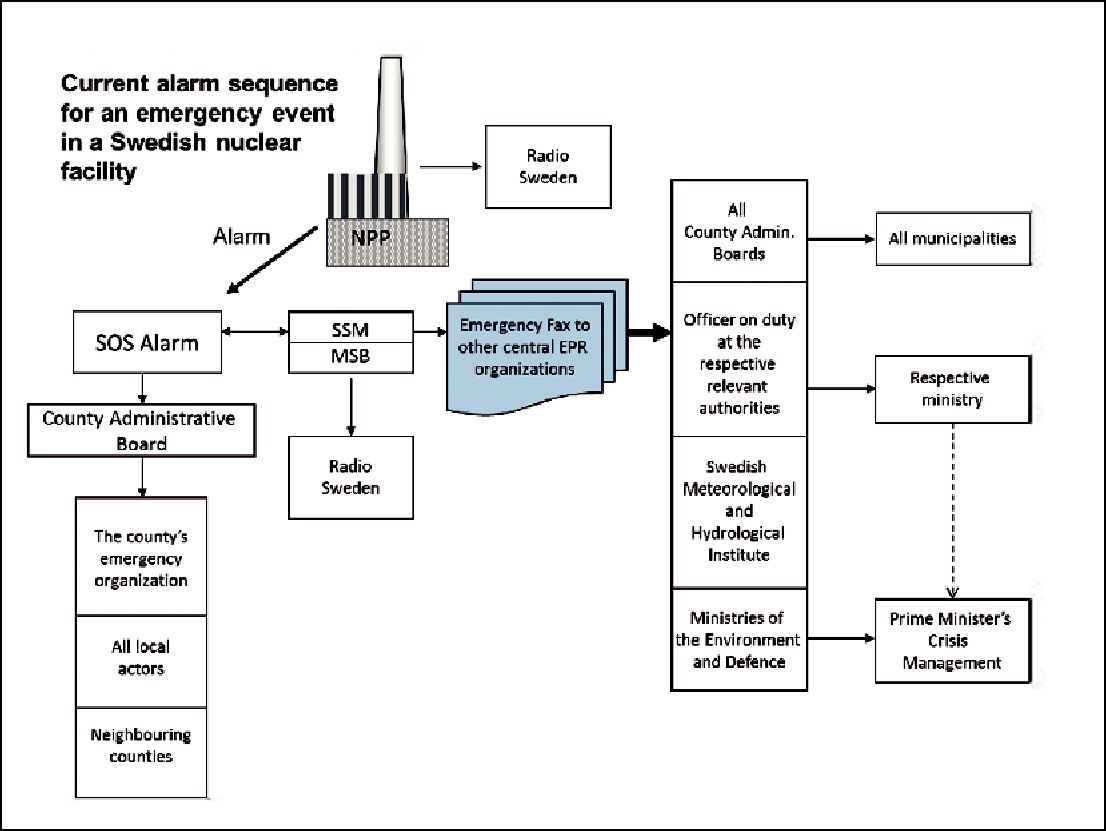
Figure 4 – Current alarm sequence for an emergency event at a Swedish nuclear facility.
A number of authorities, organizations and laboratories will cooperate or operate as supporting functions to the national organizations listed above in the event of a nuclear or radiological emergency. Participating authorities that have cooperating roles for crisis management for instance include the National Food Administration, which is responsible for taking decisions on action levels for the content of radioactivity in foodstuffs, and the Board of Agriculture, which is responsible for taking decisions on action levels regarding agricultural practices and products. Other authorities that have responsibilities during crises and that cooperate with or receive advice and recommendations from SSM include the County Administrative Boards, the Swedish Civil Contingencies Agency, the Swedish Board of Health and Welfare, Swedish Customs, the Swedish Meteorological and Hydrological Institute, Swedish National Police Board, Swedish Coast Guard and the local rescue leader, police and medical personnel.
Authorities, organizations and laboratories that comprise the national expert response organization and, among other duties, participate in radiological monitoring and measurements following nuclear and radiological emergencies are shown in Figure 5 with a summary of the contracted responsibilities covering fixed laboratory measurements, field and airborne mobile measurements and weather and plume dispersion prognoses. In addition to the tasks shown in Figure 5, the laboratories are also contracted for providing expert advice.
In addition to the tasks shown in Figure 5, the Geological Survey of Sweden and the county police force are (for instance) contracted for the use of aircraft and helicopters for airborne measurements of radiation and the Swedish Defence Research Agency (FOI) will be capable of providing expertise, technical assistance and personnel to the Swedish
Radiation Safety Authority’s crisis organization. Also, a number of additional laborato-
Page 56(87)
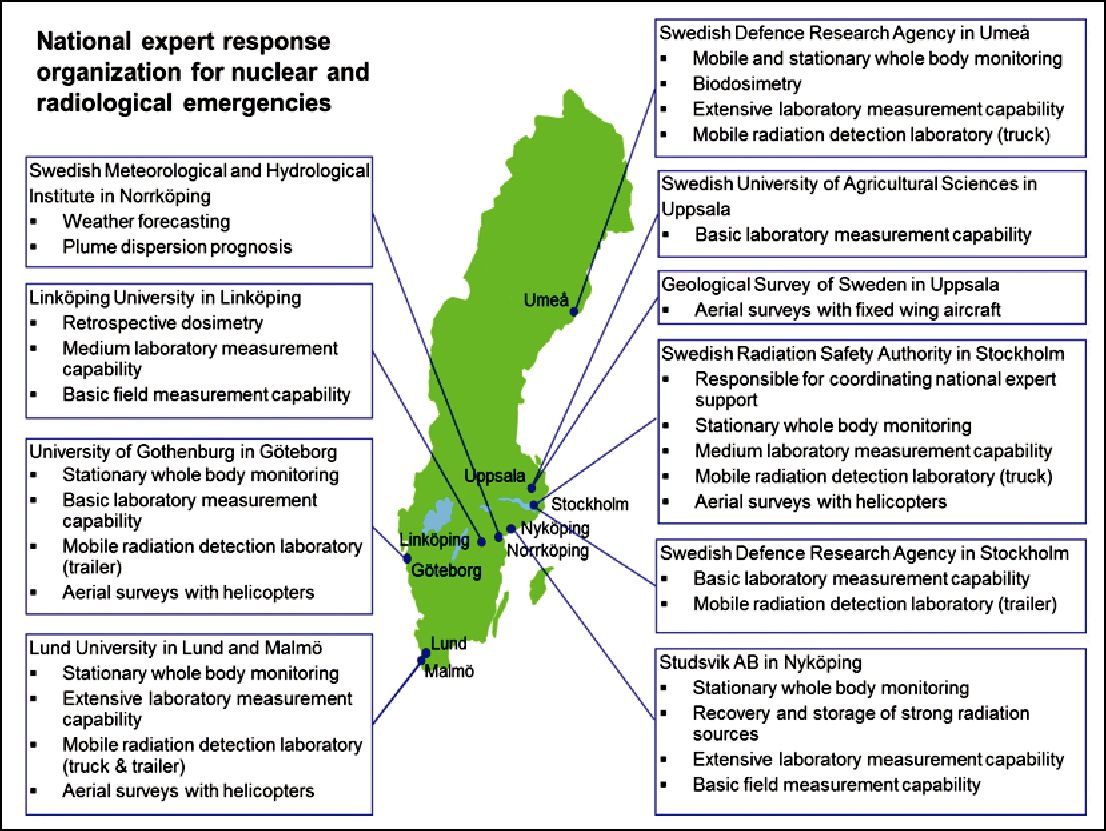
ries around Sweden, as shown in Figure 5, are prepared to make supplementary radiological measurements and analyses and providing expert advice.
Figure 5 – National expert response organization for nuclear and radiological emergencies.
The Nuclear Medical Expert Group
Also, a number of voluntary organizations such as the Armed Forces, e.g. the Women’s
Voluntary Defence Service, the Women’s Motor Transport Corps and the Women’s Auxiliary Veterinary Corps, are prepared to provide assistance in the event of a radiological emergency. One area of assistance that these voluntary organizations are extensively trained and organized for is the rapid collection of agricultural field samples for transport to the national laboratory network for measurement. This will allow for early decisionmaking on agricultural countermeasures.
Page 57(87)
Overview of other national organizations involved in achieving and maintaining a high level of nuclear safety
Swedish nuclear power plant operators jointly own the following support organizations:
The Nuclear Safety and Training (KSU) organization provides operational training, including simulator training, on a contractual basis for all the Swedish nuclear power plants. KSU also analyses international operational experience and provides the results to Swedish operators. In addition, KSU publishes regular reports about operational experience from Sweden and provides other energyand
The Swedish Qualification Centre (SQC) is a company for independent qualification of NDT systems
ERFATOM is an organization formed through cooperation between operators of Swedish and Finnish BWRs and Westinghouse Electric Sweden AB (formerly ABB At- om) to carry out experience feedback analysis of events at Swedish and Finnish BWRs.
The Swedish Nuclear Fuel and Waste Management Company (SKB) works with spent nuclear fuel and radioactive waste. SKB owns and operates the facility for intermediate storage of spent fuel (CLAB) in Oskarshamn and the facility for final storage of lowand
The supply of services in the nuclear field has been concentrated to a few companies in recent years. The main Swedish vendor,
Under Swedish law, a licence holder needs a permit from the government or the Swedish Radiation Safety Authority to contract out a major part of a nuclear activity. For minor parts, it is sufficient under certain conditions to notify the Swedish Radiation Safety Au- thority that a contract has been awarded. The Swedish Radiation Safety Authority requires the licensees to make the necessary checks of a contractor’s quality and competence and to take full responsibility for the work done by the contractor. There is, however, no formal licensing of contractors for normal commercial services, except for NDT companies where accreditation by SWEDAC is required, nor for companies handling asbestos.
Over the past few years, Swedish nuclear power plant licensees have noticed that fewer companies bid on qualified technical projects and services. This reflects the concentration of vendors and service companies on the market and also the increasing demand as a result of the extensive upgrading of the Swedish reactors and the nuclear construction project in Finland.
Studsvik Nuclear AB is an important contractor for materials testing and nuclear fuel investigations. The materials testing reactors are closed, but the company cooperates with staff of the Halden reactor in Norway and maintains the hot cell laboratory. Studsvik Nu- clear AB also provides decommissioning and waste treatment services.
Page 58(87)
Academic education in nuclear technology in Sweden is mainly concentrated to the Royal Institute of Technology in Stockholm (KTH), Chalmers University of Technology in Gothenburg (Chalmers) and Uppsala University (UU).
Sweden has taken a systematic approach to maintain basic academic resources for higher level nuclear education and research. This is partly due to an agreement concluded between the Swedish nuclear industry and the Swedish Radiation Safety Authority to support the Swedish Centre of Nuclear Technology economically over a period of several years. The present agreement covers the period
4.1 Overview of performed analyses/activities by national organizations
In the following sections, all recent activities that can be related to emergency preparedness and crisis management and that are associated with reviews of the national organizations involved in maintaining and enhancing nuclear safety will be described, whether or not these activities are directly driven by the lessons learned from the nuclear accident at the Fukushima
The Swedish national organizations are regularly reviewed in the form of exercises and evaluations. Most recently, in the spring of 2011, a
4.2 Activities performed by the operators or other national organizations involved in achieving and maintaining a high level of nuclear safety
4.2.a. Overview of the actions taken or planned by the operators to address national organizations
The County Administrative Boards in the counties with nuclear power plant conduct, at intervals of a few years, a major exercise within the Nuclear Emergency Preparedness in Sweden. A
Page 59(87)
functioned well. All actions performed by other participants were led by the County Ad- ministrative Board and lay outside OKG’s jurisdiction. The cooperation was well established and well trained.
4.2.b. Schedules and milestones for completing the operators’ planned activities
The first period of the exercise was the acute phase, 36 hours with extensive critical incidents at OKG simulating events in real time, including alerting other parts of society. Evacuation of personnel at OKG was performed. OKG’s entire emergency preparedness organization participated.
The needs identified by OKG included evaluating whether the alternative command centre should be placed outside the OKG site in order to avoid access difficulties. Other identified needs concerned evaluation of additional technical equipment as RAKEL units, possible satellite telephones and other equipment for internal needs.
4.2.c. Preliminary or final results of the activities including proposals for further actions
SAMÖ/KKÖ was performed about one month before the Fukushima accident and the scenario in the exercise was by coincidence very similar to the event in Fukushima, simulating a core melt penetrating the reactor pressure vessel followed by radiological releases to the surroundings. The results from SAMÖ/KKÖ basically demonstrate the same needs as shown later in connection with the stress tests.
4.3 Activities performed by the government or authorities
Emergency preparedness and crisis management on a national level involve a number of national organizations and authorities as well as the Government. Therefore, this subsection will not only cover regulatory activities, but will also include activities performed by the Swedish Government and all Swedish authorities.
4.3.a. Overview of the actions taken or planned by the government or authorities to address national organizations
A
During the nuclear accident at the Fukushima
Page 60(87)
tivities throughout this period led to a number of lessons learned regarding the performance of the national organizations. One example is the experience from the cooperation between the Swedish Radiation Safety Authority and the Swedish Defence Research Agency (FOI) during the accident. During the accident, the Swedish Defence Research Agency (FOI) was contracted by the Swedish Radiation Safety Authority to assist the emergency organization and to perform analyses and supplementary radiation monitoring. This interaction has been evaluated further and the need for clarification regarding the role of the Swedish Defence Research Agency (FOI) during a radiological or nuclear emergency is currently being discussed.
Handling a nuclear power accident in a country far from Sweden, but nevertheless having implications for Sweden and Swedes living in Japan, has led to a number of lessons learned regarding the performance of the national organizations during the accident and which are still being evaluated; see also Chapter 5 for further information.
The nuclear accident at the Fukushima
April 2012.
The responsibilities for security and safeguards at a national level of authority are shared between the Swedish Radiation Safety Authority, the Swedish Defence Research Agency (FOI) and the Swedish Agency for
4.3.b. Schedules and milestones for completing actions taken or planned by government or authorities
The performance of the national organizations during the
4.3.c. Conclusions from the actions taken or planned by the government or authorities regarding the outcome of the operators’ activities
The results from the evaluation of the
During the nuclear accident at the Fukushima
Page 61(87)
organizations throughout this period have been evaluated and the results will be assessed further.
During the first month of the accident at the Fukushima
The examination of responsibilities for security and safeguards at a national authority level was completed in December 2011. The conclusion has been documented in an official memorandum available at the Ministry of the Environment.
4.4 Summary table for items related to national organizations
Table 4 shows a
Table 4: Summary of items related to national organizations.
| Activities by the Operators* | Activities by the Regula- | ||||||
| tor/Government/Authority* | |||||||
| (Item 4.2.a) | (Item 4.2.b) | (Item 4.2.c) | (Item 4.3.a) | (Item 4.3.b) | (Item 4.3.c) | ||
| Activity | Results | Conclusion | |||||
| Activity | Activity | ||||||
| Schedule | Available | Schedule | Available | ||||
| - Taken? | Or Milestones | - Taken? | Or Milestones | ||||
| for Planned | - Yes? | for Planned | - Yes? | ||||
| - Ongoing? | - Ongoing? | ||||||
| Activities | - No? | Activities | - No? | ||||
| - Planned? | - Planned? | ||||||
| Topic 4 – National organizations | |||||||
| Government/authority | |||||||
| on a nuclear power plant | Taken | April 2011 | Yes | Taken | April 2011 | Yes | |
| accident | |||||||
| Evaluations of the |
|||||||
| exercise focusing on a nuclear | Taken | Oct 2011 | Yes | Taken | Oct 2011 | Yes | |
| power plant accident | |||||||
| Processing the result from the | |||||||
| evaluations of the |
|||||||
| exercise focusing on a nuclear | No | ||||||
| power plant accident | |||||||
| Evaluations of performances of | |||||||
| the national organizations | |||||||
| throughout the first month of | Taken | March 2011 | Yes | ||||
| the accident at the Fukushima | |||||||
| Processing the result from the | |||||||
| evaluations of the performanc- | |||||||
| es of the national organizations | |||||||
| throughout the first month of | Ongoing | No | |||||
| the accident at the Fukushima | |||||||
Page 62(87)
| Evaluation of the Swedish | ||||||
| Defence Research Agency‘s | ||||||
| (FOI) role during a radiological | Ongoing | No | ||||
| or nuclear emergency | ||||||
| Examine the possibilities for | ||||||
| Sweden to receive international | ||||||
| support during emergency and | Taken | April 2012 | No | |||
| crisis situations | ||||||
| Examination of responsibilities | ||||||
| for security and safeguards at | Taken | Dec 2011 | Yes | |||
| a national authority level | ||||||
* The Operator or Regulator may include other government agencies or entities, stakeholders, if applicable.
Page 63(87)
5. Topic 5: Emergency preparedness and response and
The accident has further shown the importance of preparing for
Contracting Parties are expected to summarize the results of their review of this topic.
5.1 Overview of performed analyses/activities within emergency preparedness and response
The following section describes recent activities in Sweden focusing on the review and analysis of the
The Swedish approach to handling the response to the Fukushima
The Swedish regulator, SSM, has also reviewed and evaluated its own emergency preparedness and response programme, including its links with organizations at the national level (chapter 4). The progress made thus far is due to initiatives taken by the Authority, including the results of the evaluation of the national SAMÖ/KKÖ exercise that took place between February and April 2011, an evaluation of the accident management at the Fukushima
5.2 Activities performed by the operators
5.2.a. Overview of the actions taken or planned by the operators to address emergency preparedness
The severe accident procedures are intended to cover a maximum of 24 hours. Major events would mean that the
Page 64(87)
maintain competence regarding the unit’s design and function, radiation protection/radiology and reactor safety. However, it is important to note that the licensee is responsible for all actions undertaken to mitigate the consequences of an event. The evaluation covers evacuation of remaining personnel, inward transportation of personnel, food, fuel, raw water, nitrogen, boric acid, etc. to the site.
In the
In their work with the stress tests, the licensees have identified the following recommendations for further evaluations and reassessments. All recommendations have not been identified by all licensees and are not relevant to all units:
Clarify the responsibility for
Investigate the course of action during a
An investigation has been suggested to ascertain advantages and disadvantages when replacing the present substitute Command Centre with a suitable office outside the site so that both Command Centres are not situated within the site where they would possibly both become affected by the same bad conditions.
It should be investigated whether some of the functions included in the staffing of the emergency preparedness organization are sufficient to sustain shifts around the clock.
At present, calling in personnel is dependent on a functioning GSM/Telenet/telecommunications network. An improvement in this area should be investigated.
Identify alternative evacuation routes. It might be preferable to wait with abandonment. If there are no roads, the rescue leaders must investigate the possibility of crosscountry, sea or air transportation. This scenario should be highlighted and preparations possibly made.
For some sites, connecting auxiliary power to the Command Centre is important. In the event that diesel engines and gas turbines are not available, the Command Centre is then restricted to using available battery power.
5.2.b. Schedules and milestones for completing the operators’ planned activities
The Swedish nuclear industry has initiated a joint effort for harmonization of stress test results. The goal is to share information and best practices and to coordinate further evaluations of stress test findings on the part of Swedish NPP units. The work is planned to be completed in 2012. The preliminary schedule for further work is as follows:
Page 65(87)
A first version of a common vision, strategy and targets (called the Industry Position Paper) for the
An early estimation of the time schedule of the needed measures to fulfill the defined targets will be assessed during the second half of 2012.
Investment decisions will be taken according to the general process for such decision making and decided measures will be incorporated in the plant safety upgrading programmes.
5.2.c. Preliminary or final results of the activities including proposals for further actions
5.3 Activities performed by the regulator
The Swedish Radiation Safety Authority (SSM) has the collective responsibility in Sweden for radiation protection and nuclear safety and is placed under the Ministry of the Environment. SSM is a regulatory, supervisory and licensing authority with an expert role in radiation protection, nuclear safety and emergency preparedness and response. Expert advice from SSM is delivered to the authority responsible for deciding on and implementing protective measures. In the case of the Fukushima
5.3.a. Overview of the actions taken or planned by the regulator to address emergency preparedness
Work is in progress in Sweden to address the questions that have arisen and the lessons learned during the management of an accident at a nuclear facility far away from but nevertheless having implications for Sweden. The work is aimed at two aspects that have arisen from the accident at Fukushima
Actions taken in Sweden focused on Swedish citizens in Japan during the accident at Fukushima
The crisis organization at SSM was activated around the clock between 11 and 31 March 2011. Radiological and nuclear technical analyses were fully active with continuous efforts focused on characterizing the situation in Japan using the sources of information that were available. Official and public OK information sources were used as well as informal
Page 66(87)
contacts. The situation is still being studied and monitored. One of the international studies that Sweden is participating in that is aimed at characterizing the effects of the Fukushima
The efforts of the crisis organization largely focused on the need to advise and inform the Government, mainly through the Ministry for Foreign Affairs, which has the responsibility for Swedish citizens abroad and the crisis organization was also focused on satisfying the general public’s need for information and meeting the major interest from the mass media. Information for the Government, the general public and the media was produced continuously and experts from SSM provided daily information in different types of media fora. Social networks such as Facebook and Twitter were used by SSM to enhance the availability of the information to the general public.
To ensure the public that no harmful levels of radiation were reaching Sweden, monitoring was performed in Sweden of air, fallout, foodstuffs and goods from Japan. Travellers returning home from Japan were offered medical advice, and travel recommendations and advice for citizens wanting to travel to Japan were produced.
Iodine tablets were distributed with instructions on intake, plus information on other recommendations regarding travel and living in Japan to Swedish citizens in the country. Sweden recommended its citizens residing within 250 km from the Fukushima
Actions taken in Sweden: SSM’s criteria for the recommendations given regarding iodine prophylaxis during the accident at the Fukushima
Sweden was unique in its decision to recommend to its citizens in Japan within a 250 km radius from Fukushima
Conditions and uncertainties. The conditions at the Fukushima
Normal practice in Sweden. During the planning phase in Sweden, iodine tablets and information are distributed to all households in the inner emergency zone
Page 67(87)
their households in the event a general emergency is declared. Also, in cases other than a general emergency, or for areas outside the
Swedish citizens in a foreign country receive the same recommendations for protective measures that are normal practice inside of Sweden? The answer was yes.
Analyses and rationale. Sweden followed the recommendations given by the Japanese Government until 16 March 2011. At this time, the Swedish crisis organization was conducting source term analyses as well as dispersion and dose analyses using the information available on inventories, measurement data and the weather. The first analyses used an iodine source of 0.1% - 1% of one reactor inventory of iodine. This gave a prognosis that justified iodine prophylaxis extending to 30 km (from the reactors). As the situation worsened, analyses used 10% of one reactor inventory of iodine. This justified iodine prophylaxis out to 80 km. At this point in time, there was considerable uncertainty regarding the status and the possible development of status at the larger, common spent fuel pond. The pond was heating up and its temperature was above the design temperature. Although it was not a major source of iodine, if it became too unstable the conditions in general at the plant and the other reactors could have worsened because of, among other things, an evacuation of workers and therefore a lack of manpower for dealing with the whole situation. The analyses were then performed using a source term of 10% of three reactors’ inventory of iodine, the same as 30% of one reactor, which gave a prognosis that justified iodine prophylaxis out to 250 km.
Thus, SSM’s worst case predictions showed that iodine prophylaxis could be justified out to a radius of 250 km from the Fukushima
The way forward: harmonization, coordination and information exchange. Routines for information exchange with regards to planned countermeasures should be introduced and complied with, e.g. through the IAEA’s ENAC (USIE) or the EU’s ECURIE or through regional agreements. No new channels for information exchange are necessary; however, routines for proper, predetermined usage of existing channels are needed and should be agreed upon by member states. International agreements on protective measures and coordination of strategies for protection are difficult to achieve. Countries will always exercise their own right to choose how to protect their own citizens. There are both possibilities and difficulties regarding the harmonization of protective actions; there are differences in philosophy and approach. Through continued cooperation between countries, however, optimized coordination can be achieved. At the very least, a functioning information exchange between member states should be achievable.
Actions taken to improving the crisis management of an accident of similar severity as the Fukushima
Two events occurred simultaneously in Sweden that have been analysed and evaluated,
Page 68(87)
leading to suggestions for improvements in SSM’s emergency preparedness and response. The first event was a
As a result of the accident in Japan and the subsequent activation of SSM’s crisis organization continuously over three weeks, several measures for improving the organization have been identified. These have been compiled along with measures resulting from the evaluation of the SAMÖ/KKÖ exercise, and a number of them have been implemented in a first phase of prioritized improvements. Some examples of measures already taken are: clearer routines for incident documentation, improved routines and checklists for the different functions in the crisis organization, supplementary training for staff and improvements in procedures for operational communication, shift planning, work schedules and information management for the regular SSM organization during the time that the crisis organization is activated.
Another important measure is the updating and formalization of
In addition to these measures, a more overarching action has been identified as necessary for improving the possibilities for the SSM crisis organization to fulfil its responsibilities during a nuclear accident or event. SSM’s regulations specify that the operator of nuclear facilities shall deliver a source term early during an event to SSM. SSM is also responsible for independently assessing the source term to be used in SSM’s analysis of the radiological consequences. However, the plant parameters that would provide the basis for the thorough assessment of the situation and the prediction of the accident progression and radionuclide release are not available online in the Emergency Response Centre located at SSM. SSM and the nuclear facilities are currently working towards establishing a system for electronic transmission of plant data from the Swedish nuclear power plants to SSM’s Emergency Response Centre.
Actions taken regarding updating regulations SSMFS (2008:15) concerning Emergency Preparedness at Certain Nuclear Facilities
Experiences gained from SSM’s supervision of emergency preparedness at certain nuclear facilities as well as experience gained from the Fukushima
Safety Authority’s Regulations concerning Emergency Preparedness at Certain Nuclear Facilities. Specifically with regards to experiences gained from the Fukushima
Page 69(87)
tection of personnel and the communications infrastructure at a power plant. The regulation makes specific demands on having a detailed plan for obtaining protective equipment in a drawn out or
Actions taken earlier in Sweden to ensure robust command, control and communications: the regulator’s Emergency Response Centre
SSM’s Emergency Response Centre is well equipped for its function and was well equipped even before the Fukushima event. The facility is designed to ensure an effective and sustainable management of the Authority's emergency operations, both in peacetime and during times of alert. The facility is protected both physically, through strong fortification, and also by an EMP (electromagnetic pulse) shield. The facility can be operated by autonomous systems of power and communications, is fed by an independent power supply and can operate even during extended losses in the external power supply.
In addition to the Emergency Response Centre, the Authority maintains a mobile Radiological Emergency and Assessment Centre (REAC) that can enable the emergency activities, communications and analyses to be performed anywhere
The Emergency Response Centre has fixed, mobile, encrypted and satellite telephony. SSM has installed fax gateways in its premises and at the backup location described below for efficient sending, receipt and rerouting of fax communication.
The emergency response functions at SSM have access to multiple radio communication systems. All emergency field units at SSM are also equipped with RAKEL mobile radio system (TETRA, Terrestrial Trunked Radio) terminals. By linking in the terrestrial part of the RAKEL network into SSM's PABX, the Authority's RAKEL terminals may also be used as traditional mobile phones. RAKEL is also available in the Emergency Response Centre, both in terms of air coverage and in the form of a dispatcher station physically connected to the terrestrial RAKEL network through dedicated lines within the Armed
Forces’ infrastructure.
SSM is connected to the Internet via a redundant
To enable the distributed management of complex emergency events, SSM has invested in a
SSM maintains an unmanned backup location in the form of a server hall in hot standby, geographically
Page 70(87)
such an event,
Actions identified in Sweden at the national level
In addition to the specific measures identified for improving the efficiency of SSM’s crisis organization and the improvements in SSM’s regulation for emergency preparedness at nuclear installations (SSMFS 2008:15), several overarching questions for the Swedish national emergency preparedness and response have been identified. These questions have been clarified, gained impetus and become more clearly defined through a factfinding mission in Japan undertaken by Swedish regulators in December 2012. The purpose of this mission was to achieve a better understanding of how to more efficiently handle the emergency response and compare the Japanese experiences and Swedish systems. These areas are listed below.
The need for information. The pressure on Japan from other countries and international organizations to provide information on the event and to continuously publish everything from measurement protocols to decisions in English has been considerable. How could Sweden manage this and how should it be organized so that foreign actors, who do not understand the Swedish system, receive a correct picture of the situation?
Endurance. The acute phase of the catastrophe in Japan lasted for several months. The intermediate and
Measurement capacity. The need for measurements for mapping fallout, monitoring and control of contaminated persons, foodstuffs and provisions, export control, etc., is great, even with a ‘small’ discharge. With a large discharge, the experience from Japan shows that the need would be enormous. Which measurement capacity should Sweden have and how is Sweden to receive help from other countries?
International assistance/cooperation. Japan, the world’s third largest economy with 128 million citizens, 55 reactors in operation before the accident and conducting extensive research and development within nuclear power technology and radiation protection, has received help from several countries to handle the accident. It is clear that Sweden alone would not be able to handle a large accident at a Swedish nuclear power plant.
Allocation of responsibilities. An accident in a nuclear reactor leading to a large discharge of radioactive material is a national catastrophe. Is today’s division of responsibilities optimal or how should the responsibility for handling this type of event be allocated between local, regional and national actors in Sweden? How should collaboration be organized between local, regional and national actors and the nuclear installation during an accident at a Swedish nuclear power plant?
Ambition level. An overarching issue is the organizational form of the Swedish emergency preparedness and response system: is it organized so that it is efficient and optimized with the resources at hand to be capable of managing a serious accident at a nuclear power plant in Sweden? Also, at what level of severity of an accident shall preparedness for response be withheld and maintained? How safe is safe enough?
Page 71(87)
5.3.b. Schedules and milestones for completing the regulatory body’s planned activities
The performance of the regulatory body’s actions during the
The revision of the Swedish regulation SSMFS 2008:15, The Swedish Radiation Safety
Authority’s Regulations concerning Emergency Preparedness at Certain Nuclear Facilities is in its final review stage and will be implemented on 1 January 2013.
SSM and the nuclear facilities are currently working towards establishing a system for electronic transmission of plant data from the Swedish nuclear power plants to SSM’s
Emergency Response Centre. Phase 1 of this project is scheduled for completion in De- cember of 2012. Also, updating and formalization of
Several overarching questions for the national system for emergency preparedness and response that have been identified by SSM are under consideration.
5.3.c. Conclusions of the regulatory body regarding the outcome of the operators’ activities
SSM’s overall assessment of the emergency response organizations at the nuclear facilities is that all licensees have given a good description of strategies, instructions and equipment. The stress tests have also demonstrated limitations in the emergency preparedness organizations. Investigations need to be conducted to ascertain what is needed so that a facility’s emergency preparedness organization is dimensioned to deal with situations in which several facilities are affected simultaneously. SSM’s opinion regarding which areas in the operators’ emergency preparedness need further and deeper evaluation as a result of the European stress tests for nuclear power plants is summarized as the following items:
Emergency planning should comprise severe emergency situations involving all units at the site.
Accessibility and functionality of the ordinary
Personnel safety issues have to be
The need for shared resources available at the site should be evaluated since the currently available resources are insufficient if all units at the site are affected (even in the short term).
Page 72(87)
Action plans should be set up where the need for external resources, both human and material, should be identified along with the information on where and how they can be obtained as well as the time for their transport to the site.
Areas critical for accident management in the long term should be identified. These areas can for example include the need for external resources, routines for access to the site and means for managing the larger quantities of radioactive water.
5.4 Summary table for items related to emergency preparedness and response
Table 5 shows a
Table 5: Summary of items related to emergency preparedness.
| Activities by the Operators* | Activities by the Regulator* | ||||||
| (Item 5.2.a) | (Item 5.2.b) | (Item 5.2.c) | (Item 5.3.a) | (Item 5.3.b) | (Item 5.3.c) | ||
| Results | Conclusion | ||||||
| Activity | Activity | Activity | |||||
| Schedule | Available | Schedule | Available | ||||
| - Taken? | Or Milestones | - Taken? | Or Milestones | ||||
| for Planned | - Yes? | for Planned | - Yes? | ||||
| - Ongoing? | - Ongoing? | ||||||
| Activities | - No? | Activities | - No? | ||||
| - Planned? | - Planned? | ||||||
| Topic 5 – Emergency preparedness | |||||||
| Operators | |||||||
| Clarify the responsibility for | |||||||
| decontamination stations | |||||||
| outside the site for personnel | |||||||
| during shift turnovers and | Planned | Not applicable | No | ||||
| how equipment is to be | |||||||
| replaced. | |||||||
| Investigate the course of | |||||||
| action during a |
Planned | Not applicable | No | ||||
| need for personnel. | |||||||
| Identify alternative evacua- | |||||||
| tion routes. | Planned | Not applicable | No | ||||
| An investigation is suggested | |||||||
| to ascertain advantages and | |||||||
| disadvantages in replacing | |||||||
| the present substitute Com- | Planned | Not applicable | No | ||||
| mand Centre with a suitable | |||||||
| office outside the site | |||||||
| It should be investigated | |||||||
| whether some of the func- | |||||||
| tions included in the emer- | |||||||
| gency preparedness organi- | Planned | Not applicable | No | ||||
| zation staffing are sufficient, | |||||||
| to sustain shifts around the | |||||||
| clock. | |||||||
Page 73(87)
| At present,calling in person- | ||||||
| nel depends on a functioning | ||||||
| GSM/Telenet. An improve- | Planned | Not applicable | No | |||
| ment in this area should be | ||||||
| investigated. | ||||||
| Identify alternative evacua- | Planned | |||||
| tion routes. | Not applicable | No | ||||
| For some sites connecting | ||||||
| auxiliary power to the Com- | Planned | Not applicable | No | |||
| mand Centre is important. | ||||||
Regulator
| National exercise | ||||||
| SAMÖ/KKÖ 2011: seminar | Taken | Yes | ||||
| on |
||||||
| Measure to improve the | ||||||
| regulator’s crisis organiza- | Not applicable, | |||||
| tion: clearer routines for | Taken | completed in | Yes | |||
| 2011 | ||||||
| Measure to improve the | ||||||
| regulator’s crisis organiza- | ||||||
| tion: improved routines and | Not applicable, | |||||
| checklists for the different | Taken | completed in | Yes | |||
| functions in the crisis organi- | 2011 | |||||
| zation, | ||||||
| Measure to improve the | ||||||
| regulator’s crisis organiza- | Not applicable, | |||||
| tion: complimentary educa- | Taken | completed in | Yes | |||
| tion for staff, | 2011 | |||||
| Measure to improve the | ||||||
| regulator’s crisis organiza- | Not applicable, | |||||
| tion: improvements in proce- | ||||||
| Taken | completed in | Yes | ||||
| dures for operational com- | ||||||
| 2011 | ||||||
| munication, | ||||||
| Measure to improve the | Not applicable, | |||||
| regulator’s crisis organiza- | ||||||
| Taken | completed in | Yes | ||||
| tion: shift planning, | ||||||
| 2011 | ||||||
| Measure to improve the | ||||||
| regulator’s crisis organiza- | ||||||
| tion: work schedules and | ||||||
| information management for | Not applicable, | |||||
| the ordinary running of | Taken | completed in | Yes | |||
| SSM’s organization during | 2011 | |||||
| the time that the crisis organ- | ||||||
| ization is activated. | ||||||
| of |
||||||
| countermeasures and the | ||||||
| implementation of measura- | Ongoing | Latest 2013 | ||||
| ble operational intervention | ||||||
| levels and routines for appli- | ||||||
| cation of intervention levels | ||||||
Page 74(87)
| SSM and the nuclear facili- | ||||||
| ties are currently working | ||||||
| towards establishing a sys- | ||||||
| tem for electronic transmis- | Phase 1 com- | |||||
| sion of plant data from the | Ongoing | plete Decem- | No | |||
| Swedish nuclear power | ber 2012. | |||||
| plants to SSM’s Emergency | ||||||
| Response Centre. | ||||||
| Revision of the Swedish | ||||||
| regulation SSMFS 2008:15 , | ||||||
| the Swedish Radiation Safety | ||||||
| Authority’s Regulations | Ongoing | January 2013 | ||||
| concerning Emergency | ||||||
| Preparedness at Certain | ||||||
| Nuclear Facilities. | ||||||
| General (overarching) ques- | ||||||
| tions for the national system | Planned | Not decided | ||||
| for emergency preparedness | ||||||
| and response | ||||||
| in December 2011 regarding | ||||||
| countermeasures and miti- | Taken | Yes | ||||
| gating the effects of the | ||||||
| accident | ||||||
| termeasures | Planned | By 2013 | ||||
| Item identified as a result of | ||||||
| the European stress tests | ||||||
| needing further and deeper | Not applicable, | |||||
| evaluation: Emergency plan- | ||||||
| Taken | completed in | Yes | ||||
| ning should comprise severe | ||||||
| Jan 2012 | ||||||
| emergency situations involv- | ||||||
| ing all units at the site | ||||||
| Item identified as a result of | ||||||
| the European stress tests | ||||||
| needing further and deeper | Not applicable, | |||||
| evaluation: The ordinary on- | ||||||
| Taken | completed in | Yes | ||||
| site emergency control cen- | ||||||
| Jan 2012 | ||||||
| tre and the alternative emer- | ||||||
| gency control centre should | ||||||
| be secured | ||||||
| Item identified as a result of | ||||||
| the European stress tests | Not applicable, | |||||
| needing further and deeper | ||||||
| Taken | completed in | Yes | ||||
| evaluation: The personal | ||||||
| Jan 2012 | ||||||
| safety issues have to be re- | ||||||
| assessed | ||||||
| Item identified as a result of | ||||||
| the European stress tests | ||||||
| needing further and deeper | Not applicable, | |||||
| evaluation: The need for | Taken | completed in | Yes | |||
| common at the site available | Jan 2012 | |||||
| resources should be evaluat- | ||||||
| ed | ||||||
| Item identified as a result of | ||||||
| the European stress tests | ||||||
| needing further and deeper | Not applicable, | |||||
| evaluation: Action plans | ||||||
| Taken | completed in | Yes | ||||
| should be set up where the | ||||||
| Jan 2012 | ||||||
| need for external resources, | ||||||
| both human and material, | ||||||
| should be identified |
Page 75(87)
| Item identified as a result of | ||||||
| the European stress tests | ||||||
| which needing further and | Not applicable, | |||||
| deeper evaluation: Areas | Taken | completed in | Yes | |||
| critical for accident manage- | Jan 2012 | |||||
| ment in |
||||||
| identified |
* The Operator or Regulator may include other government agencies or entities, TSOs or stakeholders, if applicable.
Page 76(87)
6. Topic 6: International cooperation
An objective of the CNS is ”to achieve and maintain a high level of safety worldwide through the enhancement of national measures and international cooperation...”
The importance of international cooperation was further highlighted during the Fukushima accident and recovery actions. At the Ministerial Conference on Nuclear Safety, “Member States were encouraged to recognize the importance of international cooperation and collaboration in enhancing safety and regulation”. Contracting Parties should include any actions taken or planned to enhance the capability to offer assistance to another Contracting Party, should a severe accident occur.
The Contracting Parties should consider actions to strengthen the global nuclear safety regime, such as expanding the use of IAEA Safety Standards, hosting peer reviews, and enhancing the transparency and effectiveness of communication among operators, regulators and international organizations.
Contracting Parties are expected to report on actions that have been taken, or are planned, to enhance international cooperation, including:
Changes in status with respect to the safety conventions;
Mechanisms for communicating with neighbouring countries and the international community;
Cooperation with international organizations;
Cooperation in the frame of international working groups;
Hosting international peer reviews;
Sharing international operating experience; and
Utilization of IAEA Safety Standards.
6.1 Overview of the topic analysis
Sweden is party to all of the relevant conventions expected for a country operating nuclear power plants, encompassing nuclear safety, emergency preparedness and response, nuclear liability, spent nuclear fuel, radioactive waste and physical protection. Sweden has also formally committed to implementation of the Code of Conduct on the Safety and Security of Radioactive Sources and the Supplementary Guidance on the Import and Ex- port of Radiation Sources.
Sweden has ratified the International Convention on Early Notification and the Convention on Assistance in the Case of a Nuclear Accident. An official national point of contact (the Swedish Meteorological and Hydrological Institute, SMHI) is available every day around the clock. This is also the case for the officer on duty at the Swedish Radiation Safety Authority (SSM).
Sweden participates in numerous bilateral (15) and multilateral (2) international agreements regarding cooperation on matters of nuclear safety and/or radiation protection. The SSM Management System document no. 102, “Policy for International Agreements”, provides internal SSM guidance for concluding international agreements. Additionally, Sweden and SSM are members of the OECD/NEA and actively participate in various working groups and nuclear radiation safety initiatives.
Page 77(87)
In the area of emergency preparedness, Sweden collaborates (exchange of information) and has concluded early warning agreements with Denmark, Finland, Germany, Norway, Russia and Ukraine in the event of an incident or accident at a Swedish NPP or abroad. There is also an agreement on the authority level (SSM) concluded with Lithuania. Sweden uses the ECURIE information system for information exchange within the European Union and the ENAC/Emercon system for information exchange between the IAEA member states.
The Nordic authorities involved in radiological emergency planning have agreed to exchange data on a routine basis from the automatic gamma monitoring stations in the respective countries. The five Nordic countries of Denmark, Finland, Iceland, Norway and Sweden have compiled a Nordic Manual describing communication and information routines between the countries for an extensive list of scenarios, which have been agreed upon by these five countries.
SSM exchanges information on nuclear safety issues in several ways. As mentioned above, several bilateral agreements (e.g. with CNSC, Canada; NISA, Japan; NNR, South Africa; US DOE, US NRC and US EPA) on issues of emergency preparedness and response, and nuclear, radiation and waste safety are in effect. SSM participates in international meetings and conferences in order to obtain and share information.
The Ministry of the Environment, the Ministry for Foreign Affairs, SSM and other authorities participate in IAEA meetings at all levels. Furthermore, SSM is active in several OECD/NEA activities, in particular the Working Group on Operating Experience (WGOE). Sharing of information also takes place by providing and extracting data from IAEA and NEA databases or event reporting networks, such as the IAEA/NEA Incident Reporting System (IRS), Information System on Occupational Exposure (ISOE), European ALARA Network (EAN), European Medical ALARA Network (EMAN), the Nordic Society for Radiation Protection (NSFS), the International Radiation Protection Association (IRPA) and several others.
SSM takes part in the cooperation of the EU clearinghouse located at the Institute for Energy of the Joint Research Centre in Petten, the Netherlands. The objective of the Eu- ropean Clearinghouse is to promote effective and efficient implementation of operational experience feedback. It is a network of safety authorities and technical support organizations from the EU region and is operated by a centralized office.
SSM has frequently participated in various peer review activities both within the frameworks of the IAEA and WANO. Sweden has during the past five or six years participated through assignment of SSM staff to IAEA Integrated Regulatory Review Service (IRRS) missions to Australia, Canada, France, Spain, Russia, the United Arab Emirates, the United States of America, Korea, Slovenia and Switzerland and an OSART mission to Japan. An IRRS was conducted in Sweden during the period
Sweden is a member of the European Union and the transposition of various EURATOM Directives into Swedish legislation has an indirect link to the consideration of the application of IAEA Standards. Furthermore, when developing SSM’s requirements and guides, the IAEA Safety Standards serve as one of the main bases, and there are many examples of the use of IAEA Standards in SSM’s regulations and general advice. Sweden and SSM have representatives in all IAEA Safety Standards Committees (CSS, NUSSC, WASSC, RASSC and TRANSSC). Representatives of SSM (formerly SKI and SSI) have to a large extent been involved in the development of IAEA Safety Standards documents.
Page 78(87)
6.2 Activities performed by the operators
The industry organization WANO has addressed the Fukushima events in various ways. Soon after the event, a WANO Fukushima commission was formed to draw important conclusions on how to make WANO more efficient. In August, the commission issued a number of new
Expanding the scope of WANO Peer Reviews, e.g.: Emergency Preparedness; Severe Accident Management; Multiple Unit Impacts; Design Safety Fundamentals.
Expanding the frequency of WANO Peer Reviews: each station is to be reviewed at least every four years.
Developing a worldwide and integrated event response strategy: WANO should take an active role in promoting and implementing a worldwide and integrated nuclear industry event response strategy that effectively and efficiently employs the resources of key international nuclear organizations.
6.2.a. Overview of the actions taken or planned by the operators to address international cooperation
All Swedish plants have agreed to host WANO peer reviews with a frequency of at least one review every fourth year for each unit, with a
WANO will also develop a worldwide and integrated event response strategy.
6.2.b. Schedules and milestones for completing the operators’ planned activities
WANO is currently developing its processes for peer reviews and other activities. New routines will be introduced gradually over the next few years.
6.2.c. Preliminary or final results of the activities including proposals for further actions
See above.
6.3 Activities performed by the government or regulator
6.3.a. Overview of the actions taken or planned by the government or regulator to address international cooperation
Conventions
Sweden prepared this national report for the Extraordinary CNS Meeting to be held
The Swedish Parliament has decided on all the necessary legislative changes to prepare for Sweden to accede to the 2004 Protocol to Amend the Paris Convention on Third Party Liability in the Field of Nuclear Energy. It is expected that this step will be harmonized between all EU Member States.
Page 79(87)
Sweden will formulate a position regarding amendments to the CNS convention to be ready at the Extraordinary CNS meeting to be held
Mechanisms for communicating with neighbouring countries and the international community
During the early phase of the Fukushima
After a few days, it was apparent that the pressure on the Japanese authorities had become so severe that international communication could not be prioritized. Sweden has a responsibility for its citizens and, furthermore, acknowledging the difficulties for some Swedish citizens to read and understand Japanese, it was felt that additional information should be supplied by the Swedish embassy. SSM issued advice and recommendations to the Swedish Ministry for Foreign Affairs based on the monitoring data available, as well as analyses conducted by SSM’s crisis organization. This work was also backed up by analyses conducted by other countries.
After the initial event in Fukushima, the European Clearinghouse focused its efforts on collecting, evaluating and summarizing all the information that was available and then informing the EU countries. This was one of the main brief descriptions available during the event. The clearinghouse published daily updates for the first 16 days when new information was available. In total, 42 updates were issued, the last one on 9 January 2012.
International communication and information dissemination in a crisis situation is an area that should be
Despite the fact that SSM participates and shares information in several ways (networks, international meetings, formal reporting systems, etc.), SSM could evaluate operating and regulatory experience in a more systematic way, including experience in other States, and establish and implement guidance for dissemination of all significant operating experience lessons learned to all relevant authorized parties. This was also one of the recommendations received by Sweden during the IRRS mission in February 2012.
International cooperation
SSM participates actively in many international activities. The latest update of standing groups with SSM participation counted 150 international groups
Page 80(87)
ing agenda, such as technical safety issues, radiation doses, decontamination and waste issues, emergency preparedness and response, outreach activities, etc. A list of all the inquiries, group work and other activities in which Sweden partakes or will partake in this connection would be far too extensive to provide in detail in this report.
As one example of other recent outreach activities, SSM recently issued a survey to certain elements of the international community to assess the licensing challenges associated with regulatory supervision of management systems, operations and safety culture at nuclear power plants.
Hosting international peer reviews
A
The IRRS review team consisted of 18 senior regulatory experts from 16 IAEA Member States, five IAEA staff members and an IAEA administrative assistant. The IRRS review team carried out the review in the following areas: responsibilities and functions of the government; the global nuclear safety regime; responsibilities and functions of the regulatory body; the management system of the regulatory body; the activities of the regulatory body including the authorization, review and assessment, inspection and enforcement processes; development and content of regulations and guides; emergency preparedness and response; occupational radiation protection; environmental monitoring; control of radioactive discharges and materials for clearance; control of chronic exposure and remediation; waste management; control of medical exposure and transport.
The IRRS mission also included the following policy areas for discussion: supervisory strategies; competence at SSM; and response to the Fukushima
The mission resulted in a total of 22 recommendations, 17 suggestions and 15 cases of good practice. The refurbishment programme implemented at Swedish nuclear power plants as a result of periodic safety reviews by SSM was seen as a good practice. Two other such examples of good practices were the training and briefing of specialists/experts to communicate complex regulatory and technical arguments during television and radio broadcasts and that SSM has developed a strong
Sharing international operating experience
SSM participates in several international information systems and receives data on events and lessons learned from several sources (IAEA databanks and information systems, NEA systems and others). SSM is a member of the EU Clearinghouse located at the Institute for Energy of the Joint Research Centre (JRC) in Petten, the Netherlands. After the initial event of the Fukushima
Page 81(87)
on collecting, evaluating and summarizing the available information and informing the EU countries. The EU Clearinghouse constituted one of the best information sources during the event.
Sweden received invaluable information about the experiences from the Fukushima Daiichi NPP accident through contact with Japanese authorities, government bodies and engineers via organizations such as INRA (International Nuclear Regulators Association), through presentations at the IAEA General Conference 2011 and other international meetings, and through bilateral information exchange between Japan and Sweden.
SSM staff from the Section for Emergency Preparedness and Response travelled to To- kyo and Fukushima prefecture in December 2011. The main objectives of the journey were to find out facts about the accident at Fukushima
In March 2012, SSM received a Japanese delegation from the Japan Engineers Federation (JEF), led by Professor Muneo Morokozu from the University of Tokyo. The delegation visited Finland and Sweden and enabled consultations and exchange of information on technical and administrative issues related to nuclear safety, stress tests of nuclear power plants and the lessons learned and experiences from the Fukushima accident.
SSM staff participated in the USNRC’s annual Regulatory Information Conference (RIC), which was held
Utilization of IAEA Standards and WENRA levels
During the IRRS mission to Sweden in February 2012, it was noted that the process for development of SSM’s regulations and general advice does not explicitly mention the use of IAEA Standards in this process. This resulted in, as part of one of the IRRS recommendations, a suggestion to better ensure the compliance with relevant IAEA Safety Standards in the process of developing legislation, regulations and general advice. The implementation will be incorporated in the
SSM is aiming for a more strategic process for following up the production and use of IAEA Safety Standards involving more coherent coordination between representatives in the IAEA
The WENRA Reactor Harmonization Working Group developed safety reference levels (RLs) for existing nuclear power plants. The methodology and results of the harmonization study were published in January 2006 in the report “Harmonization of Reactor Safety in WENRA Countries”. Stakeholders were invited by WENRA to provide comments and, as a result, the RLs were updated in March 2007. The RLs were updated once again in January 2008, mainly to take into account the publication of the IAEA document
Page 82(87)
Sweden has implemented most of the RLs but still has work that remains to be done regarding safety in connection with fires and a few other issues. Due to the experience from the Fukushima accident, WENRA will once again revise the RLs. This work will be done rather quickly, and for this reason WENRA will not wait for the IAEA to update the Safety Standards. A gap analysis is planned to be performed in 2012.
WENRA has produced and decided on seven safety objectives for new NPPs. These objectives are rather general and there is probably no need for their modification based on the lessons learned from the Fukushima accident. Instead, lessons learned will be included in the background position papers and/or as a separate chapter in a planned booklet. SSM will use the safety objectives as one kind of input for the investigations to be conducted in accordance with a Government assignment mentioned in chapter 0.3.
6.3.b. Schedules and milestones for completing the government’s or regulatory body’s planned activities
This national report and a Swedish position on possible amendments to the CNS are to be ready by the extraordinary CNS meeting to be held
Sweden has signed the 2004 Amendments to the Paris and Brussels Protocol, but the ratification will be done simultaneously by all EU Member States. No such date has been decided.
An action plan for managing recommendations and suggestions from the IRRS mission to Sweden during the period
SSM has decided to improve its coordination of work between the IAEA Safety Standards Committees, i.e. CSS, NUSSC, RASSC, TRANSSC and WASSC. This work has started and will continue throughout the full CSS term of
Assessment and possible improvement of international crisis communication and information dissemination are presently being discussed. As examples, the Nordic NEP meeting in March 2012 and the IAEA meeting with National Competent Authorities in April 2012 have been mentioned. Other work is performed by HERCA and OECD/NEA. Any changes and amendments of the international instruments in this area are not yet decided or planned.
SSM issued a survey to assess the licensing challenges associated with regulatory oversight of management systems, operations and safety culture at nuclear power plants. The result of this survey is to be reported to the Government in October 2012.
Within the Western European Nuclear Regulators’ Association, a new review of the published (2006) and updated
Sweden exemplified the ongoing international information exchange by naming a bilateral event (with Japan) and a national event with international participation (USNRC RIC). Other such activities are highly likely.
Page 83(87)
6.3.c. Conclusions of the government or regulatory body regarding the outcome of the operators’ activities
Learning from the Fukushima
During the period
One lesson from the Fukushima
Sweden has benefited from direct bilateral contact with the people of Japan, technical organizations and the Japanese authorities. Valuable insight in the present decontamination and rehabilitation activities in Japan was given in connection with a visit by representatives of Swedish authorities to Tokyo and the Fukushima prefecture in December 2011. Sweden was also given the opportunity to share some of its knowledge from activities after the Chernobyl accident in 1986. Technical discussions were held during a Japanese visit to SSM in Stockholm in March 2012.
6.4 Summary table for items related to international cooperation
Table 6 shows a
Page 84(87)
Table 6: Summary of items related to international cooperation.
| Activities by the Operators* | Activities by the Government or Regula- | ||||||
| tor* | |||||||
| (Item 6.2.a) | (Item 6.2.b) | (Item 6.2.c) | (Item 6.3.a) | (Item 6.3.b) | (Item 6.3.c) | ||
| Activity | Results | Conclusion | |||||
| Activity | Activity | ||||||
| Schedule | Available | Schedule | Available | ||||
| - Taken? | Or Milestones | - Taken? | Or Milestones | ||||
| for Planned | - Yes? | for Planned | - Yes? | ||||
| - Ongoing? | - Ongoing? | ||||||
| Activities | - No? | Activities | - No? | ||||
| - Planned? | - Planned? | ||||||
| Topic 6 – International cooperation | |||||||
| Operators | |||||||
| Expanding the scope of | Ongoing | Not applica- | |||||
| WANO Peer Reviews | ble | ||||||
| Expanding the frequency of | Not applica- | ||||||
| WANO Peer Reviews | Ongoing | ||||||
| ble | |||||||
| Developing a |
|||||||
| integrated event response | Ongoing | Not applica- | |||||
| strategy | ble | ||||||
| Government/Regulator | |||||||
| Report to Extraordinary CNS | |||||||
| meeting in August 2012 | Taken | Not applicable | Yes | ||||
| Accede to the 2004 Protocol | Parliament | ||||||
| decisions | Yes | ||||||
| to amend the Paris and | |||||||
| taken | |||||||
| Brussels Conventions on | |||||||
| Ongoing | |||||||
| Third Party Liability in the | |||||||
| Concerted | |||||||
| field of nuclear energy | |||||||
| accession by | No | ||||||
| EU MS | |||||||
| Formulate a Swedish posi- | Ready before | ||||||
| CNS extraor- | |||||||
| tion regarding amendments | |||||||
| Ongoing | dinary meeting | No | |||||
| to the CNS | |||||||
| 2012 | |||||||
| Assessment and improve- | March 2012 | ||||||
| ment of international crisis | Ongoing | Yes | |||||
| communication and infor- | |||||||
| mation dissemination. | |||||||
| 2012 | |||||||
| IRRS recommendation to | Included in | ||||||
| SSM to establish and imple- | |||||||
| action plan | |||||||
| ment guidance for dissemi- | |||||||
| nation of all significant oper- | Planned | No | |||||
| ating experience and lessons | |||||||
| To be imple- | |||||||
| learned to all relevant author- | |||||||
| mented in | |||||||
| ized parties | |||||||
| December | |||||||
| 2013 | |||||||
| International inquiry: assess | Inquiry sent to | ||||||
| the licensing challenges | selected coun- | ||||||
| associated with regulatory | tries. | ||||||
| oversight of management | Ongoing | Yes | |||||
| systems, operations and | Report to the | ||||||
| safety culture at nuclear | Government | ||||||
| power plants | 31 October | ||||||
| 2012 | |||||||
Page 85(87)
| Taken | Self- | Yes | ||||
| assessment | ||||||
| Host international peer- | ||||||
| and IRRS are | ||||||
| review (IRRS) in Sweden | ||||||
| finished | ||||||
| which took place in February | ||||||
| Work with | ||||||
| 2012 | ||||||
| Ongoing | No | |||||
| action plan | ||||||
| List of SSM staff members | Not applicable | |||||
| available for IRRS and other | ||||||
| Taken | At least annu- | Yes | ||||
| IAEA review activities | ||||||
| ally updated | ||||||
| Actively participate in infor- | ||||||
| mation exchange after the | Will continue | |||||
| Fukushima accident – Inter- | Ongoing | Not applicable | for many | |||
| national organisations | years! | |||||
| Bilateral information ex- | Not applicable | |||||
| change with Japan: visit to | ||||||
| Taken | December | Yes | ||||
| Fukushima | ||||||
| 2011 | ||||||
| SSM’s participation in | ||||||
| USNRC RIC. Information | ||||||
| given on Swedish experience | Taken | Not applicable | Yes | |||
| with filtered containment | March 2012 | |||||
| venting systems | ||||||
| Bilateral information ex- | ||||||
| change with Japan: Receive | Taken | Not applicable | Yes | |||
| visitors in Sweden | March 2012 | |||||
| Included in | ||||||
| Better ensure compliance | Ongoing | plan. To be | No | |||
| with relevant IAEA Standards | implemeted in | |||||
| December | ||||||
| 2013 | ||||||
| More strategic coordination | To be imple- | |||||
| and |
mented during | |||||
| the different IAEA Safety | Ongoing | the current | No | |||
| Standards Committees | CSS term | |||||
| WENRA review of reference | Planned / | No | ||||
| levels (RLs) | Ongoing | during 2012 | ||||
* The Operator or Regulator may include other government agencies or entities, TSOs or stakeholders, if applicable.
Page 86(87)
7.References
[1].Sweden´s fifth national report under the Convention of Nuclear Safety, Ministry of the Environment, Ds 2010:30, Stockholm 2010.
[2].European stress tests for nuclear power plants, The Swedish national report, De- cember 29, 2011.
[3].The European Nuclear Safety Regulators Group (ENSREG). Annex I - EU "Stress tests specification". 2011.
[4].Characterization of seismic ground motions for probabilistic safety analyses of nuclear facilities in Sweden, SKI Technical Report 92:3, April 1992.
[5].Guidance for External Event Analysis, SKI Report 02:27, February, 2003.
[6].
[7].European Clearinghouse: Report on the event of
.
Page 87(87)
Departementsserien 2012
Kronologisk förteckning
1.Nya regler om prospekt. Fi.
2.Specialist i allmänmedicin – en yrkeskvalifikation för läkare i allmänpraktik. S.
3.Rättssäkerhet och likabehandling i arbetslöshetsförsäkringen. A.
4.Revision i finansiella företag. Fi.
5.Behandling av personuppgifter vid Institutet för arbetsmarknads- och utbildningspolitisk utvärdering. A.
6.Patientrörlighet i EU förslag till ny lag. S.
7.Fordonsrelaterade skulder. N.
8.Nationell samordning av hemslöjden
– en översyn av Nämnden för hemslöjdsfrågor. Ku.
9.Karenstid för egenföretagare, m.m. S.
10.Blankning. Fi.
11.Kontrollköp – ålderskontroll vid försäljning av folköl, tobak och receptfria läkemedel. S.
12.En ny taltidningsverksamhet. Ku.
13.Ny bibliotekslag. Ku.
14.Skadestånd för miljöfarliga sjötransporter. Ju.
15.Bevakning ombord på svenska fartyg. N.
16.Genomförande av ändringsdirektiv 2011/62/EU. Förhindrande av förfalskade läkemedel i den lagliga försörjningskedjan. S.
17.Överflyttning av vissa utlänningsärenden till den ordinarie migrationsprocessen samt borttagande av automatiskt uppskov vid ansökan om nåd. Ju.
18.Convention on nuclear safety 2012 extra ordinary meeting.
The Swedish National Report. M.
Departementsserien 2012
Systematisk förteckning
Justitiedepartementet
Skadestånd för miljöfarliga sjötransporter. [14]
Överflyttning av vissa utlänningsärenden till den ordinarie migrationsprocessen samt borttagande av automatiskt uppskov vid ansökan om nåd. [17]
Socialdepartementet
Specialist i allmänmedicin – en yrkeskvalifikation för läkare i allmänpraktik. [2]
Patientrörlighet i EU förslag till ny lag. [6]
Karenstid för egenföretagare, m.m. [9]
Kontrollköp – ålderskontroll vid försäljning av folköl, tobak och receptfria läkemedel. [11]
Genomförande av ändringsdirektiv 2011/62/EU. Förhindrande av förfalskade läkemedel i den lagliga försörjningskedjan. [16]
Finansdepartementet
Nya regler om prospekt. [1]
Revision i finansiella företag. [4]
Blankning [10]
Miljödepartementet
Convention on nuclear safety 2012 extra ordinary meeting.
The Swedish National Report. [18]
Näringsdepartementet
Fordonsrelaterade skulder. [7] Bevakning ombord på svenska fartyg. [15]
Kulturdepartementet
Nationell samordning av hemslöjden
– en översyn av Nämnden för hemslöjdsfrågor. [8]
En ny taltidningsverksamhet. [12] Ny bibliotekslag. [13]
Arbetsmarknadsdepartementet
Rättssäkerhet och likabehandling i arbetslöshetsförsäkringen. [3]
Behandling av personuppgifter vid Institutet för arbetsmarknads- och utbildningspolitisk utvärdering. [5]
106 47 Stockholm Tel