| SOU 1997:160 | 3UMMARY 5 |
3UMMARY
This summary falls into five parts. The first of these analyses the potential economic impact on Swedish regions of a possible enlargement of the European Union. An empirically oriented analysis of the international competitive position of different branches of the economy is related to the heterogeneous branch structure possessed by local labour markets in Sweden. Conclusions are drawn concerning the development of trade - above all in the Baltic region - the spatial distribution of regions with, respectively, a dynamic and a contracting economy, effects on income developments, and the prerequisites of developing regional attractiveness. Part Two deals with Swedish regional policy in relation to the common regional and structural policy of the EU and the radical transformation of the applicant countries. This part can also be viewed in relation to the structural picture presented in the opening section. Central topics of inquiry concerning the development of the concentration and implementation of supranational support in Sweden and the possibilities of effectively using measures of regional support. The third part will illuminate the problems respectively created by and facing an eastward enlargement. This is done by considering experience from previous enlargements and the example of German reunification. This section discusses the political and fiscal costs of enlargement and the necessity of its being preceded by more thoroughgoing changes to the structural policy of the Union. Part Four summarises the analysis of the applicant countries’ capacity for coping with the new regional policy situation which membership implies. Particular interest attaches here to the present deficiencies of all applicant countries at regional and local levels and ways in which Swedish and other border regions can contribute to development in this respect. Lastly the analysis is summed up in a number of policy recommendations.
3WEDISH REGIONS AND THE PROSPECT OF %5 ENLARGEMENT EASTWARDS
How will the incorporation of ten Eastern European states in the EU affect developments in different regions of Sweden? This is of course a complex issue, and a detailed forecast is hardly feasible. It is possible, on the other hand, to describe the
| 6 3UMMARY | SOU 1997:160 |
4ABLE Sectorial specialisation trends in Swedish industry,
| Reduced or | Increasing | |
| unchanged | ||
| Highly specialised (1994) | ||
| Low specialisation (1994) | Sheltered industry | Extraction |
Source: Adapted from SCB (Statistics Sweden) 5TRIKESHANDEL OCH )NDUSTRISTATISTIK
Sweden’s international dependence is manifested above all in the industrial sectors. A study of the degree of specialisation - that is to say, output value divided by the value of domestic consumption, in the various sectors shows
4ABLE
| Labour | Capital | Knowledge | Research | Total | ||||||
| EU14 | 91 | 175 | 112 | 103 | 112 | |||||
| Spain | 130 | 392 | 176 | 391 | 163 | |||||
| Greece | 115 | 226 | 2 074 | 2 710 | 360 | |||||
| Portugal | 18 | 301 | 147 | 483 | 52 | |||||
| Russia | 97 | 14 | 4 000 | 2 673 | 79 | |||||
| Poland | 78 | 267 | 270 | 259 | 131 | |||||
| Applicant | 65 | 189 | 401 | 575 | 119 | |||||
| countries | ||||||||||
| Japan | 101 | 169 | 44 | 67 | 65 | |||||
| USA | 85 | 266 | 264 | 39 | 108 | |||||
| DA | 26 | 1 331 | 409 | 96 | 146 | |||||
Source: SCB Utrikeshandel
Note: Dynamic Asian countries (DA) consists of Thailand, Malaysia, Singapore, South Korea, Taiwan and Hong Kong
| SOU 1997:160 | 3UMMARY 7 |
This pattern of specialisation is clearer still in relation to the applicant countries as a group. Table 2, giving exports by percentages of imports, shows Sweden to have a large export surplus, above all in knowledgeand
Exchange with these countries, taken as a group, is, however, small, with only 3 per cent of Swedish exports and imports respectively in 1994 accounted for by the applicant countries, as against no less than 60 per cent of the EU. The
It is a good deal harder to say in which product categories trade will develop and in what direction.
The analyses which have been performed do indicate, however, that the effects of enlargement on Sweden are in line with the
| 8 3UMMARY | SOU 1997:160 |
4ABLE Changes in numbers of job opportunities in various sectors of Swedish industry,
| 1968 | 1990 | Change | ||||||||||
| Sector | No. | % | No. | % | Absolute | % | ||||||
| Research | 64 114 | 7,6 | 93 057 | 11,4 | 28 943 | 45,1 | ||||||
| Knowledge | 221 473 | 26,4 | 293 399 | 36,0 | 71 926 | 32,5 | ||||||
| Labour | 426 848 | 50,8 | 319 185 | 39,1 | ||||||||
| Capital | 127 624 | 15,2 | 109 745 | 13,5 | ||||||||
| Total | 840 059 | 815 386 | ||||||||||
Source: Adapted from 3#" )NDUSTRISTATISTIK.
In order to gain a more complete picture of regional conditions in Sweden, we also have to take into account the increasingly important service sector. Reduced interaction costs and rising incomes in an international market have led to a considerable change in the products delivered from industrial enterprises and in the way in which industrial activities are organised. Firms are tending to develop into
Service occupations, like industry, have developed in a variety of ways.
Thus the past 25 years have seen a significant change in the structure of the enterprise mix at national level. At the same time as the contraction of the
| SOU 1997:160 | 3UMMARY 9 |
in favour of scientifically more advanced industrial production. In the service sector, it is above service activities catering partly or wholly to other enterprises which have gained ground, reflecting the
This review shows that it is above all
The fact of industrial enterprises basing their competitive strength more and more in elements of advanced services means that service activities can have a crucial bearing on the prospects of coping with increased regional pressure for change. In addition, the ongoing development of information technology is bringing an international market within reach of certain service sectors. The export base of the Swedish regions may therefore come to be further diversified, so as also to include a variety of service activities. The rapidly expanding
The in many respects
| 10 3UMMARY | SOU 1997:160 |
branches respectively, as previously identified, into two groups. The stagnant ones are taken to include primary economic activities together with
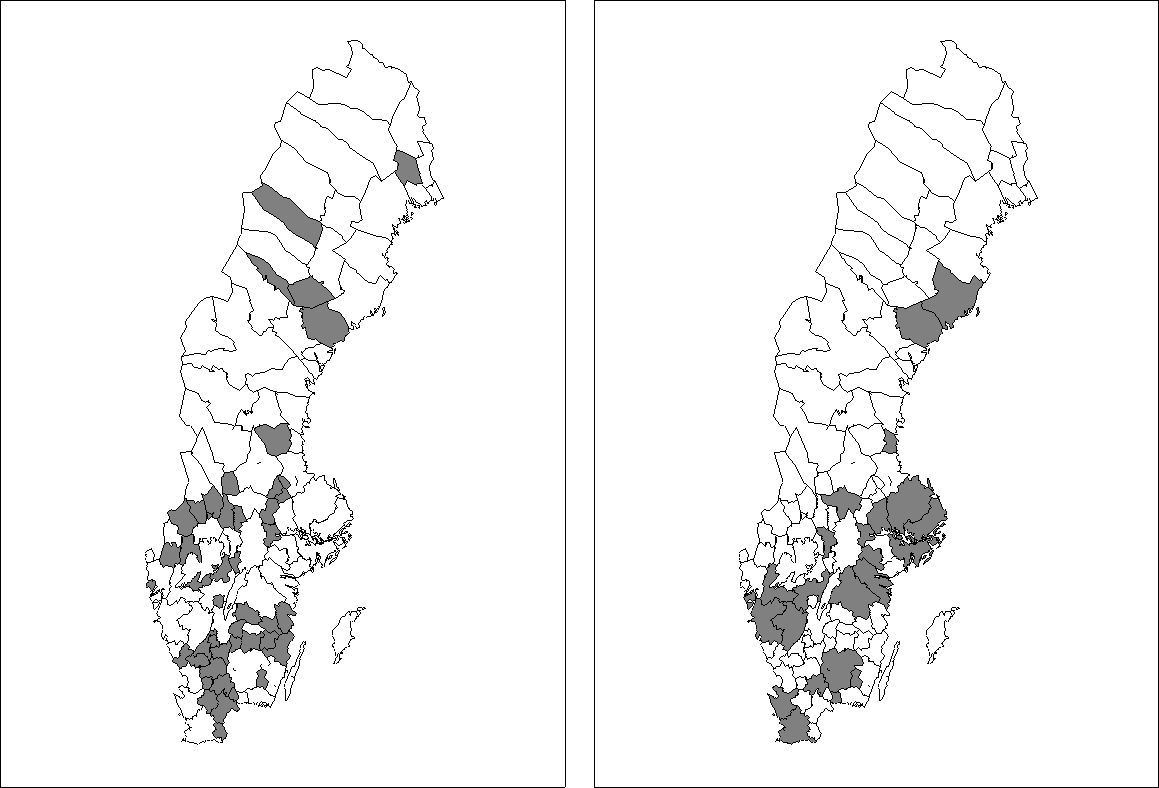
Map 1 shows the local labour markets with high shares of employment in the branches which are expected to encounter the biggest adjustment problems. A line has been drawn at an employment share of more than 25 per cent, which means more than one out of every four economically active persons being employed in one of the stagnant sectors. Leaving aside one or two scattered regions of Norrland, practically all the 46 local labour markets are to be found in Småland and the Bergslagen region. A number of typical industrial and small manufacturing BRUK communities occupy something of a special position, with employment shares of between 50 and 65 per cent. This extreme group consists of Gnosjö, Olofström, Laxå, Hylte, Gislaved and Bengtsfors.
Map 2 shows the regions presenting a large proportion of employees in sectors which are expected to benefit from integration. Here the critical
| SOU 1997:160 | 3UMMARY 11 |
limit has been put at an employment share of at least 15 per cent. Apart from a number of very scattered industrial regions, the 22 local labour markets also include all the university towns and cities. Emmaboda, Stockholm, Karlskoga, Göteborg (Gothenburg), Älmhult and Linköping are regions with more than a quarter of the work force employed in potential growth sectors.
One of the main points of inquiry in this study concerns the implications for Sweden’s regions of the applicant countries becoming EU members. The Committee has argued that membership and its effects have to be viewed in the context of a considerably more comprehensive and
The frames of this inquiry have not permitted numerical calculations of the aggregate welfare effect on Sweden’s regions of the whole of this process or of the individual part of it represented by the applicant countries’ EU membership. Such calculations, in any case, are not really possible at present, except as illustrative mathematical examples. Instead the main contribution of this study to knowledge and understanding concerning the complex course of events consists in a description of existing structures in the regions of Sweden. Basic processes and tendencies in the dynamics of economic geography can be exposed by dissolving the economic branches of the national aggregate into their more abundant regional diversity.
What, then, will be the consequences of the applicant countries joining the EU? The answer to this question hinges, of course, on the chronological perspective. In the short term, the relatively limited size of the applicant countries in relation to the EU economies must mean that membership will above all accelerate their structural transformation, following the disappearance of the protection which
| 12 3UMMARY | SOU 1997:160 |
the supportive arrangements. It is important that support should contribute towards positive structural change, as opposed to perpetuating stagnant structures in the regions.
The ongoing structural transformation has a distinctly
The smaller regions are characterised by greater
#ONSEQUENCES FOR REGIONAL POLICY IN 3WEDEN
For a long time now, regional policy in Sweden has been on the horns of a dilemma which is not directly concerned with the EU and its enlargement, namely the problem of deciding whether regional policy is primarily to reallocate support funding or whether it is to initiate change through competence development. The gap between these two working approaches has become clearly visible in recent decades. The political scene was until quite recently dominated by the
| SOU 1997:160 | 3UMMARY 13 |
Partnership is something which is highlighted through the EU’s policy for the regions. This means looking for effective processes rather than policy measures of a particular kind. The regional policy which Sweden is now developing is characterised by this view of a highly
The Committee has stated that membership and the way to it require democratic understanding and acceptance at local and regional levels in the applicant countries. They also require effective
Sweden’s regional policy in its present form will not be changed as a direct consequence of enlargement. On the other hand it is important that the Swedish process of regional development should be
In order to cope with the demands of the future, the EU has issued new directives for its regional policy. The Swedish Government has endorsed those directives and feels that there is scope for improving the efficiency of the Structural Funds. This can be done by amalgamating existing funds and by introducing uniform rules on administrative routines. Thus the drift of the Government’s thinking is that there will have to be a
| 14 3UMMARY | SOU 1997:160 |
There ought, as the Government sees it, to be no more than three objectives:
·Objective A, focusing on programmes and measures in the economically least developed countries and in sparsely populated regions.
·Objective B, focusing on regions and areas with certain
·Objective C, focusing on competence development in keeping with the measures taken under the present Objectives 3 and 4.
At the same time, the number of Community initiatives should be reduced, concentrating exclusively on transnational and
The intention is for every measure within the framework of the various EU programmes to imply an effective adjustment to the problems and possibilities of every Member State and its regions. It is important that both planning and implementation should comply with the subsidiarity principle, i.e. on an appropriate level in each system, and that partnership should be defined for all participating states. The elevation of quality which the Government is aiming for will improve the possibilities of using the large sums of money now being channelled through Structural Fund policy. The Government’s wishes are very closely in line with the proposals put forward by the Commission.
One tangible consequence of the order now proposed is that support to Sweden may come to be reduced. The Government therefore maintains that a choice will have to be made between geographically oriented measures and national programmes, in order to solve the problem of unemployment and settle the allocation of resources among regions which may find themselves receiving less support.
Objective A, in the Government’s opinion, should comprise the north of Sweden, where regional differences are most pronounced. There is every reason for the EU to continue measures for the improvement of
| SOU 1997:160 | 3UMMARY 15 |
competitive strength in what at present constitutes Objective 6, i.e. the sparsely populated regions of Sweden and Finland. The low head of population now used as a criterion, namely fewer than 8 inhabitants per sq. km., should be supplemented by other conditions qualifying for continued support. The regions at present classified as Objective 6 command great natural resources of importance to the whole of the EU.
Objective B must be aimed at coping with structural change in many different economic sectors. This objective is to focus on regions which worries of this kind or are expected to encounter them. The measures taken shall create
Objective C, lastly, is to be solely concerned on conferring superior competence and will comprise regions with special needs. Together with Objectives A and B, this objective will play an important part in achieving the Union’s employment target.
Parallel to the viewpoints tendered by the Government, there are the demands made for a reduction of Sweden’s contributions. Sweden’s contribution has been phased in since its admission to the Union but, as the rules now stand, is expected to level out at some MSEK 20,000 as from 1998. Sweden is not the only nation now demanding a reduction of its contributions. The biggest threat in this respect comes from Germany, but the Netherlands are also seeking to pay less. Both these states are among the big net payers in the Union, with Germany alone bearing an estimated 29 per cent or so of the EU budget.
Thus the Government argues that the present Objective 6 must have continuing support, at the same time as Sweden wishes to pay smaller contributions to the EU. It is impossible at present to judge the compatibility of these standpoints. With an extensive enlargement, however, mere reallocation of existing supportive measures will not, in the Committee’s opinion, be enough. If, moreover, several large net payers carry out their threats to reduce their payments to the EU, a GNP growth percentage high above the estimated 2.5 will hardly be sufficient to cover the financing of new members. In this case it will be difficult to justify Sweden’s receipt of support covering a total of 62 per cent of its territory but affecting only 12.5 per cent of its population, at the same time as Eastern and Central Europe are wrestling with enormous problems. Objective 6 alone covers 55 per cent of the country’s area but affects only
| 16 3UMMARY | SOU 1997:160 |
5 per cent of its population. It is also difficult to plead for support based on low population density, because that problem will not be solved within the foreseeable future. Evaluation of the supportive measures in relation to the support criterion is, in other words, impossible, and the present Objective 6 ought instead to be defined with reference to regions with large depopulation problems.
Sweden, with its high level of prosperity, may thus incur the “phasing out” proposed in Agenda 2000, as indeed the Government anticipates. This will mean a reduction of the current frame for structural measures in Sweden and would affect the regions belonging to Objectives 2, 5b and 6. No calculation of the effects is possible, because no one can foresee the amount by which a change in the current distribution would reduce grants from the EU. Greater
)MPLICATIONS FOR %5 POWER BALANCES
As the report observes, there are considerable difficulties involved in linking together institutional questions, policy changes and budget within the Union. A coherent grasp of these questions has up till now been lacking. Previous experience testifies that these bundles of questions have been broken up into smaller
| SOU 1997:160 | 3UMMARY 17 |
political power. It is important for the integration process that these institutions should be capable of guaranteeing national security and meeting democratic requirements. This is also essential if they are to be capable of becoming fully fledged partners within the framework of wider policy networks and of competing for EU project funding.
The EU’s policy for the regions, then, is on the verge of thoroughgoing changes. With many new members there will be no scope for generous
Policy shifts, compared with institutional changes, are relatively easy to accomplish. A qualified majority in the Council of Ministers is sufficient for the adoption of a new policy and, moreover, the directly elected Parliament is playing a far greater role now than it used to. As has already been remarked, regional and structural policies have been palpably changed in connection with enlargements. The difference this time is that stepwise solutions can prove very costly to the EU. The economic development of Central and Eastern Europe is lagging so far behind that their internal problems cannot be fully allowed for at European level; many of those problems demand national solutions. Their unfavourable negotiating position will make it hard for them to exact various forms of
| 18 3UMMARY | SOU 1997:160 |
compensation in return for membership. The EU Member States are under pressure not to let slip a historic opportunity. Disappointment and widespread social discontent in the applicant countries are liable to roll back what has so far been achieved in the form of integration with Western Europe if there is loss of confidence in democracy and the market economy as the solutions to their national problems.
In connection with enlargements, the scale of the budget becomes a subject of interstate negotiations. Experience has shown the budget to be greatly affected by the
Regional and structural policies together with agricultural policy account for the overwhelming bulk of expenditure. If phasing in is to be facilitated through a reapportionment of expenditure, both these policy fields should be subjected to an
The capacity of the applicant countries to absorb funds is probably no less than that of the former DDR. Experience of German reunification tells us that, even with generous measures of support, the transformation process takes a long time to accomplish. Limiting the amount of support to 4 per cent of the Member States’ GDP may therefore impair the possibilities of coping with the new situation which membership entails. Limited support can lead to a growth of tensions between regions in these countries, at the same time as they are under great pressure of change. A further
| SOU 1997:160 | 3UMMARY 19 |
complication will be added if the divided commencement of negotiations becomes a fact. Increased support of ECU 7bn seems too small a figure to enable those who are to wait for negotiations to catch up. In other words, the danger is that the costs of enlargement have been underestimated.
The Commission presents far too uncomplicated a picture of the future. After all, we are talking about a transitional period between 6 and 10 years ahead. The case of the DDR has taught us that, even with unusually strong financial support, the processing of adapting production and living conditions to western standards takes a long time. It is difficult, however, to envisage the present EU organisation being equal to negotiating with all applicant countries at once. Adapting the organisation to such a large influx is a tremendous experiment, but once the promises have been made it is the EU’s duty not to create greater problems than the proposed enlargement was intended to solve.
Despite aims of making no distinction between the Member States, with the enlargement now planned there is a gradation in sight. The countries
joining the EMU in 1998 will form an inner core. In practice this means that we already have a group of states WITHIN the EU which are preparing to
join the monetary union, while others have chosen to wait on events. It is this latter group of countries that the Eastern and Central European countries will in future be able to join. If the EMU materialises, new members will join up with an outer circle of EMU
The aim for an impending enlargement should be to minimise the number of
2EGIONAL IMPLICATIONS FOR THE APPLICANT COUNTRIES
The regional level, generally speaking, is weak in all the applicant countries. This is partly due to the historical legacy of the Soviet area, but there are other reasons as well. One of them is that many of these countries are small in area and, therefore, have had no need for regional thinking, They are and have been easily surveyable from the centre. This is above all true of the Baltic Sea States. The regional level has not been very thoroughly treated in the European Commission’s country review. It seems as though the Commission perceives the necessity of policies in all fields
| 20 3UMMARY | SOU 1997:160 |
during an initial phase having a properly
A large number of national authorities and private interests have been active in most of the applicant countries since the beginning of the nineties. Swedish interests are involved in all the applicant countries round the Baltic. Measures take the form of experience interchange between national authorities and educational institutions. Private business interests are also abundantly represented, and the combined presence of all these players presents an opportunity for the interchange of knowledge and a means of broadening the competence of the new array of administrators and leaders in the applicant countries. This is a highly important process which, given measures of
One promising sign is the realisation by most of the applicant countries of the need for a regional development process. Several of them, moreover, have seen to it that someone at governmental level is made responsible for the
| SOU 1997:160 | 3UMMARY 21 |
This, hopefully, can lead to the regional development process becoming a dynamic political theme as a counterpoise to the lingering old order.
The fact of several states not being considered mature enough to open negotiations in the first round can be a trifle disturbing from the viewpoint of regional development. Being considered mature enough to open negotiations at the same time as everyone else is probably a source of inspiration for further reforming endeavours. Regions bordering on Russia, for example, have a very low standard of living in European eyes, but also by comparison with regions bordering on Germany and Austria. The tension that can develop out of this regional imbalance must be made a subject of special measures in all states. The Committee doubts whether the funds which have been set aside will cover needs during the waiting period assumed by the European Commission. The ECU 45bn budgeted by the European Commission for the period between 2000 and 2006 is unlikely to cover the cost of enlargement, and it will therefore be hard to accommodate the budget within the EU’s budget ceiling of 1.27 per cent of the Member States’ total GDP.
As far as the Committee is able to understand, there are no strong objective reasons for excluding any candidate state on the grounds of its administrative apparatus or its capacity for receiving and using EU Structural Fund programmes being inferior to another country’s. There are differences, but it is impossible today to place the countries in ranking order in the light of available facts. This is particularly true of the Baltic Sea States, where the European Commission’s negative attitude to Lithuania’s regional policy preparedness does not tally with the view taken by the Lithuanian Government. None of the applicant countries in question wishes to be left out, and an apparently unjustified and impenetrable ranking system can generate tensions within and between the applicant countries. The Union has already committed itself to an eastward enlargement. And there cannot be any decisive argument in allowing certain states to commence negotiations while others have to wait. All should be enabled to start simultaneously but to conclude their negotiations at different points in time, in which case there would at least be no room in the debate for the argument concerning unfair treatment. A common opening of negotiations would also give the applicant countries a breathing space and afford less scope for the oppositional forces wishing to prevent an enlargement of the Union from having special consequences for their own country. Perhaps the limitation lies more in the structure of the EU itself than in that of the applicant countries?
| 22 3UMMARY | SOU 1997:160 |
0OLICY RECOMMENDATIONS
Given the potential which is now being established in the neighbouring region, Sweden and the entire Baltic and Bothnian Sea region will achieve greater accessibility and a more central location in relation to the growing European markets. The best way of developing trade with Central and Eastern Europe is by opening the way to imports from these countries and, since trade is above all impeded by
links include elements giving them the character of
Sweden can also play a decisive part in the development of, above all, the Baltic Sea States and Poland. Sustainable development of the applicant
countries will require measures over and above
4HE REGIONAL PROCESS IN THE APPLICANT COUNTRIES MUST BE SUPPORTED BY THEIR NEIGHBOURS #ROSS BORDER REGIONAL CO OPERATION IS IMPORTANT IN THIS RESPECT In order to keep track of the course of events in Central and
Eastern Europe, knowledge production relating to the regional development process must be linked more closely with research. One way of achieving this would be by setting up an institute responsible for regional development in the applicant countries - an institute which, it is suggested, can be localised in one of the new Member States.
Nor is it absolutely certain that the markets themselves are capable of accomplishing the structural renewal which the regions of Sweden have been greatly in need of for a long time now. A renewal of the regional enterprise structure is needed, regardless of EU enlargement. If enlargement results in declining industries encountering a growth of demand, the desirable pressure for change may be reduced. It is therefore important that the
labour market, enterprise and regional policies should be abolished.
%UROPEAN AND 3WEDISH POLICIES FOR ENTERPRISE AND THE REGIONS NEED TO BE SLANTED CLEARLY IN FAVOUR OF STRUCTURAL CHANGE
| SOU 1997:160 | 3UMMARY 23 |
On the other hand it is policy measures themselves, in relation to enterprise structure and regional development during the 80s and 90s, which demonstrate the uncertainty of the political process being able to cope with this kind of change better than the markets.
can indicate more clearly the sectors in which the growth of earnings is going to be further decelerated.
Urban growth is a dominant tendency of
markets. If the regional population base goes on stagnating, this is bound to mean a growing concentration of population. 2EGIONS MUST THEREFORE DEVELOP THEIR COLLECTIVE RESOURCES IN THE FORM OF FACTORS OF PRODUCTION TECHNOLOGY ENVIRONMENT AND NETWORKS IN ORDER TO CREATE ATTRACTIVE JOB MARKETS
In order for the regions themselves to be capable of acting and in order for national and European
Swedish regions and of their available resources today constitutes a limiting factor of regional policy. 4HE REGIONAL PROBLEM PICTURE EXISTING BELOW THE NATIONAL SURFACE IS INSUFFICIENTLY CLEAR AT PRESENT What is more,
the possibilities of responding more distinctly and rapidly to the adjustment requirements and the cyclical sensitivity entailed by an
integrated European market call for a high level of efficiency in Sweden’s regional policy. 4HROUGH SECTORIALLY CO ORDINATED AND CONCENTRATED MEASURES A NEW REGIONAL POLICY CAN MAKE 3WEDEN MORE COMPETITIVE It is
also important for this course of events to be more closely linked with research in the field.
Comparisons with German reunification show that the cost of an eastward enlargement can be considerably greater than the European Commission has bargained for. This makes heavy demands on a thoroughgoing reform
| 24 3UMMARY | SOU 1997:160 |
of the common regional and demands greater concentration
lead to a revised definition of
SUGGEST THAT 3WEDEN MUST BE ALLOCATIONS FROM THE %5.
structural policy. Resource conservation
and clarity, which in turn must ultimately Objectives. !CCORDINGLY THERE IS MUCH TO PREPARED FOR A REDUCTION OF ITS FUNDING
Finally it is worth mentioning that in its material the Committee has found no clear objective reasons for splitting the commencement of negotiations.